Rs 935 crore misappropriated in MGNREGA schemes over last 4 years: Congress
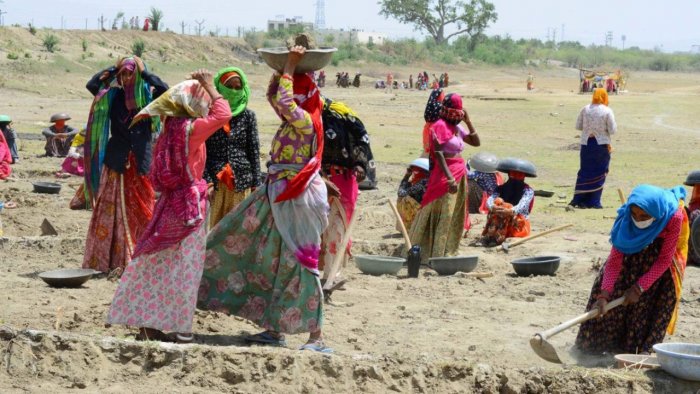
New Delhi, Aug 21: The Congress on Saturday alleged that Rs 935 crore had been misappropriated in MGNREGA schemes over the last four years and said the government must be held accountable for failing to check corruption.
The party also demanded that the government restore the four per cent quota for differently-abled persons in police forces.
Congress spokesperson Pawan Khera said a media report, which assessed publicly available information of the Rural Development Ministry, revealed that Rs 935 crore was misappropriated in schemes under the Mahatma Gandhi Employment Guarantee Act (MGNREGA) over the last four years.
These numbers are the outcome of audits done by social audit units under the Rural Development Department of the Ministry of Rural Development, he told a press conference.
Khera said the significant outcome of the social audit unit was that the primary type of misappropriation in most cases was "financial misappropriation" which includes and is not limited to bribery, payments to non-existent persons and to vendors at inflated procurement prices.
He said of the "whopping" Rs 935 crore misappropriated, only Rs 12.5 crore, which is 1.34 of the misappropriated amount, stands recovered.
The very fact that misappropriations has been happening is a testament to the lack of accountability and due diligence by the Narendra Modi government, the Congress leader alleged.
"The Congress party demands that the government of India is held accountable for the misappropriations in the MNREGA scheme and ensures that social audit is undertaken as per the provisions of the MGNREGA," Khera said.
"We also demand that the government of India recovers the misappropriated amount at the earliest and ensures that the recovered money is used to compensate the poor and marginalised who have suffered a lot due to COVID-19 mismanagement," he said.
The Congress leader claimed that Tamil Nadu had the highest misappropriation of Rs 245 crore between 2017 18 and 2020-21, and in Bihar, Rs 12.34 crore was misappropriated.
Jharkhand, then ruled by the BJP, saw misappropriations to the tune of Rs 51.29 crore, while Rajasthan did not see any misappropriation of MGNREGA funds, Khera claimed.
He alleged that this reflects on the real intentions of the BJP, whose government allowed misappropriation of Rs 935 crores of tax-payers money meant for the poor and marginalised.
Khera also demanded that the Centre withdraw the notification that scrapped the four per cent quota for differently-abled persons in police forces and undo this inhuman wrong.
With rising crimes against women under this government it is a matter of shame that more than 90 per cent of the reserved posts for women police officers are vacant, he claimed.
"We demand filling them on a war footing," Khera said.
Let the Truth be known. If you read VB and like VB, please be a VB Supporter and Help us deliver the Truth to one and all.
Kharge speaks with CPI's D Raja, seeks support for TVK
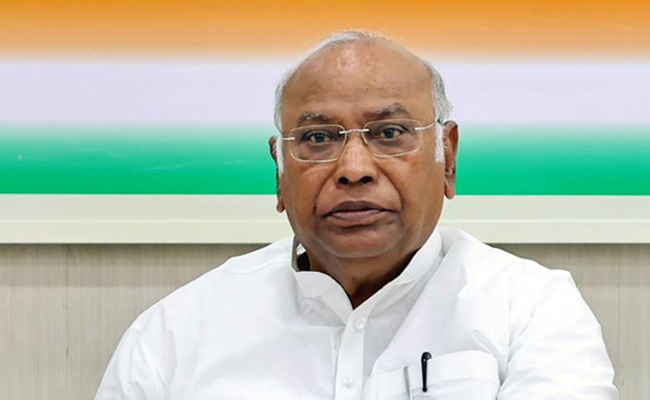
New Delhi (PTI): Congress president Mallikarjun Kharge has spoken with CPI general secretary D Raja and urged his party to support the TVK for the formation of a secular government in Tamil Nadu, sources said on Friday.
Sources said Kharge called Raja on Thursday to emphasise that the CPI should take an early decision so that the BJP does not get a chance to try and grab power through the backdoor.
Raja is understood to have said that CPI will consult its local allies, including the DMK, and decide on it soon.
The Congress, a long-time ally of the DMK, on Wednesday announced its support to actor-politician Vijay's TVK to form the government in Tamil Nadu and severed ties with the Dravidian major.
The DMK dubbed the act of Congress to snap ties with it and join forces with TVK as "backstabbing."
The TVK won 108 seats in the 234-member Assembly in the April 23 polls. Though the Congress, which has five MLAs, has extended support to the TVK, the actor-politician-led party is still short of as many seats to touch 118, the majority mark.
The CPI executive committee, which met here on Friday over support to the TVK, is involved in weighing the pros and cons, the party said.
The Communist Party of India is keen on safeguarding its ideology and ensuring that a common minimum programme is followed in case the party decides to back the TVK, a source in the party said.
The CPI won two seats in the April 23 Assembly election in alliance with the DMK.
Earlier, CPI general secretary D Raja told PTI Videos that the party was keen on keeping the right wing away from the state.
"We will come to some conclusion and we want a stable government that will work in the interest of the state, keep away communal right-wing forces and uphold secular democratic values," Raja said, adding, the party's position would be clear by the evening