RSS can't be banned at someone's whim: Hosabale

Jabalpur (MP) (PTI): Rashtriya Swayamsevak Sangh (RSS) general secretary Dattatreya Hosabale has said the organisation cannot be banned just because somebody wishes so, and those making such a demand should learn from past experiences.
Speaking to reporters on Saturday after the conclusion of a three-day all-India executive meeting of the RSS in Jabalpur, Hosabale was replying to a question about Congress president Mallikarjun Kharge's statement that the Sangh should be banned.
"Such attempts were made three times in the past. What did society say then? What did the court say? Despite all this, the Sangh's work kept growing. There must be valid reasons to impose a ban," he said.
"It cannot happen just because someone wishes so. If a leader says that an organisation working for the unity, security and culture of India should be banned, he must also state the reason," Hosabale added.
Society has accepted the RSS, and the "government system" too has ruled that such bans were wrong, the senior Sangh leader said, adding, "Those who now demand a ban should learn from past experiences."
To a question on banning the RSS at a press conference in Delhi on Friday, Congress president Kharge said, "It is my personal opinion, and I will say it openly, it should be done," and alleged that most of the law and order problems are arising because of the BJP and RSS.
Meanwhile, to a question on whether the Bihar or West Bengal elections were discussed at the RSS meeting, Hosabale said there was no discussion on the upcoming Bihar polls, but the Sangh's position was clear that people should vote in large numbers, and on issues concerning the nation and society, not based on caste or money.
"We work for public awareness on this," he said.
Polling in Bihar will be held on November 6 and 11, while votes will be counted on November 14.
As to West Bengal, Hosabale said the situation there was not discussed in this meeting, but there had been a discussion on it earlier.
"The situation there is serious. In the previous meeting, a resolution on Bengal was passed. The Sangh's work is expanding in the state, but hatred and animosity spread after the last elections due to the political leadership and the chief minister," he said.
Bengal is a border state and faces the pressure of people coming from Bangladesh, the RSS leader said, adding, "If the political leadership fails to end this menace, it would be unjust to keep Bengal, once a guiding state for India, in an atmosphere of instability and violence."
RSS volunteers were working to strengthen social unity in Bengal, he added.
On the Special Intensive Revision (SIR) of electoral rolls, Hosabale said it should be updated from time to time. "The list should be refined. What is the problem with that? If anyone has objections to the process, they can present them before the commission," he added.
Let the Truth be known. If you read VB and like VB, please be a VB Supporter and Help us deliver the Truth to one and all.
Passenger, railway staff in Maddur stabbed by two men who fought for train seat
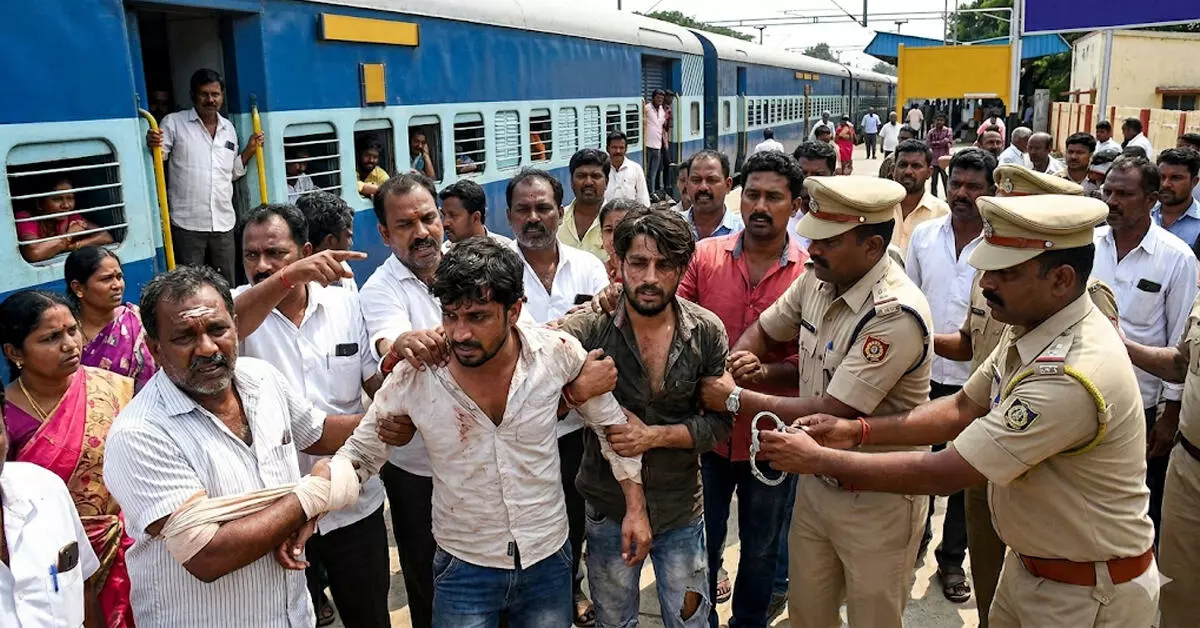
Mandya: An argument over a seat in a train intensified into a fight, resulting in a passenger and a Railways staff member being stabbed and sustaining grievous injuries near the Maddur Railway Station in the district on Wednesday.
The other passengers as well as the locals are said to have caught and assaulted the three accused as they were attempting to escape. The trio, Subaan Qureishi, Shoiab Qureishi and Wasim, has been handed over to the police.
The assault victims, identified as Shivakumar of Tumakuru and Railways staff Kumar were taken to the Maddur Taluk Hospital for first aid and later shifted to the Mandya Institute of Medical Sciences (MIMS) District Hospital.
The argument is said to have erupted over a seat in the Mysuru-Bengaluru train. When a third passenger, Shivakumar, tried to intervene, however, the men fighting for the seat allegedly stabbed him with a knife. Shivakumar is said to have pulled the chain of the train, which was arriving at the Maddur station and was at Channegowdanadoddi on the outskirts of the town, in a desperate attempt to save his life.
The suspects, who tried to jump off the train which was slowing down, stabbed Kumar, the railway gate-keeper near Channegowdanadoddi, as he attempted to stop the duo from escaping.
The other passengers in the train and the locals at the station caught up with the accused, who were escaping and assaulted them physically before handing them over to the police.
A case has been registered by the Railway Police and the officers are investigating the incident.