Rupee falls 23 paise to 89.94 against US dollar in early trade

Mumbai (PTI): The rupee depreciated 23 paise to 89.94 against the US dollar in early trade on Friday, weighed down by foreign fund outflows and recovery in crude oil prices.
Forex traders said a negative trend in domestic equities, dollar demand from importers, and trade deal uncertainty further dented investor sentiment.
At the interbank foreign exchange, the local unit opened at 89.84 against the dollar but lost ground to trade at 89.94, down 23 paise from its previous close.
On Wednesday, the rupee pared initial gains and settled for the day lower by eight paise at 89.71 against the US dollar.
Forex and equity markets were closed on Thursday for Christmas.
After strengthening to the 89.00 level last week, the rupee has again started to weaken in holiday-thin trade, with FPIs continuing to sell equity and buy dollars after a brief pause, said Anil Kumar Bhansali, Head of Treasury and Executive Director at Finrex Treasury Advisors LLP.
Meanwhile, the dollar index, which gauges the greenback's strength against a basket of six currencies, was trading 0.08 per cent lower at 97.89.
Brent crude, the global oil benchmark, was trading 0.16 per cent higher at USD 62.34 per barrel in futures trade.
On the domestic equity market front, the 30-share benchmark index Sensex declined 183.42 points to 85,225.28 in early trade, while the Nifty dipped 46.45 points to 26,095.65.
Foreign institutional investors offloaded equities worth Rs 1,721.26 crore on Wednesday, according to exchange data.
Let the Truth be known. If you read VB and like VB, please be a VB Supporter and Help us deliver the Truth to one and all.
Karnataka gram panchayats achieve record 89 pc tax collection in 2025-26: Minister
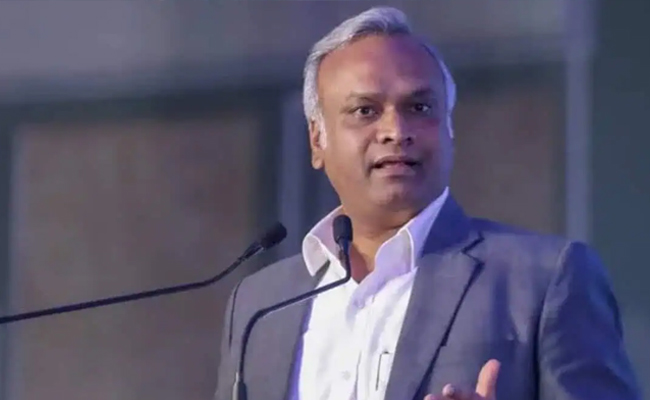
Bengaluru (PTI): Karnataka has achieved a significant milestone in grassroots governance, with 5,943 gram panchayats across the state recording higher tax collection and revenue realisation in 2025-26 compared to the previous financial year, Minister Priyank Kharge said on Thursday.
The Department of Rural Development and Panchayat Raj reported total tax collections of Rs 1,382.57 crore in 2025-26, marking an increase of Rs 110.04 crore over Rs 1,272.54 crore collected in 2024-25, the minister’s office said in a statement.
This represents a record 89 per cent realisation of the current demand, the highest in recent years, it added.
The Minister for Rural Development & Panchayat Raj said, “Our focus over the past few years has been on improving systems, ensuring accountability, and empowering local bodies to enhance their own revenue capabilities.”
“It is encouraging to see that every rupee collected is being reinvested into village infrastructure, public services, and local development. This is laying a strong foundation for inclusive and sustainable rural growth,” he added.
Karnataka had previously secured the top position at the national level in tax collection and revenue mobilisation, and the continued upward trend highlights the impact of efficient administration, strict enforcement of regulations, and strengthened tax collection mechanisms.
In 2024-25, gram panchayats had, for the first time in the department’s history, collected Rs 1,272.54 crore, achieving 80 per cent of the current demand.
Building on this momentum, the state further improved performance in 2025–26, reaching a record 89 per cent collection efficiency, the statement said.
This achievement has been driven by extensive awareness campaigns, targeted tax collection drives, and the sustained efforts of officials at all levels—from gram panchayat bill collectors to senior administrators, the minister said, congratulating all staff and officers for their contribution.
Highlighting district-level performance, Priyank noted that Raichur district recorded an exceptional 129 per cent tax collection, while 11 districts across the state achieved over 100 per cent collection, demonstrating strong local-level execution and compliance.
Over the past three years, Karnataka has witnessed a steady upward trend in tax collection. The increased revenue is being channelled into public works, improved civic services, and local development initiatives, contributing to the overall progress of rural communities, he added.