Rupee plunges 47 paise to close at 88.69 against US dollar

Mumbai (PTI): The rupee depreciated 47 paise to close at 88.69 against the American currency on Thursday on a strong US dollar, weak domestic markets, and a hawkish US Fed.
Forex traders said the US Federal Reserve slashed interest rates by 25 bps in its Federal Open Market Committee (FOMC) meeting. However, Fed Chair Jerome Powell's commentary was hawkish, trimming rate-cut expectations for December.
Moreover, month-end dollar demand from Oil Marketing Companies (OMCs) and foreign fund outflows may also weigh on the rupee.
At the interbank foreign exchange market, the rupee opened at 88.37, and later fell to an intra-day low of 88.74. The local unit finally settled at 88.69 against the greenback, registering a loss of 47 paise from its previous close.
On Wednesday, the rupee appreciated seven paise to close at 88.22 against the US dollar.
"We expect the rupee to trade with a slight negative bias on a strong US Dollar, weak domestic markets and a hawkish Fed. Month-end dollar demand from OMCs may also weigh on the rupee," said Anuj Choudhary, Research Analyst, Currency and Commodities, Mirae Asset ShareKhan.
The US Fed cut rates by 25 bps, as expected. However, Fed Chair Jerome Powell said the December cut was not a foregone conclusion, given inflation remains above target and labour-market uncertainties persist.
Following Powell's remarks, market expectations of a December rate cut fell sharply, prompting a rise in US Treasury yields and a stronger dollar, traders said.
Choudhary further noted that the weakness in crude oil prices may support the rupee at lower levels. "USDINR spot price is expected to trade in a range of 88.45 to 89," he said.
Meanwhile, the dollar index, which gauges the greenback's strength against a basket of six currencies, fell 0.09 per cent to 99.12.
Brent crude, the global oil benchmark, fell 0.65 per cent to USD 64.50 per barrel in futures trading.
On the domestic equity markets front, the Sensex tanked 592.67 points to settle at 84,404.46, while the Nifty dropped 176.05 points to 25,877.85.
Foreign institutional investors sold equities worth Rs 3,077.59 crore on Thursday, according to exchange data.
Let the Truth be known. If you read VB and like VB, please be a VB Supporter and Help us deliver the Truth to one and all.
Annpurna Devi expresses anguish over girl's rape in TN, urges NCW to act
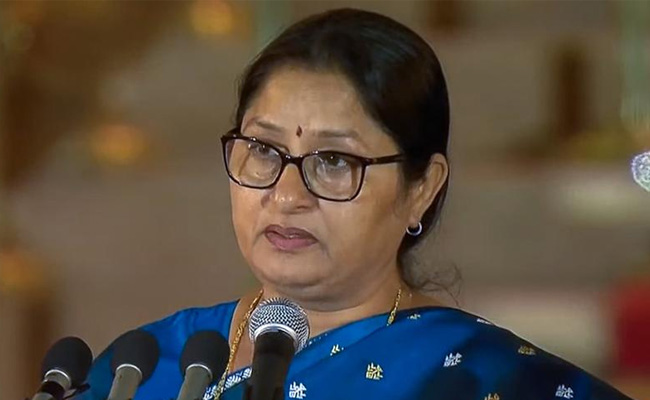
New Delhi (PTI): Union Minister for Women and Child Development Annpurna Devi on Tuesday expressed her anguish over the alleged gang rape of a girl in Tamil Nadu and urged the National Commission for Women to take immediate cognisance of the matter.
In a post on X, Devi said, "Deeply anguished by this horrific incident. I urge the NCW to take immediate cognisance and act swiftly in coordination with the concerned authorities to ensure the strictest action against all culprits."
Devi said, "Justice must be swift and unsparing — the accused must be brought to book without delay," adding, "the safety, dignity, and justice of every daughter of India remain our highest priority."
"We stand firmly with the survivor and her family in this difficult hour," she said.
Reacting to a post by former Tamil Nadu BJP president K Annamalai, who flagged concerns over the law and order situation in the state, Devi said such incidents "expose grave concerns" under the Dravida Munnetra Kazhagam government.
Annamalai, in his post, alleged that a 15-year-old girl from Kanchipuram, who had come to participate in a temple festival near Seyyaru in Tiruvannamalai district, was gangraped.
He said the incident was "deeply shocking and enraging" to him and alleged that such crimes point to a "complete failure" of law and order in Tamil Nadu.
Annamalai demanded immediate arrest of all those involved and the "harshest punishments" for the accused.
He also called for full protection and mental health counselling for the survivor and her family.