Sardar Patel wanted to unite entire Kashmir with India, Nehru did not allow it: Modi
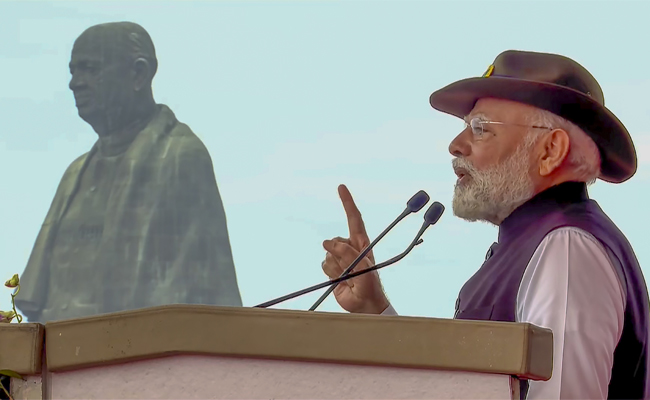
Ekta Nagar (PTI): Prime Minister Narendra Modi on Friday said Sardar Patel wanted to unite the entire Kashmir, just as he did with other princely states, into India, but then PM Nehru did not allow it to happen.
“Sardar Patel believed that one should not waste time writing history but we should work hard to create history,” Modi said, addressing the gathering after the Rashtriya Ekta Diwas parade near the Statue of Unity in Gujarat’s Ekta Nagar.
“Sardar Patel wanted to unite the entire Kashmir, just as he did with other princely states. But Nehru ji stopped his wish from being fulfilled. Kashmir was divided, given a separate Constitution and a separate flag - and the nation suffered for decades because of Congress’ mistake,” Modi said.
The policies that Sardar Patel formulated, the decisions he took, created new history, the PM said.
“After Independence, the impossible task of uniting more than 550 princely states was made possible by Sardar Patel. The idea of One India, Excellent India, was paramount for him,” Modi said.
“Sardar Patel once remarked that his greatest joy came from serving the nation. I want to convey to the people of our country that there is no greater source of happiness than dedicating oneself to the service of the nation,” he said.
“The country has decided to have a decisive fight against infiltrators. On Rashtriya Ekta Diwas, we should pledge to remove each and every infiltrator from the country,” Modi said.
“Today, the unity and internal security of our nation face serious threat from infiltrators. For decades, infiltrators have been entering our country and disrupting its demographic balance,” Modi said.
Highlighting the work against Naxal terror, Modi said his government will not stop till Naxalism and Maoism is rooted out of the country.
Slamming the Congress, Modi said that party inherited “slave mentality” from the British who ruled India. The country is removing every trace of colonial mindset, he added.
“Every thought or action that weakens the unity of our nation must be shunned by every citizen. This is the need of the hour for our country,” the prime minister said.
Before his speech, Modi reviewed the National Unity Day parade in which contingents from police and paramilitary forces took part.
Women officers commanded all the contingents, including paramilitary forces like BSF, CISF, ITBP, CRPF and SSB, and police contingents from Jammu & Kashmir, Punjab, Assam, Tripura, Odisha, Chhattisgarh, Kerala, Andhra Pradesh, Maharashtra and Madhya Pradesh.
A contingent of the National Cadet Corps (NCC) also participated in the parade.
The parade featured 16 BSF personnel who were awarded gallantry medals for their participation in Operation Sindoor.
The parade showcased a marching contingent of Indian breed dogs from the BSF, including the celebrated Mudhol hound Riya which recently won the All-India Police Dog Competition.
Rampur hounds and Mudhol hounds demonstrated their skills at the event, which included a spectacular air show by the Surya Kiran team of the Indian Air Force.
The Surya Kiran Aerobatic Team was formed in 1996 and is among the very few nine-aircraft aerobatics teams in the world, and the only one of its kind in Asia.
The parade also featured a motorcycle daredevil show by Assam Police, and a camel mounted contingent and band by the BSF.
Ten tableaux from various states and union territories, including the NSG and NDRF, reinforce the theme of unity in diversity.
Let the Truth be known. If you read VB and like VB, please be a VB Supporter and Help us deliver the Truth to one and all.
Annpurna Devi expresses anguish over girl's rape in TN, urges NCW to act
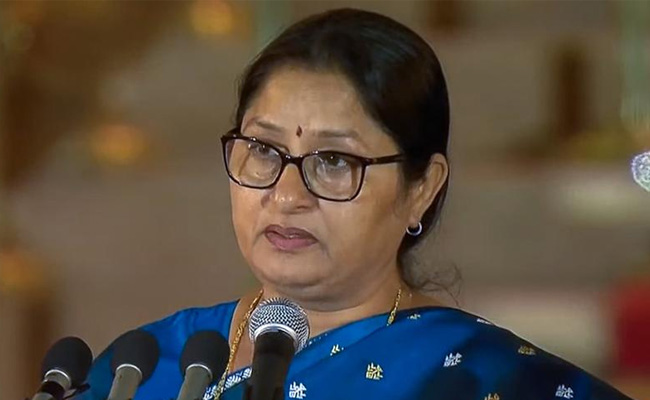
New Delhi (PTI): Union Minister for Women and Child Development Annpurna Devi on Tuesday expressed her anguish over the alleged gang rape of a girl in Tamil Nadu and urged the National Commission for Women to take immediate cognisance of the matter.
In a post on X, Devi said, "Deeply anguished by this horrific incident. I urge the NCW to take immediate cognisance and act swiftly in coordination with the concerned authorities to ensure the strictest action against all culprits."
Devi said, "Justice must be swift and unsparing — the accused must be brought to book without delay," adding, "the safety, dignity, and justice of every daughter of India remain our highest priority."
"We stand firmly with the survivor and her family in this difficult hour," she said.
Reacting to a post by former Tamil Nadu BJP president K Annamalai, who flagged concerns over the law and order situation in the state, Devi said such incidents "expose grave concerns" under the Dravida Munnetra Kazhagam government.
Annamalai, in his post, alleged that a 15-year-old girl from Kanchipuram, who had come to participate in a temple festival near Seyyaru in Tiruvannamalai district, was gangraped.
He said the incident was "deeply shocking and enraging" to him and alleged that such crimes point to a "complete failure" of law and order in Tamil Nadu.
Annamalai demanded immediate arrest of all those involved and the "harshest punishments" for the accused.
He also called for full protection and mental health counselling for the survivor and her family.