SC acquits death row convict, says he was made 'scapegoat' by police
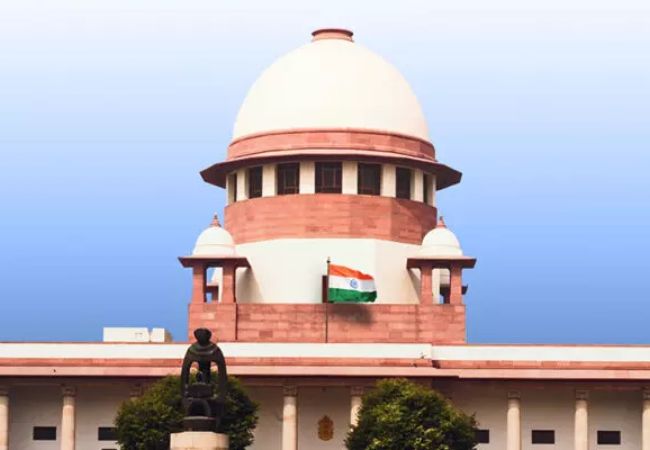
New Delhi (PTI): The Supreme Court on Wednesday acquitted a man on death row for sexually assaulting and murdering a seven-year-old girl in 2017, saying the trial in the case was conducted in a "lopsided manner" and he was made a "scapegoat" by police.
The apex court said the constitutional right afforded to an accused to defend himself is not illusory or imaginary and it is the duty of the court and the State to ensure that the accused is not prejudiced or deprived of a fair opportunity to defend himself in a case where he may be awarded capital punishment.
A bench of Justices Vikram Nath, Sanjay Karol and Sandeep Mehta delivered the verdict on an appeal filed by the accused, Dashwanth, who challenged a July 2018 judgement of the Madras High Court, which had upheld the death sentence awarded to him by a trial court.
The bench said the prosecution failed miserably to prove the vital circumstances, including last seen together theory and FSL reports establishing the DNA profiling comparison, on which his conviction was based.
It said the appellant was not represented by a defence lawyer and the services of a free legal aid counsel were provided to him on December 13, 2017, after the charges had been framed.
"A bare perusal of the above sequence of events and proceedings makes it clear that right from the stage of framing of the charges, the trial was conducted in a lopsided manner and without due deference to the principles of fair trial," the bench said in its 71-page verdict.
It said the documents relied upon by the prosecution were not provided to the appellant and without complying with the mandate of Section 207 of the CrPC, charges were framed on October 24, 2017, against the accused, who was unrepresented on that date.
"For the trial to be fair and reasonable, an effective opportunity to defend must be provided to the accused and representation by a counsel of choice is an important component of this guarantee," it said.
The top court said in a case where an accused is facing charges for offences which carry capital punishment, this constitutional mandate becomes even more
sacrosanct.
It said the appellant was convicted on February 19, 2018, and on the very same day, the trial judge proceeded to undertake the exercise of hearing him on the aspect of sentence and awarded the death penalty.
"Evidently, the manner in which the trial court proceeded to pass the sentencing order indicates hot haste, leaving much to be desired, and (this) would vitiate the death sentence awarded to the appellant," it noted.
It said the failure to collect the data from the digital video recorder of the CCTV camera, which allegedly captured the suspicious movements of the appellant on the fateful day, created grave doubt on the bonafides of the investigation agency.
"It seems that the investigation officers were intentionally trying to screen the truth from being brought on record and washed their hands off the matter by making the appellant a scapegoat," the bench said.
It said reliance placed by the prosecution on the so-called CCTV footage was nothing but a figment of imagination and cannot be accepted.
The bench said the prosecution's claim that the victim's body was recovered in furtherance of the disclosure statement made by the appellant was belied by cogent material available on record.
The bench said while the case pertained to the commission of a heinous offence involving a minor girl, it cannot ignore or bypass the fundamental principle of criminal jurisprudence that prosecution is duty-bound to prove the guilt of the accused beyond reasonable doubt.
It said the onus is heavier in a case based purely on circumstantial evidence.
"However, regrettably, the prosecution has miserably failed to do so in the instant case, leaving the court with no choice but to acquit the appellant, despite the heinous nature of the crime," it said.
The bench further said, "While it is acknowledged that the acquittal of an individual involved in a heinous crime can lead to societal distress and cause grave anguish to the victim's family, the legal framework does not permit the courts to punish an accused person based merely on moral convictions or conjectures".
It said each case must be adjudicated by courts rigorously on its individual merits and in strict conformity with the law, without yielding to public sentiment and external pressures.
While allowing the appeal, the bench set aside the judgements delivered by the high court as well as the trial court.
It set aside the appellant's conviction and sentence, and acquitted him of the charges.
The bench directed that the appellant be released from custody forthwith, if not wanted in any other case.
The trial court had convicted the man for murder and under the provisions of the Protection of Children from Sexual Offences Act. According to the prosecution, the victim went missing and her charred body was recovered on February 8, 2017, in furtherance of the disclosure statement made by the appellant.
He was arrested on February 8, 2017.
During the trial, he had refuted the allegations and said he was falsely implicated.
Let the Truth be known. If you read VB and like VB, please be a VB Supporter and Help us deliver the Truth to one and all.
KKR defeat LSG via Super Over

Lucknow (PTI): Kolkata Knight Riders edged Lucknow Super Giants via Super Overs in a battle between two bottom-placed teams in the IPL, here on Sunday.
Chasing a modest 156, LSG suffered a batting collapse and managed to tie the contest and take it to Super Over with No. 9 Mohammed Shami striking a last-ball six against a wayward Kartik Tyagi, who leaked 16 runs in the final over.
But Sunil Narine bowled a stunning Super Over conceding just one run and taking two wickets to give KKR an easy target.
Rinku Singh then finished the chase with a boundary off first ball from Prince Yadav.
Earlier the KKR were in deep trouble with 93/7 in 15 overs but Rinku smashed a sensational 83 not out from 51 balls including four sixes in a row in the final over to lift them to 155/7.
Cameron Green (34) was the only other batter to reach double-digit scores as KKR suffered a familiar batting meltdown with Mohsin taking his maiden fifer.
In reply, LSG continued their dismal show with the bat to succumb to their fifth loss in a row.
Brief Scores:
Kolkata Knight Riders 155/7; 20 overs (Rinku Singh 83 not out, Cameron Green 34; Mohsin Khan 5/23). Lucknow Super Giants 155/8; 20 overs (Rishabh Pant 42). KKR won via Super Over.