SC agrees to examine plea against stray dog culling in Karnataka
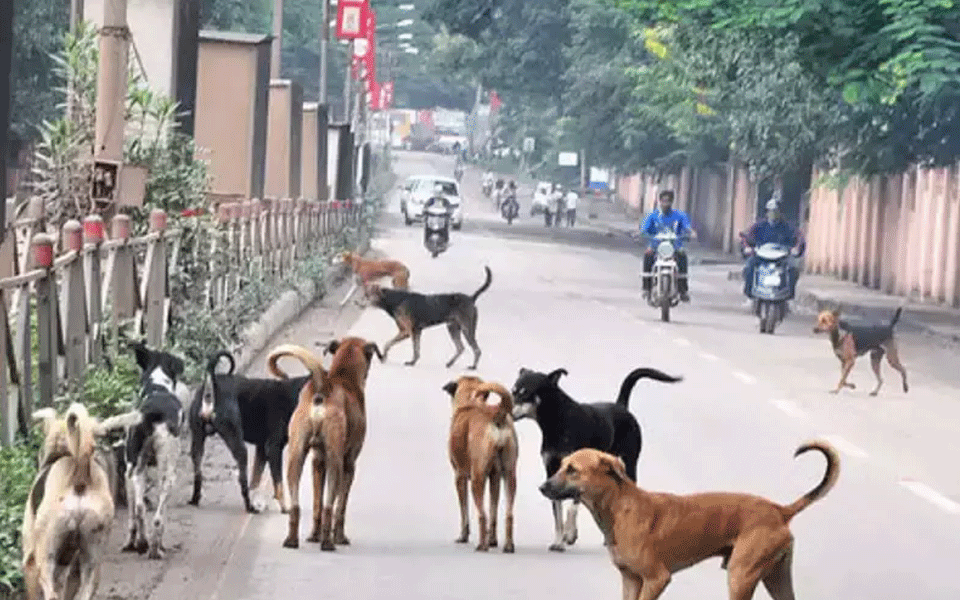
New Delhi, Nov 17: The Supreme Court has agreed to examine a plea seeking contempt action against the chief officer of a municipal council in Karnataka and a private contractor on allegations of mass culling of stray dogs.
A bench of Justices N V Ramana and M M Shantanagoudar issued notice to Wilson VT, Chief officer of Municipal Council of Sakleshpura town, and contractor V George Robert and sought their response in four weeks.
Advocate Siddharth Garg, appearing for petitioner animal rights activist Neveena Kamath, said the contempt proceedings should be initiated against the two respondents for willfully disobeying the specific directions of the apex court.
He said that on November 18, 2015, the apex court had directed that all local authorities and panchayats should strictly follow the Prevention of Cruelty to Animals (PCA) Act, 1960 and the Animal Birth Control (ABC) Rules, 2001 and that no "subterfuge or innovative methods" to circumvent the order of the court will be tolerated.
Garg said the PCA Act 1960 and the ABC Rules, 2001 prohibit any wanton catching and relocation of stray dogs and only allow catching for the purpose of sterilisation and relocation back to the same place, where the stray dogs were picked up.
According to the petition, Wilson had given contract to George to catch and then relocate stray dogs within his municipality.
George was paid Rs 91,537 for catching and relocating 350 stray dogs.
"It must be made clear that the Prevention of Cruelty to Animals Act, 1960 and the ABC Rules, 2001 only allow catching then sterilising, vaccinating and then relocation at the very same place. They do not allow any such catching and dislocating," the plea said.
It said that the respondents have "deliberately and willfully" violated the orders of this court and contempt proceedings should be initiated against them.
"If such violations are not dealt, swiftly and sternly, by this Court then it will send a very wrong message to society that the orders of the apex court can be trifled with and there are no consequences for even the most open and egregious defiance. The actions of the Respondents are making a mockery of the majesty of this Court and invite the wrath of this Court to its fullest extent," the plea said.
Let the Truth be known. If you read VB and like VB, please be a VB Supporter and Help us deliver the Truth to one and all.
Maharashtra sets up state vaccination task force to strengthen immunisation programme

Mumbai (PTI): The Maharashtra government has set up a State Vaccination Task Force to strengthen the regular immunisation programme and review the progress of related campaigns, a health department official said on Monday.
The State Vaccination Task Force will comprise at least 29 members and will be headed by the administrative head of the health department, he informed.
The government has also constituted separate district-level and municipal vaccination task forces to improve implementation and address challenges at the grassroots level, he said.
Municipal task forces, chaired by respective civic commissioners, have been constituted in view of the vast urban population in Maharashtra and the role of civic bodies in implementing different health programmes.
The district-level task forces will function under the chairmanship of collectors.
"Complete immunisation of children at the appropriate age is an extremely simple, cost-effective and highly effective measure to reduce child mortality and the prevalence of diseases among kids. Immunisation is a powerful tool for reducing illness in children," maintained the official.
To ensure full vaccination of all children, the state government implements various campaigns from time to time as per the central government guidelines, he pointed out.
"Active participation and cooperation of other relevant government departments are essential (in making these campaigns successful)," according to the official.
The state-level body will review the regular immunisation programme, associated campaigns and vaccine-preventable diseases in detail. It will also conduct focused assessments of high-risk districts and municipal corporations, including vacancies at district, municipal and sub-district levels, availability of cold chain equipment, resource gaps and training requirements, he noted.
The state task force will review allocation and utilisation of funds for immunisation and ensure timely action by officers concerned based on reports from district and municipal task forces and state-level monitoring mechanisms, the official said.
It will also ensure active coordination and participation of other government departments in immunisation drives, while district and municipal task forces will carry out similar functions at their respective levels, the official added.