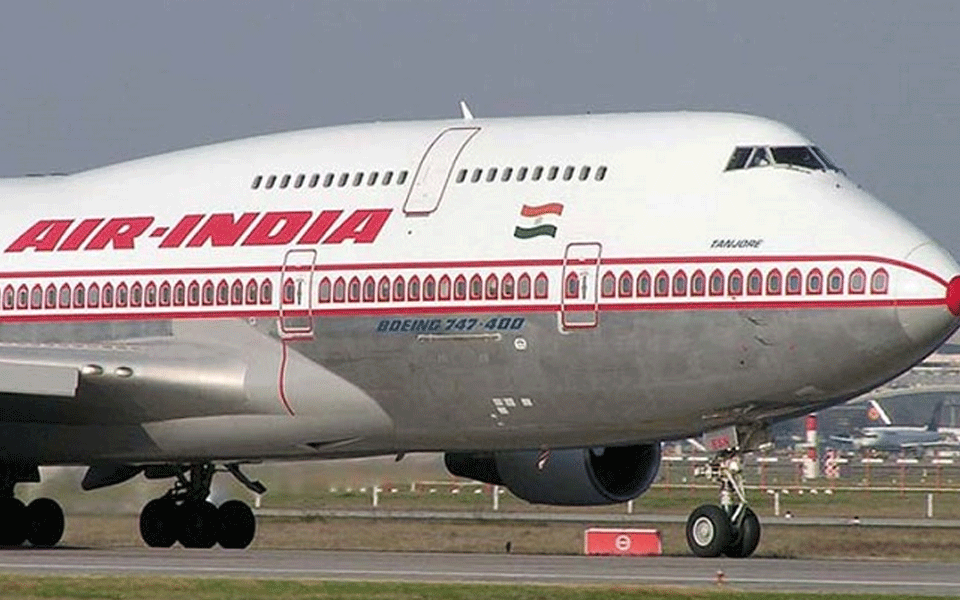
New Delhi, July 23 : The Supreme Court on Monday agreed to hear a plea filed by a transgender who was refused a cabin crew position by national carrier Air India owing to her sexual orientation.
Chief Justice Dipak Misra and Justices A.M. Khanwilkar and D.Y. Chandrachud said they would hear after two weeks the petition of Shanavi Ponnusamy, who alleged she was not hired by Air India because she is a transgender and the vacancies in the cabin crew were earmarked only for men or women.
Ponnusamy, who had undergone gender surgery in 2014 to change into a woman, moved the apex court to scrap the airline's hiring criteria which included a group discussion and a personality screening test for those willing to apply for cabin crew jobs.
Ponnusamy, born in 1989 in Tamil Nadu, graduated in engineering in 2010. She learnt about an advertisement on July 10, 2017 by Air India for the post of a female cabin crew for its Northern Region office in Delhi for an initial period of five years.
She applied in the female category as she had undergone a successful sexual reassignment surgery in Bangkok, she said in the plea, adding that she had no other option than to apply as a woman since there was no transgender column in the form given by Air India.
The petitioner said she got a call letter, appeared for group discussion and Personal Assessment tests and undertook four attempts, "but unfortunately she has not been short-listed for the post in question even though she fared well in the tests conducted".
The Transgender Persons (Protection of Rights) Bill, 2016 prohibits discrimination. It is clear that no person shall discriminate against a transgender person in relation to employment or occupation, the petition stated.
The petition also cited the apex verdict of 2014 that gave certain directions for protection of the rights of transgenders by including a third category in documents.
It said: "The right to choose one's gender identity is an essential part to lead a life with dignity, which again falls under the ambit of Article 21. Determining the right to personal freedom and self-determination, the court observed that the gender to which a person belongs is to be determined by the person concerned."
Let the Truth be known. If you read VB and like VB, please be a VB Supporter and Help us deliver the Truth to one and all.
Bengaluru (PTI): India is planning to collect samples from the Moon and bring them back to Earth under Chandrayaan-4, while Chandrayaan-5 will involve a heavier lander with a longer mission life, ISRO Chairman V Narayanan said on Wednesday.
He also spoke about ISRO's future missions including the one to study Venus and the other on Mars landing mission.
"Now we are working on the continuation of the Chandrayaan programme. In Chandrayaan-4, we plan to collect samples and bring them back. Chandrayaan-5 will involve a heavier lander with a longer mission life," he said at the inaugural ceremony of ISRO's fourth edition of the Space Science and Technology Awareness Training (START 2026) programme here.
He recalled that in Chandrayaan-3, the lander's mission life was only 14 days.
"In the future mission, we are talking about a life of around 100 days. The rover will also be heavier. Chandrayaan-3 had a rover of about 25 kg, while the future mission will have a rover of about 350 kg," Narayanan said.
Referring to ISRO's future programmes like the Venus Orbiter Mission, he said, "We have already accomplished the Mars Orbiter Mission, and now we are working on a Mars landing mission."
"These are some of the projects being discussed for government approval. So there is a lot of interest in the science area."
He noted that under Prime Minister Narendra Modi, the vision of the space programme has been expanded and said, "We are currently working on the Gaganyaan programme and are planning to send our own astronauts into space and bring them back safely, possibly within the next two years."
"We are also planning to build our own space station by 2035. Additionally, we are working on landing Indians on the Moon and bringing them back safely by 2040. Brainstorming activities have already begun. So there are many activities happening in the space sector. Apart from application-related activities that ensure food security, water security, communication, and safety for citizens, there are many initiatives planned in the science area as well," he added.
Narayanan noted that India's space programme has accomplished 10 scientific missions so far, including AstroSat, which recently completed a decade in orbit and was still functioning very well.
He also highlighted India's various lunar exploration missions -- Chandrayaan-1, Chandrayaan-2, and Chandrayaan-3 -- saying they led to many scientific discoveries.
"We are progressing in a big way," he added.
Highlighting the successful Chandrayaan-3 mission in the year 2023, the ISRO chairman said that India became the first country to successfully achieve a soft landing near the south pole of the Moon.
"Not only did we achieve the landing, but many discoveries were made. Around eight minerals were identified, seismic activity was studied, and the thermal profile of the Moon's surface was understood. Electron clouds were also studied. So many discoveries have come from that mission," he added.
Referring to the launch of Aditya-L1, the ISRO chairman said, "India is the fourth country to successfully place a satellite to study the Sun, and a large amount of data has already come out, and we have released the data as well."
Emphasising India's Space Vision 2047, he recalled that the country, which started with very humble beginnings, has developed significant capabilities.
"Today, we have the capability to conceive, design, and build our own launch vehicles, as well as conceive, build, and place satellites in orbit. Fifty years ago, we did not have this capability. Today, we can build satellites and the payloads required for them," Narayanan said.
Citing an example, he said that earlier optical cameras used lenses that were only about one inch in diameter.
"But today, in ISRO, cameras with optics of about 1.7 metres in diameter and almost one foot in thickness are being developed. These optics are being built at the LEOS (Laboratory For Electro Optics Systems) laboratory in Bengaluru for space observation. Many such activities are happening in the space sector," he noted.
He pointed out that the US, after 1969 and almost after 50-55 years, has again shown interest in landing on the Moon.
"The Artemis programme is already a very vibrant programme, with many activities going on. An accord was signed in 2023, and India is also a signatory to that accord," he said.
Speaking about China and Russia leading efforts to build the International Lunar Research Station (ILRS), the ISRO chairman noted, "When we talk about such space stations, one aspect is technology development. The second aspect is the large number of scientific experiments that will take place there. There is also a lot of competition today."
"There was a time when only government organisations across the world carried out space activities. Today, companies like SpaceX have advanced significantly. In fact, they have overtaken many others in terms of launches," he added.
He said that the main idea behind programmes like START 2026 is to encourage the next generation of youngsters to develop interest in this field and to build scientific temper so that they can become great leaders in building the nation.