SC fixes pleas challenging CEC, EC appointments under new law for Feb 19
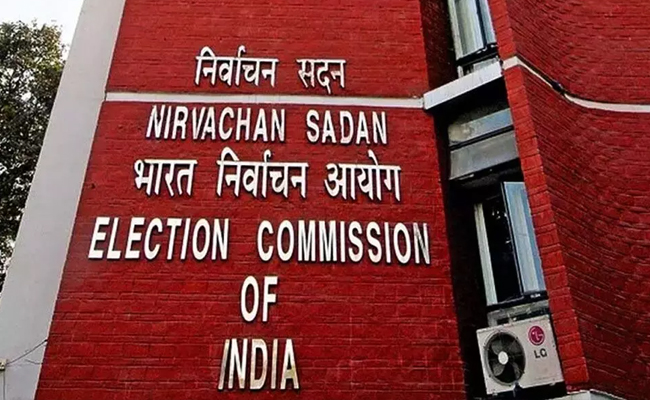
New Delhi (PTI): The Supreme Court on Wednesday fixed February 19 to hear pleas against the appointment of the chief election commissioner and election commissioners under the 2023 law saying if anything happens in the interregnum, the consequences are bound to follow.
A bench of Justices Surya Kant and N Kotiswar Singh was told by advocate Prashant Bhushan, appearing for an NGO, that earlier the pleas were scheduled to be heard on Wednesday but now they have been listed for hearing on February 19.
Bhushan said the urgency in the matter is that Chief Election Commissioner Rajiv Kumar is scheduled to superannuate on February 18 and the government may appoint the new CEC under the 2023 law, which is under challenge.
The bench said, "We are fixing the matter for hearing on February 19. If anything happens in the interregnum, then the consequences are bound to follow."
Bhushan, appearing for NGO 'Association for Democratic Reforms', said the apex court registry has informed them that as Justice Kant was unwell, the matters were posted for hearing on February 19.
Justice Kant said now all the matters will be taken up for hearing on February 19.
On February 3, the top court while fixing the matter for Wednesday, said it will decide the issue on merit and finally.
Bhushan had earlier submitted that the 2023 verdict held that the election commissioners have to be selected for appointment by an independent panel comprising the prime minister, Leader of Opposition and Chief Justice of India.
"They have brought an Act by which they have removed the chief justice and brought in another minister, effectively making the commissioners appointment only at the pleasure of the government. You need to have an independent committee to appoint the election commissioners," Bhushan had said.
Advocate Varun Thakur, appearing for petitioner Congress' Jaya Thakur, had earlier submitted that they had moved the application seeking a direction to the Centre that the appointment of the CEC should be made as per the March 2, 2023 verdict of the Constitution bench.
On March 15, 2024, the top court refused to stay the appointments of new ECs under a 2023 law which excluded the CJI from the selection panel and deferred the hearing on a batch of pleas challenging the appointments.
The apex court told the petitioners the March 2, 2023 verdict directed for the three-member panel comprising the prime minister, Leader of Opposition and the CJI to operate till Parliament enacted a law.
The NGO challenged the CJI's exclusion and contended the election commission should be insulated from "political" and "executive interference" for maintaining a healthy democracy.
ADR's plea alleged the verdict was overruled by the Centre without removing its basis and the composition of the selection committee under the new law which amounted to excessive interference of the executive in the appointments and was detrimental to the independence of the poll panel.
Former IAS officers Gyanesh Kumar and Sukhbir Sandhu were recommended to be appointed as ECs in 2024 by a selection panel chaired by Prime Minister Narendra Modi under the new law.
The NGO challenged the validity and sought a stay on the operation of Section 7 of the Chief Election Commissioner and Other Election Commissioners Act, 2023, which excluded the CJI.
The apex court's March 2, 2023 verdict held that leaving the appointment of the ECs and CEC in the hands of the executive would be detrimental to the health of the country's democracy and the holding of free and fair elections.
Thakur has sought to restrain the Centre from appointing new ECs under the 2023 law while challenging its provisions.
Let the Truth be known. If you read VB and like VB, please be a VB Supporter and Help us deliver the Truth to one and all.
TN Governor should invite Vijay to form govt, then prove majority: Former MP Prakash Ambedkar
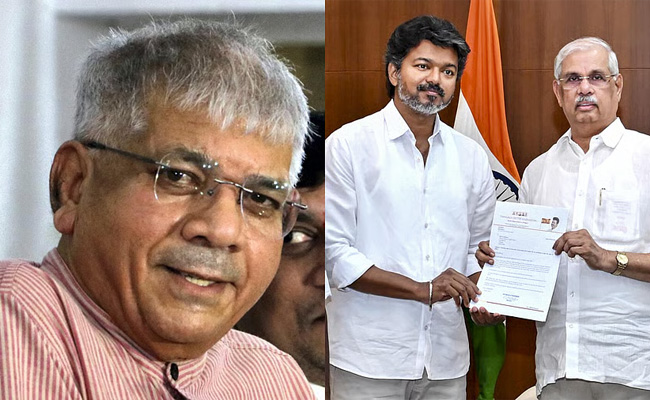
Mumbai: Senior politician and constitutional expert Prakash Ambedkar has opined that Tamil Nadu Governor Rajendra Arlekar should invite the Tamilaga Vettri Kazhagam President Vijay to form the government as his party emerged as the single largest party in the Assembly elections.
Ambedkar, who is a Mumbai-based advocate, activist and also the grandson of Dr. BR Ambedkar, is a former Parliamentarian.
Citing articles from the Constitution and similar incidents in the political history of the nation, Prakash Ambedkar has explained why Vijay cannot be stopped from forming the government in Tamil Nadu, reports Deccan Herald.
“Merely doubt over whether the TVK has the necessary number cannot suffice to withhold the invitation to the party to form the government. The Governor should invite Vijay, President of TVK, the single-largest party, to form the government and assume office as the next Chief Minister. After taking charge, as per the Article 164 (2) of the Constitution, Vijay will have to prove that his government has a majority in the House,” Ambedkar explained.
He also gave examples from India’s political history supporting his argument.
Ambedkar cited the example of the 1989 Lok Sabha elections and said that, although the Congress (I) emerged the single-largest party with 194 seats, Rajiv Gandhi declined the invitation by President R Venkataraman to form the government. “My friend Vishwanath Pratap Singh, leader of the National Front, was then invited and sworn in as Prime Minister on December 2, 1989,” he added.
He then recalled the 1996 elections to the Lower House of the Parliament, when the BJP emerged the single-largest party, but the Parliament was hung as the BJP lacked a majority. “Atal Bihari Vajpayee was invited by President Shankar Dayal Sharma to form the government and was sworn in as Prime Minister. Vajpayee resigned 13 days later on May 28, 1996, after failing to secure majority support in the Lok Sabha,” Ambedkar explained.