SC grants time to Centre to file reply on pleas challenging law on Places of Worship
New Delhi (PTI): The Supreme Court on Tuesday granted time till October 31 to the Centre to file its response to a batch of pleas challenging certain provisions of a 1991 law that prohibits filing of a lawsuit to reclaim a place of worship or seek a change in its character from what prevailed on August 15, 1947.
A bench comprising Chief Justice D Y Chandrachud and justices P S Narasimha and Manoj Misra took note of the submissions of Solicitor General Tushar Mehta, appearing for the Centre, that the government is seized of it and a comprehensive reply will be filed.
Taking note of the submissions of the top law officer, the bench granted time till October 31 to the Centre to file its reply to the petitions.
"The Centre is taking adjournment after adjournment. Please list it (the plea) for final hearing," BJP leader Subramanian Swamy said.
"The Union of India is asking for an adjournment. Let them file a counter affidavit. Let us see the affidavit of the Centre," the bench said.
The top court also made clear that it has not stayed the operation of the law and asked lawyer Vrinda Grover to share the copy of her petition to the counsel assisting the solicitor general.
On January 9, the top court had asked the central government to file its reply to the PILs against some provisions of the Places of Worship (Special Provisions) Act, 1991, and had granted it time till the end of February to submit its response.
The top court is seized of six petitions, including the PILs filed by lawyer Ashwini Upadhyay and former Rajya Sabha MP Swamy, against the provisions of the law.
Upadhyay has prayed that sections 2, 3, 4 of the Places of Worship (Special Provisions) Act, 1991 be set aside on grounds, including that these provisions take away the right of judicial remedy to reclaim a place of worship of any person or a religious group.
Earlier, the top court had observed that the pleas challenging the validity of certain provisions of the law can be referred to a five-judge Constitution bench for adjudication.
While Swamy wanted the apex court to "read down" certain provisions to enable Hindus to stake claim over the Gyanvapi Mosque in Varanasi and the Shahi Idgah Mosque in Mathura, Upadhyay claimed the entire statute was unconstitutional and no question of reading down arises.
The doctrine of reading down a law is generally used to save a statute from being struck down on account of its unconstitutionality.
The Jamiat Ulama-i-Hind, represented by advocate Ejaz Maqbool, had referred to the five-judge Constitution bench judgment in the Ram Janmabhoomi-Babri Masjid title case and said the Places of Worship (Special Provisions) Act, 1991, has been referred to there and it cannot be set aside now.
The petition alleged that the 1991 law creates an "arbitrary and irrational retrospective cut-off date" of August 15, 1947, for maintaining the character of the places of worship or pilgrimage against encroachment done by "fundamentalist-barbaric invaders and law-breakers".
The 1991 law prohibits conversion of any place of worship and to provide for the maintenance of the religious character of any place of worship as it existed on August 15, 1947, and for matters connected therewith or incidental thereto.
The law had made only one exception -- on the dispute pertaining to the Ram Janmabhoomi-Babri Masjid in Ayodhya.
Let the Truth be known. If you read VB and like VB, please be a VB Supporter and Help us deliver the Truth to one and all.
KKR defeat LSG via Super Over
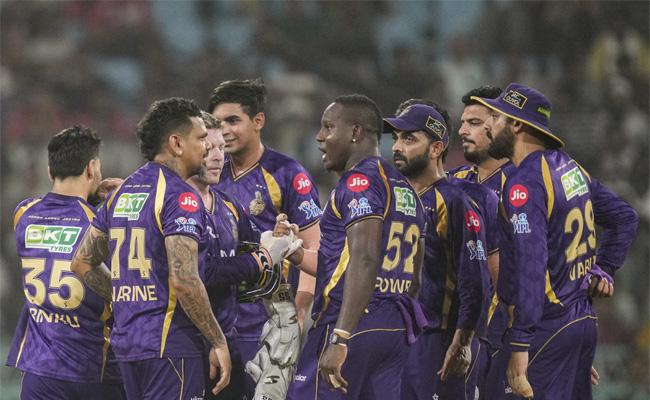
Lucknow (PTI): Kolkata Knight Riders edged Lucknow Super Giants via Super Overs in a battle between two bottom-placed teams in the IPL, here on Sunday.
Chasing a modest 156, LSG suffered a batting collapse and managed to tie the contest and take it to Super Over with No. 9 Mohammed Shami striking a last-ball six against a wayward Kartik Tyagi, who leaked 16 runs in the final over.
But Sunil Narine bowled a stunning Super Over conceding just one run and taking two wickets to give KKR an easy target.
Rinku Singh then finished the chase with a boundary off first ball from Prince Yadav.
Earlier the KKR were in deep trouble with 93/7 in 15 overs but Rinku smashed a sensational 83 not out from 51 balls including four sixes in a row in the final over to lift them to 155/7.
Cameron Green (34) was the only other batter to reach double-digit scores as KKR suffered a familiar batting meltdown with Mohsin taking his maiden fifer.
In reply, LSG continued their dismal show with the bat to succumb to their fifth loss in a row.
Brief Scores:
Kolkata Knight Riders 155/7; 20 overs (Rinku Singh 83 not out, Cameron Green 34; Mohsin Khan 5/23). Lucknow Super Giants 155/8; 20 overs (Rishabh Pant 42). KKR won via Super Over.