SC places before CJI plea for SOP on freezing, de-freezing of bank accounts during cybercrime probes

New Delhi (PTI): The Supreme Court has directed that a plea seeking directions to the Centre and the Reserve Bank of India to formulate a Standard Operating Procedure governing freezing and de-freezing of bank accounts during cybercrime probes be placed before Chief Justice of India Surya Kant.
A bench of Justices Pankaj Mithal and SVN Bhatti directed the apex court registry to seek instruction from the CJI and place the matter accordingly before appropriate bench after it was informed by the Centre that the CJI-led bench was already hearing a suo moto matter related to digital arrests, where the same issue is under consideration.
"Anil Kaushik, ASG further submits that as far as prayers 'B' and 'C' are concerned, they are the subject matter of consideration before another bench of this Court in Suo Moto Writ Petition (Crl.) No…. In view of the above, the registry to obtain appropriate orders from the Chief Justice of India and post the matter accordingly," the top court said in its order on January 16.
The top court had earlier agreed to examine the plea which have prayer 'B' stating that no bank account shall be frozen without a written reasoned order and intimation to the account holder within 24 hours of such action and every freezing order shall be forthwith reported to the jurisdictional magistrate as mandated under Section 106(3) of BNSS/ 102(3) of the CrPC.
Its prayer 'C' seeks direction to the Centre and the Reserve Bank of India to formulate a uniform Standard Operating Procedure (SOP) governing freezing and de-freezing of bank accounts during cybercrime investigations, so as to prevent arbitrary action and ensure procedural fairness nationwide.
ALSO READ: Hindu woman in bridal attire, Muslim man found hanging from tree in UP's Jhansi
At the outset, Kaushik informed the bench that Centre has not freezed the bank accounts of petitioners, who alleged the action was taken without intimation.
On January 6, the top court had asked the copy of the petition to be served on the Centre within three days, and listed the matter next week.
The plea also sought the issuance of appropriate guidelines to all investigating agencies, including cyber cells across the country, to ensure that no bank account is frozen without a written, reasoned order and intimation to the account holder within 24 hours of such action.
The plea filed by petitioner Vivek Varshney, through advocate Tushar Manohar Khairnar ,said he was aggrieved by the "arbitrary freezing/holding" of his bank account(s) by the Cyber Cell of Tamil Nadu police allegedly without any prior notice, communication or judicial approval, thereby violating his fundamental rights under Articles 19(1)(g) and 21 of the Constitution.
The petitioner claimed that the freezing order in his case has resulted in complete financial paralysis, restricting him from carrying out his professional and personal obligations, including payment of essential expenses, taxes and liabilities.
"It is respectfully submitted that Section 106(3) of BNSS/ 102(3) of the Cr.P.C. mandates that any seizure or freezing of property must be forthwith reported to the jurisdictional magistrate. However, in the instant case, no such compliance has been made. The action of the respondents is, therefore, without jurisdiction, arbitrary, and unconstitutional," it said.
The plea highlighted that there is currently no uniform procedure or Standard Operating Protocol (SOP) governing the freezing and unfreezing of bank accounts during cybercrime or financial investigations.
"Consequently, citizens across different states are subjected to inconsistent practices, prolonged freezing periods, and deprivation of their financial rights without due process.
"Hence, this court's indulgence is sought to (i) direct the immediate defreezing of the petitioner’s account(s); and (ii) frame uniform guidelines to ensure procedural safeguards, proportionality, and accountability in all future actions of this nature," it said.
Varshney, whose bank account was allegedly frozen due to transaction related to sale of jewellery, submitted that his writ petition was filed to formulate a rule that unless an account holder is proven to be complicit in a crime, their entire bank account or amount more than alleged to be involved in the crime should not be frozen merely because a suspicious transaction has been traced to it.
"Recognising the increasing frequency of such cases", the plea urged the court to "formulate guidelines to save the common man from suffering from unnecessary harassment".
It also urged the court to direct "the Ministry of Home Affairs, Government of India to formulate a uniform policy and standard operating procedures (SOPs) in the cases of similar nature where cyber cell issues notices freezing accounts"
Let the Truth be known. If you read VB and like VB, please be a VB Supporter and Help us deliver the Truth to one and all.
Trump loyalist Pam Bondi out as attorney general
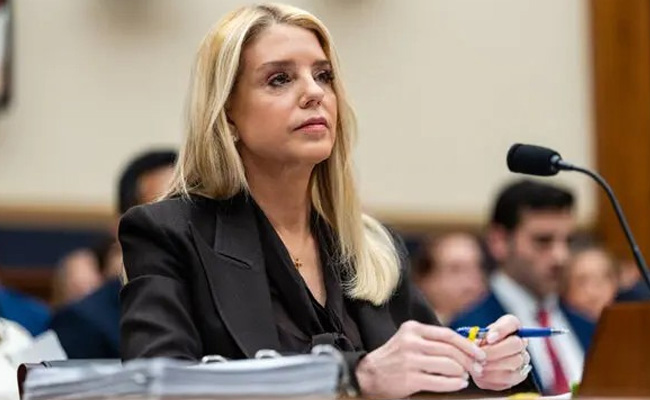
Washington (AP): US President Donald Trump said Thursday that Pam Bondi is out as his attorney general, ending the contentious tenure of a loyalist who upended the Justice Department's culture of independence from the White House, oversaw large-scale firings of career employees and moved aggressively to investigate the Republican president's perceived enemies.
The departure followed months of scrutiny over the Justice Department's handling of files related to the Jeffrey Epstein sex trafficking investigation and failed efforts to meet Trump's unwavering demands for criminal cases against his adversaries. As Trump's own frustrations mounted, he began privately discussing firing Bondi, people familiar with the matter say.
“Pam Bondi is a Great American Patriot and a loyal friend, who faithfully served as my Attorney General over the past year,” Trump said in a statement. He added, “We love Pam, and she will be transitioning to a much needed and important new job in the private sector, to be announced at a date in the near future.”
Trump named Deputy Attorney General Todd Blanche, one of his former personal lawyers, as the acting attorney general. Three people familiar with the matter told The Associated Press on Thursday that he has privately discussed Lee Zeldin, the head of the Environmental Protection Agency, as a permanent pick.
ALSO READ: President Trump in 'freefall', says fan-turned-critic podcaster Alex Jones
In her own statement, Bondi called the job “the honor of a lifetime” and said she would be working over the next month to transition the position to Blanche.
Bondi came into office 14 months ago pledging that she would not play politics with the Justice Department. But she quickly set out to do Trump's bidding, heaping lavish praise at congressional hearings and White House events, firing prosecutors deemed insufficiently loyal to the president and opening investigations into his political foes. The intense turmoil contributed to the resignations of hundreds of employees, with the norm-breaking actions stirring concern that he department was being wielded as a tool to advance Trump's personal and political interests.
“Pam Bondi oversaw an unprecedented weaponization of the Justice Department that brought our nation's rule of law to its knees,” said Sen. Adam Schiff, a California Democrat.
Bondi rejected accusations that she politicised the Justice Department and said her mission was to restore the institution's credibility after overreach by President Joe Biden's Democratic administration, which included two federal criminal cases against Trump. Bondi's defenders have said she worked to refocus the department to better tackle illegal immigration and violent crime and brought much-needed change to an agency they believe unfairly targeted conservatives.
Embracing, supporting and protecting the president
-------------------------------------------------------
Bondi's public embrace of the president, however, marked a sharp departure from her predecessors, who generally took pains to maintain an arm's-length distance from the White House to protect the impartiality of investigations and prosecutions. Bondi postured herself as Trump's chief supporter and protector, praising and defending him in congressional hearings and placing a banner with his face on the exterior of Justice Department headquarters.
She called for an end to the “weaponisation” of law enforcement she said occurred under the Biden administration, even though Biden's attorney general, Merrick Garland, and Jack Smith, the special counsel who produced two cases against Trump, have said they followed the facts, the evidence and the law in their decision-making. Bondi's critics, meanwhile, said she was the one who had politicised the agency to do the president's bidding.
“You've turned the People's Department of Justice into Trump's instrument of revenge,” Rep Jamie Raskin of Maryland, the top Democrat on the House Judiciary committee, said at a February hearing.
Bondi delivered a combative performance but few substantive answers at that hearing as she angrily insulted her Democratic questioners with name-calling, praised Trump over the performance of the stock market — “The Dow is up over 50,000 right now” —- and openly aligned herself as in sync with a president whom she painted as a victim of past impeachments and investigations.
Even Republicans began to challenge her, with the Republican-led House Oversight Committee last month issuing a subpoena to her to appear for a closed-door interview about the Epstein files.
Under Bondi's leadership, the department opened investigations into a string of Trump foes, including Federal Reserve Chair Jerome Powell, New York Attorney General Letitia James, former FBI Director James Comey and former CIA Director John Brennan. The high-profile prosecutions of Comey and James were short-lived as they were quickly thrown out by a judge who ruled that the prosecutor who brought the cases was illegally appointed.
Trump repeatedly praised and defended Bondi publicly but also showed flashes of impatience with his attorney general's efforts to meet his demands to prosecute his rivals. In one extraordinary social media post last year, Trump called on Bondi to move quickly to prosecute his foes, including James and Comey, telling her, “We can't delay any longer, it's killing our reputation and credibility.”
ALSO READ: Earthquake off Indonesia topples buildings, kills 1, sets off small tsunami
Bondi oversaw the exodus of thousands of career employees — both through firings and voluntary departures — including lawyers who prosecuted violent attacks on police at the US Capitol on January 6, 2021; environmental, civil rights and ethics enforcers; counterterrorism prosecutors; and others.
Fumbling the Epstein files
---------------------------
She struggled to overcome early stumbles over the Epstein files that angered conservatives eager for government bombshells about the case, which has long fascinated conspiracy theorists. She herself had fed the conspiracy theory machine with a suggestion in a 2025 Fox News Channel interview that Epstein's “client list” was sitting on her desk for review. The department later acknowledged that no such document exists.
Bondi was ridiculed over a move to hand out binders of Epstein files to conservative influencers at the White House, only for it to be later revealed that the documents included no new revelations. And despite promises that more files were going to become public, the Justice Department in July said no more would be released, prompting Congress to pass a bill to force the agency to do so.
The Epstein files fumbles led to a stunning public criticism from White House chief of staff Susie Wiles, a close friend of Bondi's, who told Vanity Fair that the attorney general “completely whiffed.” The Justice Department's release of millions of pages of Epstein files did little to tamp down criticism, prompting a House committee with the support of five Republicans to subpoena Bondi to answer questions under oath.
Bondi, who defended Trump during his first impeachment trial, was his second choice to lead the Justice Department, picked for the role after former Rep. Matt Gaetz of Florida withdrew his name from consideration amid scrutiny over sex trafficking allegations.