SC slams UP police officer for defying its order, saying “I don’t follow any SC’s directions”

New Delhi: The Supreme Court has sharply criticised a police officer from Uttar Pradesh’s Pratapgarh district for openly defying its order and assaulting a petitioner who was under the Court’s interim protection.
The officer, identified as Gulaab Singh Sonkar, Station House Officer of Kandhai Police Station, had allegedly arrested and beaten the petitioner on April 23, 2025, despite a Supreme Court order dated March 28 granting protection from coercive action.
According to the complaint, when the petitioner showed the SHO a copy of the Court’s order, the officer responded in Hindi, saying, “Main kisi Supreme Court ka aadesh nahin manunga, mai tumhara sara High Court aur Supreme Court nikal dunga aaj” (I will not obey any Supreme Court order; I will get your entire High Court and Supreme Court removed today).
A bench comprising Justices Aravind Kumar and N.V. Anjaria, hearing the contempt petition, expressed deep concern over the blatant defiance, observing that such conduct “pollutes the stream of justice under the guise of a police uniform.” The bench noted that the state government’s inquiry, conducted by an officer not below the rank of ADGP, had confirmed the willful disobedience.
“Prima facie, there is willful disobedience of the order of this Court by the first respondent, which requires to be dealt with an iron hand,” the bench stated.
While the Court was prepared to issue a stern order against the officer, it deferred its decision after the Uttar Pradesh government’s counsel assured that immediate action would be taken based on the inquiry report. The Court accepted the request for time and scheduled the next hearing for November 7, 2025.
The Court order recorded: “The learned AAG for the State, having perused the inquiry report, has assured that the Government will act immediately and inform the Court of the action taken by the next date of hearing. The matter will be re-listed on November 7, 2025.”
Let the Truth be known. If you read VB and like VB, please be a VB Supporter and Help us deliver the Truth to one and all.
CSK's Ayush Mhatre ruled out of remainder of IPL 2026 due to hamstring injury
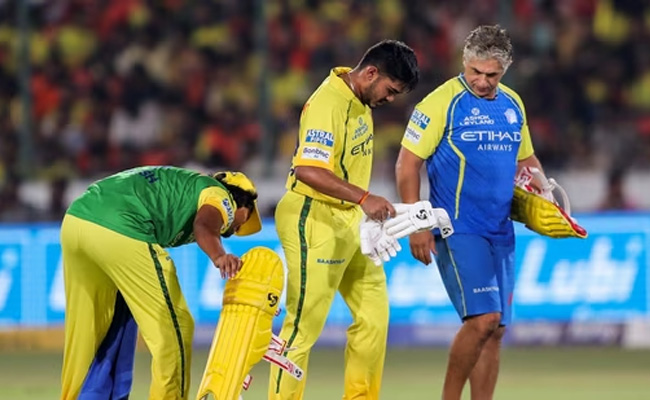
New Delhi (PTI): Chennai Super Kings batter Ayush Mhatre has been ruled out of the remainder of the ongoing IPL season due to a hamstring injury, dealing a major blow to the five-time champions.
The franchise said Mhatre, who sustained the injury during CSK’s previous game against Sunrisers Hyderabad on April 18, will require a rehabilitation period of six to 12 weeks.
"Ayush Mhatre has been ruled out of the remainder of IPL 2026 due to a left hamstring injury sustained while batting during the match against Sunrisers Hyderabad on April 18.
"Ayush's injury will require a rehabilitation period of 6-12 weeks," CSK announced on its social media on Tuesday.
The 18-year-old, who came in as an impact substitute, was seen in visible discomfort and clutched his hamstring while attempting a run during CSK’s 10-run loss to SRH in Hyderabad.
He required on-field treatment and, although he continued briefly, was dismissed soon after.
"It looks pretty bad, unfortunately. And he's going to be a big, big loss because he's been in really nice touch for us," CSK's batting coach Mike Hussey had said at the post-match press conference.
Mhatre has been CSK's standout batter this season. He lea collecting 201 runs from six matches at a strike-rate of 177.87.
Chennai Super Kings have endured a poor start to the 2026 season, losing four of their six matches to languish in eighth place.