SC to pronounce verdict on Monday on pleas challenging abrogation of Article 370 in J&K
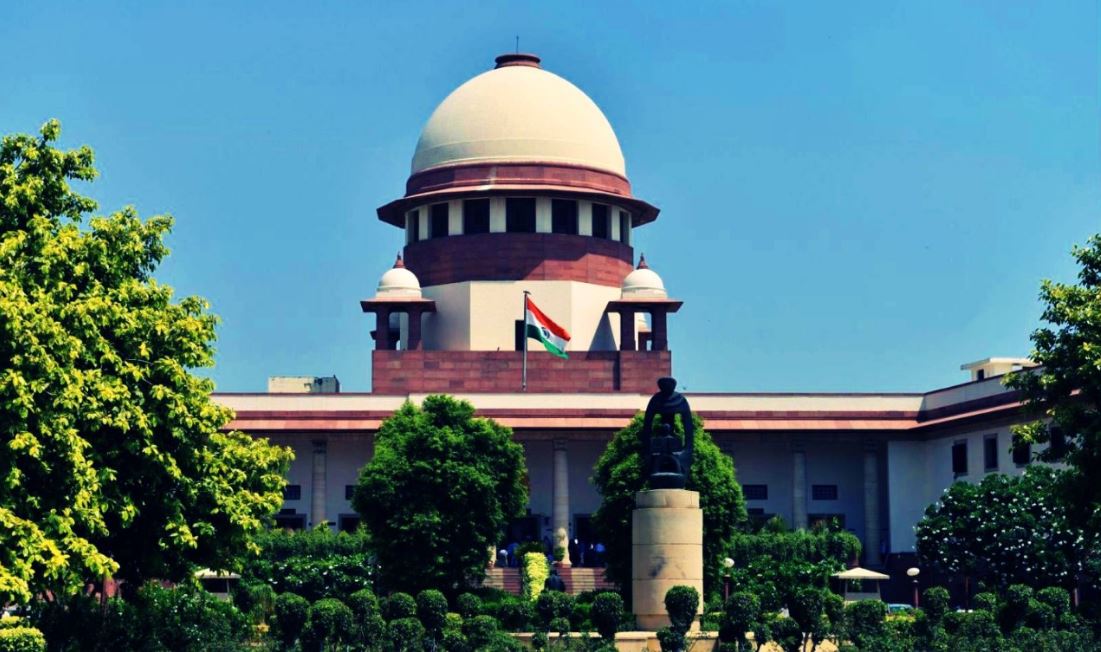
New Delhi, Dec 10: Was the decision taken by the Centre on August 5, 2019 to abrogate the provisions of Article 370 of the Constitution, which bestowed a special status on the erstwhile state of Jammu and Kashmir, constitutionally valid?
The Supreme Court is scheduled to pronounce its verdict on Monday on a batch of petitions challenging the abrogation of the provisions of Article 370.
According to the cause list for December 11 (Monday), uploaded on the apex court's website, a five-judge Constitution bench headed by Chief Justice D Y Chandrachud would deliver the verdict.
The other members of the bench are Justices Sanjay Kishan Kaul, Sanjiv Khanna, B R Gavai and Surya Kant.
The apex court reserved its verdict in the matter on September 5 after a 16-day hearing.
During the hearing, the top court heard Attorney General R Venkataramani, Solicitor General Tushar Mehta, senior advocates Harish Salve, Rakesh Dwivedi, V Giri and others on behalf of the Centre and the intervenors defending the abrogation of the provisions of Article 370.
Senior advocates, including Kapil Sibal, Gopal Subramanium, Rajeev Dhavan, Zaffar Shah and Dushyant Dave, had argued on behalf of the petitioners.
The lawyers had dwelt on various issues, including the constitutional validity of the Centre's decision to abrogate the provisions of Article 370, the validity of the Jammu and Kashmir Reorganisation Act, which split the erstwhile state into two Union territories, challenges to the imposition of the governor's rule in Jammu and Kashmir on June 20, 2018 and the imposition of the president's rule on December 19, 2018 and its extension on July 3, 2019.
The petitions challenging the abrogation of the provisions of Article 370 and the validity of the Jammu and Kashmir Reorganisation Act, 2019 that divided the erstwhile state into the Union territories of Jammu and Kashmir and Ladakh were referred to the Constitution bench in 2019.
The arguments in the matter had commenced on August 2.
During the hearing, the apex court had asked who can recommend the revocation of Article 370 in Jammu and Kashmir when no constituent Assembly, the concurrence of which is required before taking such a step, exists there.
The top court had also asked how can a provision (Article 370), which was specifically mentioned as temporary in the Constitution, become permanent after the tenure of the Jammu and Kashmir constituent Assembly came to an end in 1957.
Some of the petitioners opposing the repeal of Article 370 had argued that the provision could not have been abrogated as the term of the Jammu and Kashmir constituent Assembly ended in 1957 after it drafted the erstwhile state's Constitution.
With the constituent Assembly having become extinct, Article 370 acquired a permanent status, they had said.
The Centre had argued that there was no "constitutional fraud" in annulling the provision that accorded the special status to the erstwhile state of Jammu and Kashmir.
Let the Truth be known. If you read VB and like VB, please be a VB Supporter and Help us deliver the Truth to one and all.
BJP workers protest Bengaluru event on Umar Khalid, taken into preventive custody
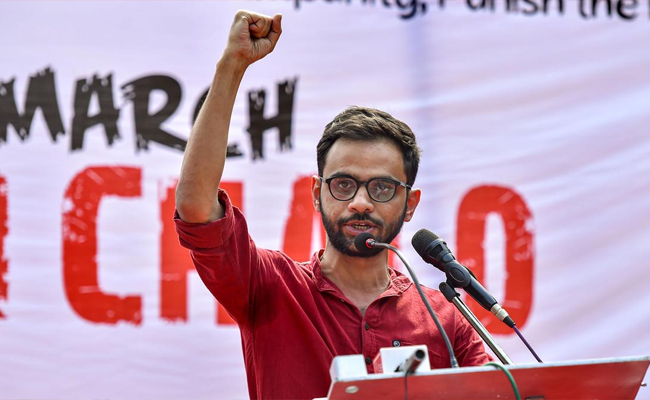
Bengaluru (PTI): BJP workers, led by former Bengaluru Mayor M Gautham Kumar, staged a protest outside the heavily fortified BIC in the city on Tuesday ahead of an event.
The editors of the book “Umar Khalid and His World” have planned a reading of excerpts from the book at the venue, followed by a discussion involving several “historians and intellectuals”.
The BJP activists raised slogans demanding the cancellation of the event. They attempted to enter the venue by breaking through the barricades put up by the police.
Police personnel deployed at the spot took the BJP workers into preventive custody.
ALSO READ: Nirmala Sitharaman inaugurates Gems and Jewellery Institute campus in Udupi
The party had on Monday petitioned Bengaluru Police Commissioner Seemant Kumar Singh seeking cancellation of the event organised in support of activist Umar Khalid.
A delegation of BJP leaders led by Bengaluru Central MP P C Mohan met the commissioner and submitted a memorandum in this regard.
Khalid is currently in jail in connection with allegations of conspiracy in the 2020 Delhi riots.
In a post on ‘X’ earlier in the day, the Karnataka BJP alleged that while courts are still hearing cases related to anti-national activities, the Congress-backed ecosystem is busy glorifying individuals who aim to divide Bharat.
“Why is Bengaluru being turned into a hub for celebrating such elements? Is this the ‘cultural contribution’ the Siddaramaiah government wants to promote? Our city is a land of innovators and patriots, not a playground for the ‘Tukde Tukde’ (divisive) narrative,” it alleged.
The Supreme Court on April 20 dismissed Khalid’s plea seeking review of a verdict denying him bail, observing that there are reasonable grounds to believe the allegations against him in connection with the conspiracy behind the 2020 Delhi riots.
The court had earlier said there was a prima facie case against Khalid and Sharjeel Imam (another accused) under the Unlawful Activities (Prevention) Act (UAPA), noting that prosecution material suggests their involvement in the “planning, mobilisation, and strategic direction” of the riots.
The February 2020 riots in northeast Delhi broke out during protests against the Citizenship (Amendment) Act (CAA) and the National Register of Citizens (NRC), leaving 53 people dead and more than 700 injured.