SC verdict on Monday on pleas challenging abrogation of Article 370
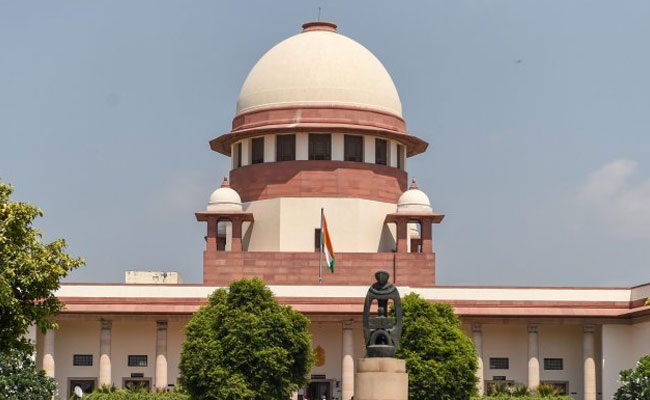
New Delhi (PTI): The Supreme Court is scheduled to pronounce its verdict on December 11 on a batch of petitions challenging the abrogation of Article 370 of the Constitution which bestowed special status on the erstwhile state of Jammu and Kashmir.
According to the cause list for December 11, Monday, uploaded on the apex court website, a five-judge constitution bench headed by Chief Justice D Y Chandrachud would deliver the verdict.
The other members of the bench are Justices Sanjay Kishan Kaul, Sanjiv Khanna, B R Gavai and Surya Kant.
The apex court had on September 5 reserved its verdict in the matter after a marathon 16-day hearing.
During the course of the hearing, the top court had heard Attorney General R Venkataramani, Solicitor General Tushar Mehta, senior advocates Harish Salve, Rakesh Dwivedi, V Giri and others on behalf of the Centre and the intervenors defending the abrogation of Article 370. Senior advocates including Kapil Sibal, Gopal Subramanium, Rajeev Dhavan, Zaffar Shah, Dushyant Dave and others had argued on behalf of the petitioners.
The lawyers had dwelt on various issues including the constitutional validity of the Centre's August 5, 2019 decision to abrogate the provision, the validity of Jammu and Kashmir Reorganisation Act, which split the erstwhile state into two Union Territories, challenges to imposition of Governor's rule in Jammu and Kashmir on June 20, 2018 and imposition of President's rule in the erstwhile state on December 19, 2018 and its extension on July 3, 2019. Several petitions challenging the abrogation of Article 370 and the Jammu and Kashmir Reorganisation Act, 2019 that divided the erstwhile state into two union territories - Jammu and Kashmir, and Ladakh - were referred to a Constitution bench in 2019.
The arguments in the matter had commenced on August 2.
During the hearing, the apex court had asked who can recommend the revocation of Article 370 in Jammu and Kashmir when no constituent assembly, whose concurrence was required before taking such a step, exists there.
The top court had also asked as to how can a provision (Article 370), which was specifically mentioned as a temporary provision in the Constitution, become permanent after tenure of the Jammu and Kashmir constituent assembly came to an end in 1957.
Some of the petitioners opposing the repeal of Article 370 had argued that the provision could not have been abrogated, as the term of the Jammu and Kashmir Constituent Assembly ended in 1957 after it drafted the erstwhile state's Constitution.
With the constituent assembly having become extinct, Article 370 acquired a permanent status, they had said.
The Centre had argued that there was no "constitutional fraud" in annulling the provision that accorded special status to the erstwhile state of Jammu and Kashmir.
Let the Truth be known. If you read VB and like VB, please be a VB Supporter and Help us deliver the Truth to one and all.
BJP takes out torch rally in Ranchi over women's quota bill
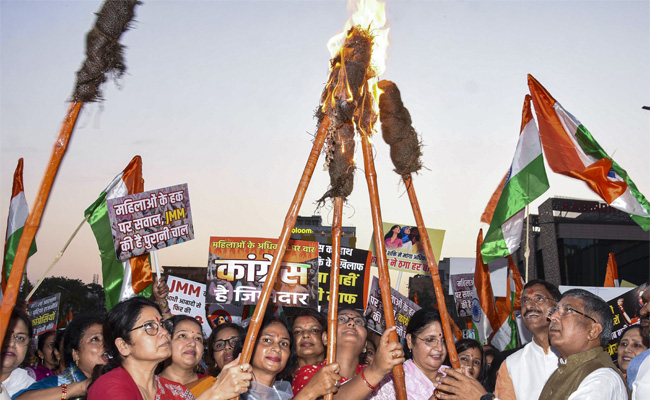
Ranchi (PTI): Jharkhand BJP on Tuesday took out a torch rally in Ranchi against the Congress-led opposition alliance for allegedly obstructing the implementation of the women's reservation bill in the Lok Sabha.
Led by the BJP women's wing, the 'Mahila Aakrosh Mashal Yatra' was taken out from Ranchi's Jaipal Singh Stadium to Albert Ekka Chowk.
Jharkhand BJP president Aditya Sahu, who also took part in the procession, said, "By opposing the Women's Reservation Bill, the Congress-led opposition alliance in Lok Sabha has committed an injustice against women in the country. The people will never forgive them."
Union Minister of State for Defence Sanjay Seth said, "Historic decisions are being taken to empower women under the leadership of Prime Minister Narendra Modi, but the opposition is obstructing women's rights due to its narrow politics."
Jharkhand BJP women's wing president Aarti Singh said that the women of Jharkhand have now awakened and are ready to fight to any extent for their honour and rights.