Sebi bans US-based Jane Street from securities mkt; impounds illegal gains of Rs 4,843 cr

New Delhi, Jul 4 (PTI): Markets regulator Sebi has barred US-based Jane Street Group from the securities markets and directed the group to disgorge unlawful gains of Rs 4,843 crore for allegedly manipulating stock indices through positions taken in derivatives segment.
This could be the highest disgorgement amount ever directed by the Securities and Exchange Board of India (Sebi).
In its interim order, the regulator has debarred JSI Investments, JSI2 Investments Pvt Ltd, Jane Street Singapore Pte Ltd, and Jane Street Asia Trading -- entities collectively referred to as the Jane Street Group -- from trading until further notice, while continuing its investigation.
Established in 2000, Jane Street Group LLC is a global proprietary trading firm in the financial services industry. It employs more than 2,600 people across five offices in the US, Europe, and Asia, and conducts trading operations in 45 countries.
The Jane Street (JS) Group has come under Sebi's scrutiny for allegedly manipulating index levels in the stock market to earn illegal profits, primarily through the highly liquid Bank Nifty and Nifty index options segments.
An investigation by Sebi revealed that over 21 expiry days between January 2023 and May 2025, the group executed large trades in the underlying cash and futures markets to influence index movements and profit from massive positions in the options market.
Two key strategies were identified-- one involved buying heavily in Bank Nifty stocks and futures in the morning and selling them aggressively in the afternoon to create a softer close, while the other involved concentrated selling or buying in the last two hours of the expiry day to sway index levels.
These actions helped the group earn illegal profits of about Rs 4,843 crore, even as they incurred smaller losses in cash and futures trades, the regulator said.
Sebi also noted that between January 2023 and March 2025, the JS Group recorded substantial trading activity across various segments of the market. The group made gains of Rs 44,358 crore from index options trading, which formed the bulk of their profits.
However, these were partially offset by losses of Rs 7,208 crore in stock futures, Rs 191 crore in index futures, and Rs 288 crore in the cash market. After accounting for all gains and losses, the JS Group reported a net total profit of Rs 36,671 crore during this period, Sebi noted.
The case stems from media reports in April 2024, which suggested that Jane Street and its related entities may have used unauthorised proprietary trading strategies in the Indian options market.
Sebi noted that the JS Group continued to carry out suspicious trading activities, mainly near market closing on expiry day, by making large and aggressive trades to unfairly influence the index, even after receiving a warning in February and making promises to the NSE to stop such practices.
"Such egregious behaviour, in clear disregard/ defiance of the explicit advisory issued to them by NSE in February 2025, amply demonstrates that unlike the vast majority of Foreign Portfolio Investors and other market participants, JS Group is not a good faith actor that can be, or deserves to be, trusted.
"In the face of such a strong prima facie case that allowing the JS Group to continue as before may severely compromise investor protection on an extraordinary scale, Sebi has a duty to directly intervene," Sebi added.
Accordingly, Sebi said, "the total amount of unlawful gains earned by the JS Group from the alleged violations, Rs 4,843.57 crore, shall be impounded jointly and severally."
The entities have been "restrained from accessing the securities market and are further prohibited from buying, selling or otherwise dealing in securities, directly or indirectly."
Additionally, banks where the entities are holding accounts have been directed to ensure that no debits are made, without Sebi's permission, except for the purpose of complying with this order.
Let the Truth be known. If you read VB and like VB, please be a VB Supporter and Help us deliver the Truth to one and all.
Bridge collapse in Jammu: 3 bodies, 1 injured pulled out from rubble; probe ordered
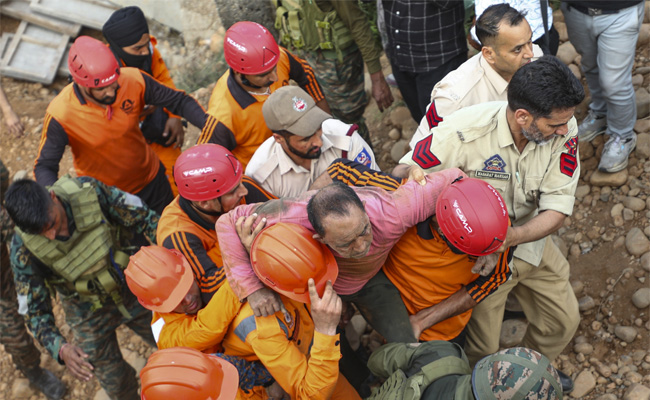
Jammu (PTI): Rescue workers pulled out three bodies and an injured person from the debris of a partially collapsed old bridge during a 12-hour search operation on the outskirts of Jammu, officials said on Saturday.
One injured worker was rescued on Friday, shortly after a portion of the bridge collapsed in the Thuther area of Bantalab.
Deputy Chief Minister Surinder Kumar Choudhary rushed to the spot at midnight and ordered the suspension of two engineers. The government has also constituted a committee to probe the incident.
According to the officials, labourers were carrying out retaining wall and foundation-laying work on the bridge, which was damaged in flash floods last year, when a portion of it gave way, trapping four of them.
Police, Army, National Disaster Response Force, State Disaster Response Force, and fire and emergency department immediately launched a rescue operation. The rescue teams first pulled out a labourer, who was identified as Tarsem Lal, the officials said.
ALSO READ: Five from TN drown in MP boat tragedy
"The search and rescue operation concluded this morning. Three bodies have been recovered from the spot. Two others have been rescued in injured condition," a senior officer told PTI.
The bodies were recovered during the 12-hour search operation, which went on through the night under floodlights, the officials said.
Among the two injured was Divisional Fire Officer, Fire and Emergency Services Department, Mohammad Jaffar, who was hit by a boulder during the rescue operation. The injured have been hospitalised.
Deputy Chief Minister Choudhary was briefed about the incident after he reached the spot at midnight.
"I have ordered the suspension of the assistant executive engineer and the junior engineer. I have also issued directions to the engineer-in-chief for attachment of the executive engineer," he told reporters at the spot.
Choudhary ordered a probe into the incident and directed the authorities to complete it in five days.
Following his order, Assistant Executive Engineer Sahil Verma and Junior Engineer Sajad Mir were placed under suspension, pending inquiry into their conduct, the officials said.
The government has also constituted a three-member inquiry committee headed by Purshotam Kumar, Secretary Technical (Engineer-in-Chief), Public Works (R&B) Department, they said.
Superintendent Engineer, Public Works (R&B), Circle Jammu South, Arit Gupta, and Executive Engineer, Public Works (R&B) Satwari division, Rajan Mengi are members of the panel, they said.