Serious issue: Supreme Court on cases of missing children
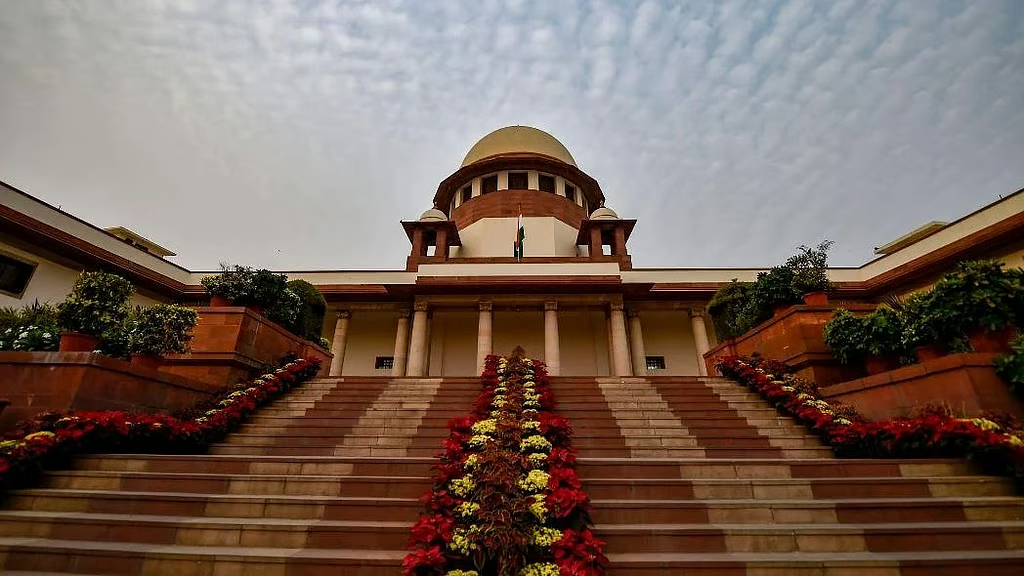
New Delhi (PTI): The Supreme Court on Tuesday voiced concern over a news report that claimed that every eight minutes, a child goes missing in the country, and described it as a serious issue.
A bench of Justices B V Nagarathna and R Mahadevan said the adoption process in the country is complicated and asked the Centre to streamline the mechanism.
"I have read in a newspaper that every eight minutes, a child goes missing in the country. I don't know if this is true or not. But this is a serious issue," Justice Nagarathna observed orally.
The top court remarked that as the adoption process is rigorous, it is bound to be flouted and people go for illegal means to have children.
During the hearing, Additional Solicitor General Aishwarya Bhati, appearing for the Centre, sought six weeks time for appointing a nodal officer to handle cases of missing children.
The apex court, however, refused to grant six weeks and asked the ASG to complete the process by December 9.
On October 14, the bench had directed the Union government to instruct all States and Union territories to depute a nodal officer to handle cases of missing children and to provide their names and contact details for publication on the Mission Vatsalya portal operated by the Ministry of Women and Child Development.
It had directed that whenever a complaint regarding a missing child is received on the portal, the information should be simultaneously shared with the respective nodal officers.
The top court had earlier asked the Centre to create a dedicated online portal under the aegis of the home ministry to trace missing children and investigate such cases.
It had underlined the lack of coordination among police authorities entrusted with the job of tracing missing children in States and Union territories in the country.
The court had said the portal could have a dedicated officer from each state who could be the in-charge of missing complaints besides disseminate information.
NGO Guria Swayam Sevi Sansthan had moved the top court and highlighted unresolved cases of kidnapping or missing children besides the actions required to be taken on the basis of information available with the Khoya/Paya portal monitored by the government of India.
The petition illustrated its argument with five cases registered in Uttar Pradesh last year in which minor boys and girls were kidnapped and trafficked through a network of middlemen to states like Jharkhand, Madhya Pradesh and Rajasthan.
Let the Truth be known. If you read VB and like VB, please be a VB Supporter and Help us deliver the Truth to one and all.
Trump’s fresh threat to bomb Iran amid reports of deal to end war
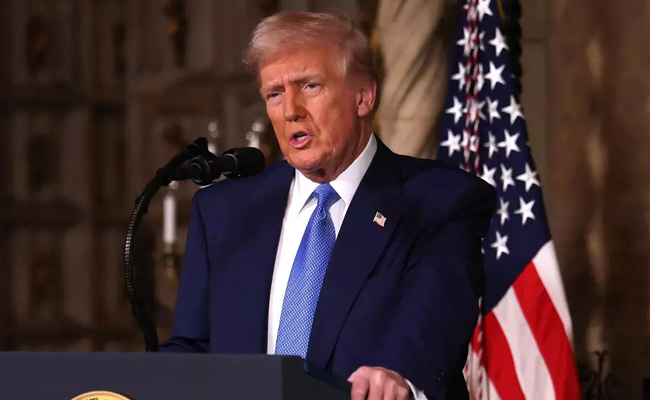
Washington (PTI): US President Donald Trump on Wednesday threatened Iran with more bombing if it doesn't reopen the Strait of Hormuz, amid a report that the warring sides were nearing an agreement to end the war.
US media outlet Axios reported, quoting US officials and two other sources, that the US and Iran were getting close to a one-page memorandum of understanding to end the war and set a framework for more detailed nuclear negotiations.
The US expects Iranian responses on several key points over the next 48 hours, Axios reported, adding that nothing has been agreed yet. This was the closest the parties had been to an agreement since the war began.
"Assuming Iran agrees to give what has been agreed to, which is, perhaps, a big assumption, the already legendary Epic Fury will be at an end, and the highly effective Blockade will allow the Hormuz Strait to be OPEN TO ALL, including Iran," Trump said in a post on Truth Social.
"If they don’t agree, the bombing starts, and it will be, sadly, at a much higher level and intensity than it was before," Trump said.
According to Axios, the deal would involve Iran committing to a moratorium on nuclear enrichment, the US agreeing to lift its sanctions and release billions in frozen Iranian funds, and both sides lifting restrictions around transit through the Strait of Hormuz.
It said many of the terms laid out in the memo would be contingent on a final agreement being reached, leaving the possibility of renewed war or an extended limbo in which the hot war has stopped, but nothing is truly resolved.