Seven die of electrocution as record rain paralyses Kolkata; Mamata blames dredging, CESC
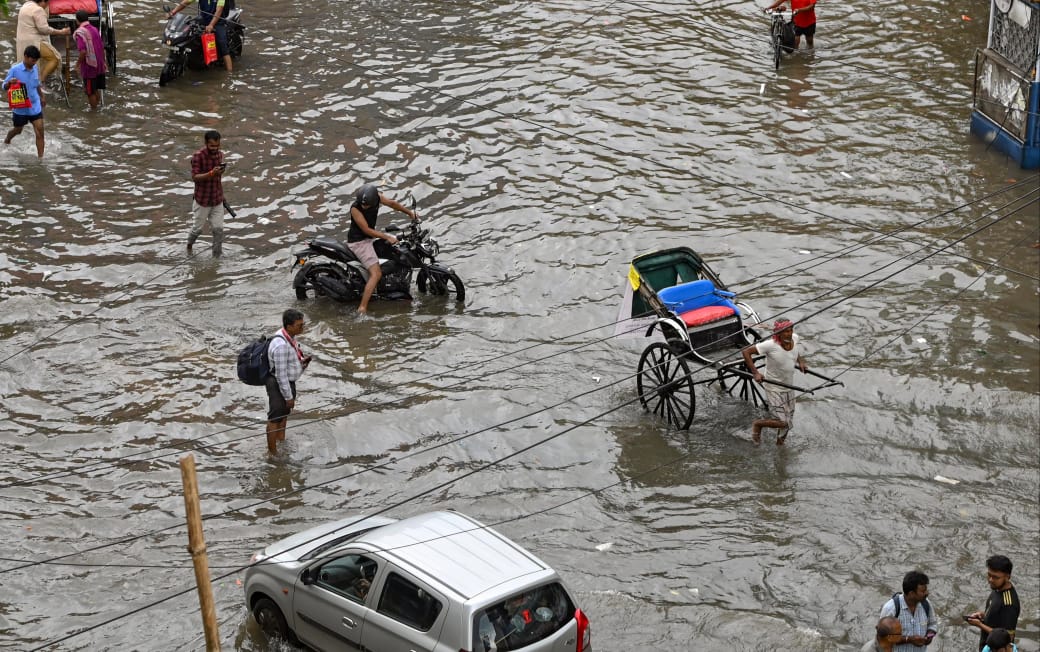
Kolkata (PTI): Torrential overnight rain left Kolkata paralysed on Tuesday, killing at least seven people due to electrocution and bringing life in the metropolis to a grinding halt as large swathes were submerged, transport services crippled, and traffic movement thrown out of gear.
According to IMD data, with an average of 251.4 mm overnight downpour, this was the third-highest September month rainfall, which battered the city in nearly half a century, with some pockets receiving as high as 332 mm of rains in just a few hours.
The relentless downpour caused massive flooding across the city, leaving thousands of commuters stranded and severely affecting transport services across roads, railways and flights.
Chief Minister Mamata Banerjee described the downpour as "unprecedented", lashing out at poor dredging of the Farakka barrage and lapses by private power utility CESC, while appealing to people to stay indoors for their own safety.
"I have never seen rain like this. I feel so bad for the people who have lost their lives in the cloudburst. I heard 7–8 people have died due to electrocution by open or unattended wires. It is so unfortunate… Their families must all be given jobs by the CESC. I am saying this clearly. We will also do whatever is possible to help," Banerjee told a Bengali news channel.
According to the IMD, the 251.4 mm average rainfall throughout early Tuesday morning in Kolkata was bettered by 369.6 mm showers on September 28, 1978 and 259.5 mm rains on September 26, 1986.
Records for all months maintained by the Met office show that only on five occasions in the last 140 years did Kolkata experience rains in higher volume than what it received on Tuesday.
The heavy overnight rains brought Kolkata to its knees on Tuesday as the city was preparing for its biggest festival, Durga Puja, which will begin later this week.
The intensity of the downpour was higher in the southern and eastern parts of Kolkata, the KMC said. Garia Kamdahari recorded 332 mm of rainfall in just a few hours, followed by Jodhpur Park (285 mm), Kalighat (280 mm), Topsia (275 mm) and Ballygunge (264 mm). Thantania in north Kolkata received 195 mm.
Squarely blaming the utility, Banerjee said, "Electricity is supplied by CESC, not us. It is their duty to ensure people do not suffer because of this. They will do business here, but not modernise here? They should send people to the field and fix this."
"Even our houses are submerged; we are all suffering. I am feeling so bad for the Pujo pandals as well. Schools have been asked to declare holidays and office-goers advised to stay home today and tomorrow," the chief minister said, adding she was in constant touch with the Mayor, chief secretary and police.
Those who lost their lives include Firoz Ali Khan (50) of Beniapukur, Pranatosh Kundu (62) of Netaji Nagar, and Mumtaz Bibi (70) of Ekbalpur, besides an unidentified person in Gariahat.
Kolkata Mayor and state Urban Development Minister Firhad Hakim said, "So far, we have received information of four deaths due to electrocution in different places in the city, but later official tallies placed the figure at seven. Hakim said that most parts of the city were waterlogged and teams of the Kolkata Municipal Corporation (KMC) were working round the clock to drain out water.
"We fear that the high tide which is around 1.30 PM today, may not help in our efforts to drain out the excessive water. It would be around 10 PM when the situation could be expected to improve," Hakim said.
Across the city, vehicles lay stranded on arterial roads, commuters waded through waist-deep water at several intersections, and Metro services were suspended on a long stretch of the Blue Line.
Traffic movement was severely affected at key intersections such as Park Circus, Gariahat, Behala and College Street, while long snarls were reported on EM Bypass, AJC Bose Road and Central Avenue. Several smaller lanes in south and central Kolkata were completely cut off. Commuters complained of buses breaking down mid-way, while taxis and app cabs either stayed off the roads or charged exorbitant fares.
Many schools declared a holiday as students and staff could not make their way through flooded streets. Calcutta University and Jadavpur University also suspended all academic activities for the day.
Office-goers faced severe hardships due to lack of public transport and traffic snarls. Train and Metro Railway services were badly hit.
A Metro spokesperson said services were suspended between Shahid Khudiram and Maidan stations since morning hours. "Truncated services are being run between Dakshineswar and Maidan stations," the official said, adding that normal services were expected to resume soon.
The rains disrupted air travel, leading to the cancellation of at least 30 flights and significant delays in 31 others, officials said.
At Kolkata's Netaji Subhas Chandra Bose International Airport, multiple flights were grounded due to adverse weather conditions, with authorities citing incessant rains and restricted visibility as key safety concerns.
Trains to and from Howrah and Kolkata terminal stations were partially affected, while Circular Railway services were suspended due to waterlogging at Chitpur yard.
The IMD said a low-pressure area over the northeast Bay of Bengal was likely to bring more heavy rain in several south Bengal districts.
Let the Truth be known. If you read VB and like VB, please be a VB Supporter and Help us deliver the Truth to one and all.
Putin meets Iran's FM Araghchi, says Russia ready to do its best to help bring peace to West Asia
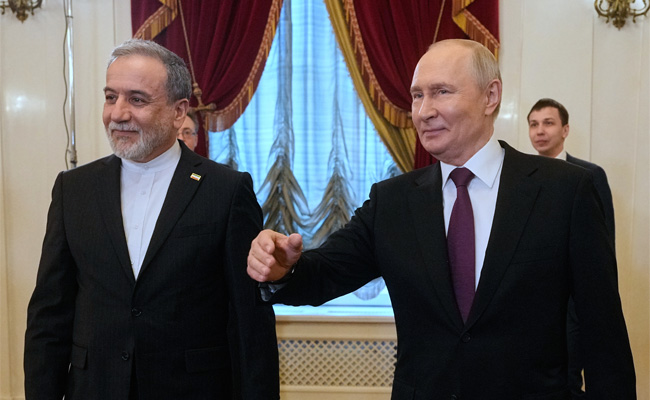
Moscow (PTI): Iran's Foreign Minister Abbas Araghchi on Monday met Russian President Vladimir Putin, who hailed the Iranian people for fighting bravely and heroically for their sovereignty and said Moscow is ready to do its best to help bring peace to West Asia as soon as possible.
Araghchi, who held talks with Omani and Pakistani leadership before arriving in Russia, met Putin in St. Petersburg and thanked him for supporting Iran, state-owned TASS news agency reported.
"Russia is ready to do everything in its power to ensure that peace in the Middle East is achieved as soon as possible," Putin said during his meeting with Araghchi, which was also attended by Russian Foreign Minister Sergey Lavrov.
Revealing that he received a message from Iranian Supreme Leader Mojtaba Khamenei last week, Putin asked Araghchi to convey his "gratitude for this message and best wishes for his health and well-being."
He praised the Iranian people for fighting "bravely and heroically" for their sovereignty, Iran's state-run PRESS TV reported.
"We really hope that, based on the courage and desire for independence, the Iranian people, under the guidance of the new leader, will weather this difficult period of trials and peace will come,” Putin said.
He also stressed that Russia “intends to maintain” its strategic relations with Iran.
Araghchi said that the world witnessed Iran’s strength in countering the US during the recent war, and that the Islamic Republic is a "stable and powerful establishment."
"With their courage, the Iranian people succeeded in resisting the US aggression and will be able to endure it,” he said.
He said that it became clear that Iran has “great friends and allies” like Russia, and conveyed “warmest greetings” from Supreme Leader Mojtaba Khamenei and President Masoud Pezeshkian to the Russian leader.
Araghchi said relations between Moscow and Tehran represent a “strategic partnership at the highest level” and will continue to develop "regardless of circumstances."
"We are grateful to you for the solid and strong positions in support of the Islamic Republic of Iran," he said.
Foreign Minister Lavrov said that the talks between President Putin and the Iranian Foreign Minister were "useful and constructive."
Kremlin Spokesman Dmitry Peskov later said that Russia is "ready to provide any good offices, any mediation services that are acceptable to the parties."
"We will be ready to do everything so that ultimately peace ensues, guaranteed peace, and that there is no return to hostilities," Peskov was quoted as saying by TASS.
He was asked how Moscow can assist in future negotiations on the Iranian settlement.
Araghchi arrived in Russia after his whirlwind trip to Islamabad, which, according to him, was “very productive” and involved “good consultations" with Pakistan's Army Chief Field Marshal Asim Munir, amid uncertainty over the second round of peace talks to resolve the war in West Asia.
"We held good consultations with our friends in Pakistan. The trip was successful. We assessed the outcome of our recent (meetings) and discussed in what direction and under what conditions talks can move on,” Araghchi said in a video posted on his Telegram channel upon his arrival in St Petersburg.
Referring to the second round of talks between the US and Iran to resolve the conflict in West Asia, Araghchi said: "Developments have taken place in the negotiations."
"Despite some progress in earlier rounds, the talks failed to reach their objectives due to the Americans' approach, the excessive demands they made, and the wrong approaches they adopted. Therefore, it was necessary to consult with our friends in Pakistan to review the latest situation,” Iran's official news agency IRNA quoted him as saying.
He said that the trip to Pakistan was a good opportunity to review developments related to the US-Israeli war against Iran, expressing confidence that “these consultations and coordination between the two countries will be highly significant.”
Araghchi arrived at St. Petersburg's Pulkovo Airport early Monday, where he was welcomed by Russian officials and Iran’s ambassador to Russia, Kazem Jalali, the report said.
The first round of peace talks between Iran and the US, held on April 11 and 12, failed to bring the desired result for the parties to the conflict.
The Iranian minister arrived in Islamabad for the second time on Sunday after a short visit to Oman, where he held talks with Sultan Haitham bin Tariq al-Said on security in the Strait of Hormuz and diplomatic efforts to end the Iran-US conflict.
After Araghchi left Pakistan for Oman on Saturday, President Donald Trump announced that US negotiators Steve Witkoff and Jared Kushner would no longer be going to Islamabad for talks with Iran, contending that Washington held all the cards on the matter.
Trump on Sunday reiterated that the US and Iranian officials can talk by phone for a peace solution to the conflict.
On Tuesday, Trump extended the two-week ceasefire with Iran indefinitely to give Tehran more time to prepare a unified proposal to end the war, just hours before the truce was set to expire.
The war began when the US and Israel jointly attacked Iran on February 28, killing Iranian Supreme Leader Ayatollah Ali Khamenei and several top commanders. The retaliation by the Islamic Republic extended the war to the entire Gulf region.