SGPC writes to Mann, seeks ban on 'Emergency' in Punjab a day before release

Amritsar, Jan 16 (PTI): The SGPC on Thursday wrote to Punjab Chief Minister Bhagwant Mann, seeking a ban on the release of Kangana Ranaut's movie 'Emergency' saying it "tarnishes" the image of Sikhs and "misrepresents" history.
Actor and BJP MP Ranaut's 'Emergency' is slated to release in cinemas on January 17.
In the letter to Mann, Shiromani Gurdwara Parbandhak Committee chief Harjinder Singh Dhami expressed strong objection to Ranaut's film.
Dhami said that if the film is released in Punjab, it will spark "outrage and anger" in the Sikh community and therefore it is the responsibility of the government to ban its release in the state.
The SGPC, an apex gurdwara body, had earlier also protested the film.
"It has come to our attention that the movie 'Emergency' produced by BJP MP Kangana Ranaut is going to be released on 17th January 2025 in cinemas in different cities of Punjab and the tickets have also started to be booked," its letter to Mann read.
Dhami said the SGPC had also protested the release of the movie in a letter to the Punjab Chief Secretary on November 14 last year.
"But it is sad that the Punjab government has not taken any step till now. If this film is released on January 17, 2025, then it is natural to create outrage and anger in the Sikh world," the current letter read.
Dhami said the SGPC will submit a letter also to all the deputy commissioners in Punjab, seeking a ban on the film in the state.
The SGPC denounced the "character assassination" of Jarnail Singh Bhindranwale, the Khalistani militant killed in 1984 in a military operation.
"If this film is released in Punjab, we will be forced to strongly oppose it at the state level," Dhami said.
In August last year, the SGPC sent a legal notice to the producers of the 'Emergency' film, alleging that it "misrepresented" the character and history of Sikhs, and asked them to remove the objectionable scenes depicting "anti-Sikh" sentiments.
In the notice, the producers of the film, including Kangana Ranaut, were asked to remove the trailer released on August 14 from all public and social media platforms and tender a written apology to the Sikh community.
The SGPC objected to film writing separate letters to the Minister of Information and Broadcasting and the Central Board of Film Certification.
Let the Truth be known. If you read VB and like VB, please be a VB Supporter and Help us deliver the Truth to one and all.
Massive turnout in assembly polls across states, women voters outnumber men: EC data
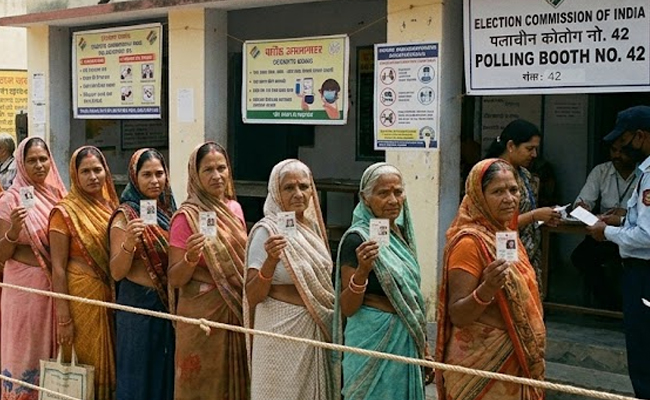
New Delhi (PTI): The recently-concluded assembly elections witnessed exceptionally high voter participation across states, with women voters outnumbering men in turnout percentages, according to Election Commission data.
West Bengal recorded the highest voter turnout among states, with 93.71 per cent polling in 293 constituencies where counting has been completed. The state saw over 6.38 crore votes cast, including postal ballots, against a total of more than 6.81 crore electors.
Women voters recorded a turnout of 93.8 per cent in the West Bengal Assembly polls, slightly higher than the 92.06 per cent participation among men.
The data for West Bengal does not include the figures for the Falta assembly constituency, which is scheduled for repolling.
Tamil Nadu registered an 85.01 per cent turnout, with nearly 4.8 crore votes polled from an electorate of 5.74 crore. Women voters recorded a turnout of 86.2 per cent, higher than the 83.77 per cent among men.
Assam also witnessed robust participation, with the final turnout touching 85.74 per cent. More than 2.15 crore votes were cast in the state, while female turnout at 86.53 per cent marginally exceeded the 84.95 per cent recorded among male voters.
Kerala registered a turnout of 78.11 per cent, with over 2.12 crore votes polled. Female voter participation stood at 81.17 per cent against 74.9 per cent among men.
Puducherry recorded a turnout of 89.82 per cent, with women voters again leading participation at 91.39 per cent. More than 8.5 lakh votes were polled in the Union territory.
Yet, women's representation among elected candidates remained modest.
Tamil Nadu elected 23 women MLAs (9.83 per cent) out of 234 members, West Bengal elected 37 women legislators (12.62 per cent) out of 293, while Kerala returned only 11 women MLAs (7.85 per cent) in the 140-member House.
Only two third-gender candidates contested the elections - one each from Tamil Nadu and Kerala, and both lost, forfeiting their deposits.
The elections also reflected extensive electoral mobilisation infrastructure. West Bengal had the highest number of polling stations at 85,092, followed by Tamil Nadu with 75,064 and Assam with 31,490.
In terms of candidates, Tamil Nadu saw the largest contest with 4,023 candidates in the fray across 234 constituencies, averaging 17 candidates per seat and peaking at 79 contestants in one constituency.
West Bengal pitted 2,920 candidates for 293 constituencies, while Kerala had the fewest contestants among the major states, with 883 candidates for 140 seats.
The data also showed relatively low NOTA votes across states. Tamil Nadu recorded the lowest NOTA share at 0.4 per cent of total votes polled, while Assam recorded the highest at 1.23 per cent. In West Bengal, 0.78 per cent of the total votes polled were NOTA, while it 0.77 per cent and 0.57 per cent of the electorate opted for None of the Above (NOTA) in Puducherry and Kerala, respectively.