Shimla water woes: Protests continue, tanker runs over woman
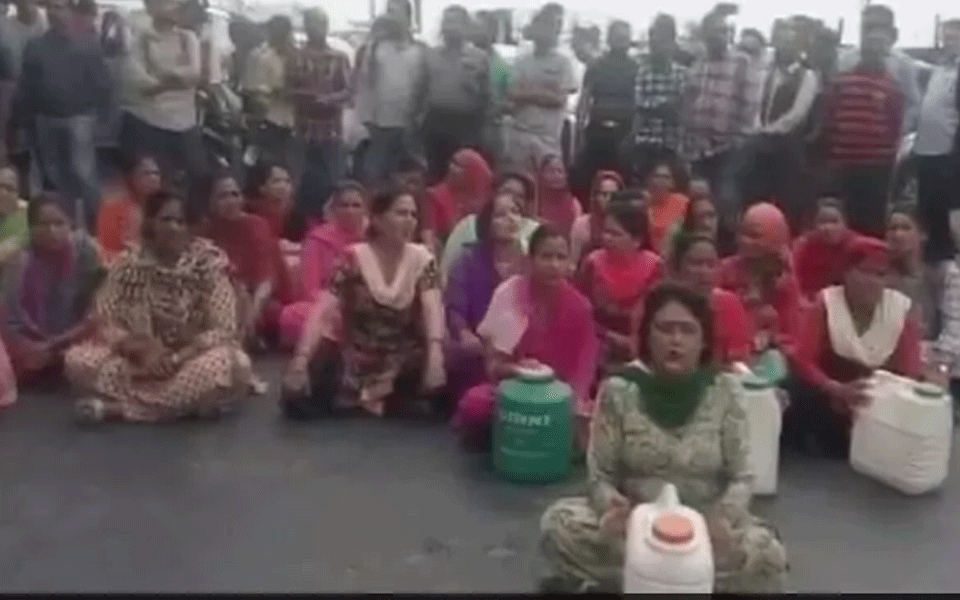
Shimla, June 2: Protests continued to rock the Himachal Pradesh capital on Saturday, as the densely populated Kusumpti area reeled under acute portable water shortage for the straight 14th day.
A water tanker driver deployed by the civic body got an epilepsy attack and run over a 65-year-old woman on the busy Mall Road, who was rushed to the Indira Gandhi Medical College and Hospital here where she was declared dead.
Assistant Superintendent of Police Praveer Thakur confirmed that the tanker driver suffered epilepsy attack due to which the woman, Uma Keprate, got hit by the tanker.
Hundreds of residents blocked the road leading to the state secretariat in Kusumpti, raising slogans against the government and the Shimla Municipal Corporation, both ruled by the Bharatiya Janata Party (BJP).
"Despite instructions by the High Court on supplying water in the city on a rotational basis, there is no water supply in this locality.
"The piped water has not been supplied for the past eight days. Three days ago I got just three buckets of water for a family of five from a government tanker," housewife Sanjana Jindal told IANS.
Residents were out on the streets protesting even late on Friday.
"We are depending on bottled water for cooking and drinking. There is no water to clean utensils and wash clothes. I have not taken bath for almost a week now.
"Our toilets are stinking literally as we are refraining from flushing them. We just managed to collect two buckets of water from rooftop when it rained in Shimla on Friday evening," college-goer Nandita Chauhan said.
"We are prepared to live with very little water but we need that little water to sustain our daily chores and personal hygiene," she said, adding: "I think the government should promote dry toilets in Shimla in order to save millions of litres of water."
The problem of water shortage persisted in Pantha Ghatti, Chhota Shimla, Vikasnagar, Kangnadhar, New Shimla and Khalini localities.
A government statement said the civic body received 24.50 million litre per day water on Friday and it was distributed as per the timetable. It said 1.70 lakh litre water was supplied to different localities through tankers.
Chief Minister Jai Ram Thakur on Saturday rushed to New Delhi to brief the Prime Minister's Office (PMO) on steps taken to restore water normalcy in Shimla.
"The PMO sought information and that is a routine one about the prevailing water crisis in Shimla. We have provided the information earlier also. Today, I have given the status report personally," Thakur told reporters in New Delhi.
Blaming the previous Congress government in the state, he said the Congress deliberately ignored the gravity of the water problem for five years.
"For the past 15 days, I am monitoring the water situation of Shimla on a daily basis and also through video conferencing if I am out of Shimla. We have improved the water supply but it still needs to be strengthened," he said, admitting that the water shortage this summer was worst in 10 years.
Officials blamed water shortage on the rising mercury and the drying up of natural water channels. Shimla has a population of nearly 200,000 that requires 42 MLD water.
Facing flak from the high court, which is monitoring the water situation on a day-to-day basis, the Municipal Corporation has disconnected the water connections of over 40 hotels for their failure to clear the pending arrears.
Issuing a slew of directives on Friday, it said all 62 keymen, who are responsible for supplying water in localities, should be kept under surveillance to ensure equitable distribution.
The court has listed the case for next hearing on June 11. It has also made it categorically clear that no individual request even to the VIPs, including the judges, would be entertained.
Let the Truth be known. If you read VB and like VB, please be a VB Supporter and Help us deliver the Truth to one and all.
Single higher education regulator bill tabled in LS; Oppn flags ‘centralisation,' JPC likely
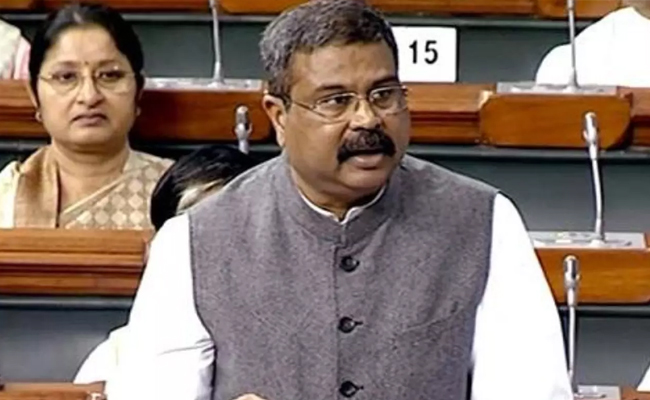
New Delhi: A bill to set up a 13-member body to regulate institutions of higher education was introduced in the Lok Sabha on Monday.
Union Education Minister Dharmendra Pradhan introduced the Viksit Bharat Shiksha Adhishthan Bill, which seeks to establish an overarching higher education commission along with three councils for regulation, accreditation, and ensuring academic standards for universities and higher education institutions in India.
Meanwhile, the move drew strong opposition, with members warning that it could weaken institutional autonomy and result in excessive centralisation of higher education in India.
The Viksit Bharat Shiksha Adhishthan Bill, 2025, earlier known as the Higher Education Council of India (HECI) Bill, has been introduced in line with the National Education Policy (NEP) 2020.
The proposed legislation seeks to merge three existing regulatory bodies, the University Grants Commission (UGC), the All India Council for Technical Education (AICTE), and the National Council for Teacher Education (NCTE), into a single unified body called the Viksit Bharat Shiksha Adhishthan.
At present, the UGC regulates non-technical higher education institutions, the AICTE oversees technical education, and the NCTE governs teacher education in India.
Under the proposed framework, the new commission will function through three separate councils responsible for regulation, accreditation, and the maintenance of academic standards across universities and higher education institutions in the country.
According to the Bill, the present challenges faced by higher educational institutions due to the multiplicity of regulators having non-harmonised regulatory approval protocols will be done away with.
The higher education commission, which will be headed by a chairperson appointed by the President of India, will cover all central universities and colleges under it, institutes of national importance functioning under the administrative purview of the Ministry of Education, including IITs, NITs, IISc, IISERs, IIMs, and IIITs.
At present, IITs and IIMs are not regulated by the University Grants Commission (UGC).
Government to refer bill to JPC; Oppn slams it
The government has expressed its willingness to refer it to a joint committee after several members of the Lok Sabha expressed strong opposition to the Bill, stating that they were not given time to study its provisions.
Responding to the opposition, Parliamentary Affairs Minister Kiren Rijiju said the government intends to refer the Bill to a Joint Parliamentary Committee (JPC) for detailed examination.
Congress Lok Sabha MP Manish Tewari warned that the Bill could result in “excessive centralisation” of higher education. He argued that the proposed law violates the constitutional division of legislative powers between the Union and the states.
According to him, the Bill goes beyond setting academic standards and intrudes into areas such as administration, affiliation, and the establishment and closure of university campuses. These matters, he said, fall under Entry 25 of the Concurrent List and Entry 32 of the State List, which cover the incorporation and regulation of state universities.
Tewari further stated that the Bill suffers from “excessive delegation of legislative power” to the proposed commission. He pointed out that crucial aspects such as accreditation frameworks, degree-granting powers, penalties, institutional autonomy, and even the supersession of institutions are left to be decided through rules, regulations, and executive directions. He argued that this amounts to a violation of established constitutional principles governing delegated legislation.
Under the Bill, the regulatory council will have the power to impose heavy penalties on higher education institutions for violating provisions of the Act or related rules. Penalties range from ₹10 lakh to ₹75 lakh for repeated violations, while establishing an institution without approval from the commission or the state government could attract a fine of up to ₹2 crore.
Concerns were also raised by members from southern states over the Hindi nomenclature of the Bill. N.K. Premachandran, an MP from the Revolutionary Socialist Party representing Kollam in Kerala, said even the name of the Bill was difficult to pronounce.
He pointed out that under Article 348 of the Constitution, the text of any Bill introduced in Parliament must be in English unless Parliament decides otherwise.
DMK MP T.M. Selvaganapathy also criticised the government for naming laws and schemes only in Hindi. He said the Constitution clearly mandates that the nomenclature of a Bill should be in English so that citizens across the country can understand its intent.
Congress MP S. Jothimani from Tamil Nadu’s Karur constituency described the Bill as another attempt to impose Hindi and termed it “an attack on federalism.”
_vb_22.jpeg)