Shubhanshu Shukla returns to India to a warm welcome
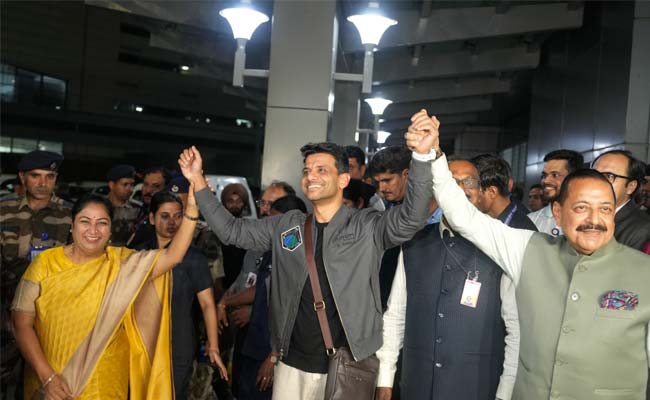
New Delhi(PTI): Astronaut Shubhanshu Shukla returned to India early Sunday after his historic visit to the International Space Station (ISS).
Shukla, who has been in the US training for the Axiom-4 mission to the ISS over the past year, was welcomed at the airport by Union Minister Jitendra Singh, Delhi Chief Minister Rekha Gupta, and ISRO Chairman V Narayanan.
Shukla's backup astronaut, Prashanth Balakrishnan Nair, also returned to the homeland.
Shukla is expected to meet Prime Minister Narendra Modi and travel to his hometown, Lucknow He is also expected to return to the capital to participate in the National Space Day celebrations on August 22-23.
"India’s space glory touches Indian soil... as the iconic son of Mother India, #Gaganyatri Shubhanshu Shukla, lands in Delhi in the early hours of this morning. Accompanying him, another equally accomplished Group Captain Prashanth Balakrishnan Nair, one of the astronauts selected for India’s first human mission Gaganyaan, who was India’s designated backup for the mission to the International Space Station #ISS," Singh said in a post on X.
Earlier on Saturday, Shukla had posted a smiling photograph of himself sitting in an aeroplane on Instagram, saying he was filled with mixed emotions as he left the US and looked forward to returning to India to share his experiences with everyone back home.
"As I sit on the plane to come back to India, I have a mix of emotions running through my heart. I feel sad leaving a fantastic group of people behind who were my friends and family for the past year during this mission. I am also excited about meeting all my friends, family, and everyone in the country for the first time post-mission. I guess this is what life is - everything all at once," Shukla said in the post.
"Having received incredible love and support from everyone during and after the mission, I can’t wait to come back to India to share my experiences with all of you. Goodbyes are hard, but we need to keep moving in life. As my commander Peggy Whitson fondly says, ‘The only constant in spaceflight is change.’ I believe that applies to life as well," he added.
Shukla also wrote, "I guess at the end of the day - 'Yun hi chala chal rahi - jeevan gaadi hai samay pahiya'," recalling the song from the Bollywood movie Swades, which was on his playlist just before he embarked on the Axiom-4 mission to the ISS on June 25 from the US.
Shukla and his backup astronaut Nair participated in the Independence Day celebrations at the Indian Consulate in Houston on Friday.
Addressing the 79th Independence Day celebrations at the Red Fort, Prime Minister Modi on Friday said India was developing its own space station and noted that Group Captain Shukla had returned from a space mission.
"Our Group Captain Shubhanshu Shukla has returned from the space station. In the coming days, he is returning to India," Modi had said.
Shukla was part of the Axiom-4 private space mission that lifted off from Florida on June 25 and docked at the International Space Station on June 26. He returned to Earth on 15 July.
Along with three other astronauts - Peggy Whitson (US), Slawosz Uznanski-Wisniewski (Poland), and Tibor Kapu (Hungary) - Shukla conducted over 60 experiments and 20 outreach sessions during the 18-day mission.
Let the Truth be known. If you read VB and like VB, please be a VB Supporter and Help us deliver the Truth to one and all.
Rickelton's ton in vain as SRH beat MI by 6 wickets
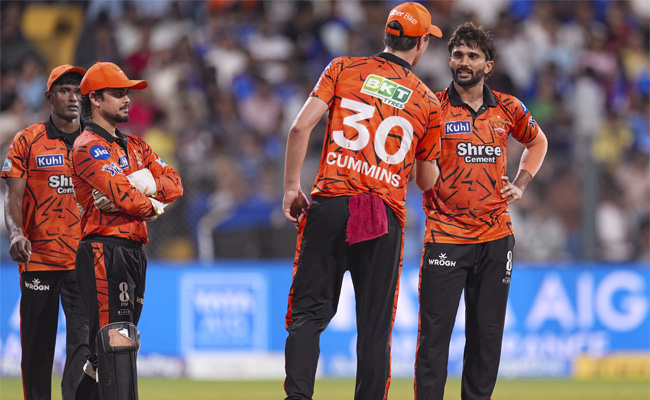
Mumbai (PTI): Ryan Rickelton's whirlwind unbeaten ton was overshadowed by Heinrich Klaasen's unbeaten 65 as Sunrisers Hyderabad defeated Mumbai Indians by six wickets in an IPL match here on Wednesday.
Chasing an imposing 244-run target, Travis Head (76 off 30) and Abhishek Sharma (45 off 24) shared 129 runs for the opening wicket to set the platform for SRH.
Klaasen (65 not out off 30 balls) then displayed his all-round hitting abilities to guide SRH home with the help of Nitish Kumar Reddy (21) and Salil Arora (30 not out off 10) in 18.4 overs.
Earlier, Rickelton's knock powered MI to 243 for five.
MI rode on a 93-run stand between Rickelton (123 not out off 55 balls) and Will Jacks (46 off 22) in 7.1 overs for the opening stand to power the side.
MI skipper Hardik Pandya scored a valuable 31 off 15 balls before being dismissed.
Praful Hinge (2/54), Eshan Malinga (1/29), Sakib Hasan (1/39) and Nitish Kumar Reddy (1/31) were the wicket-takers for SRH.
Brief Scores:
Mumbai Indian: 243 for 5 in 20 overs (Ryan Rickelton 123 not out; Praful Hinge 2/54).
Sunrisers Hyderabad: 249 for 4 in 18.4 overs (Travis Head 76, Heinrich Klaasen 65 not out; AM Ghazanfar 2/51).