SP-rank officer to lead CRPF convoys in Kashmir; maximum 40 vehicles at one time
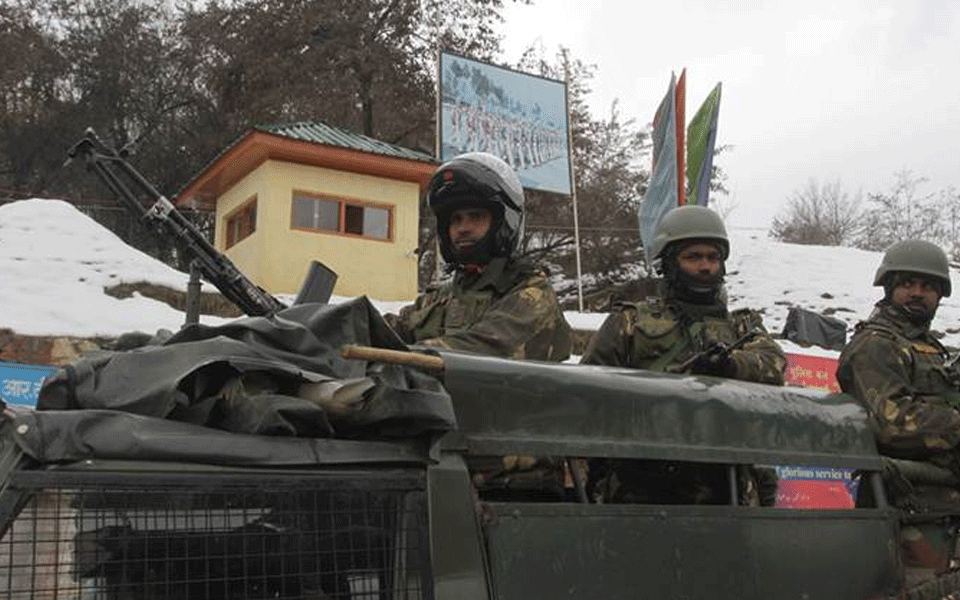
New Delhi: CRPF convoys moving to and from the Kashmir Valley will now be commandeered by a higher SP-rank officer and a single motorcade will not have more than 40 vehicles at any point of time, the paramilitary force has ordered in the wake of the Pulwama terror attack that killed 40 troops during a similar movement.
PTI has accessed a set of new standard operating procedures (SOPs) issued by the force headquarters in Delhi for vehicle-mounted movement of troops in Jammu and Kashmir, and it has also been ordered that the 'passenger manifest discipline' for each vehicle in the convoy be strictly adhered to.
Amongst the first set of changed SOPs is the move to depute a second-in-command rank officer (equivalent to Superintendent of Police rank) of the force to lead the convoy instead of the current practice of a junior Assistant Commandant-rank (Assistant SP) officer heading the entourage.
This is to ensure that the convoy is led by an experienced and senior officer who will have a better understanding and strategy to manoeuvre the convoy to and from the Kashmir Valley which is operationally very sensitive due to terrorist acts and IED threats, official sources said.
This will also upgrade the accountability hierarchy and the new convoy commander will now directly report and co-ordinate with one of the three Central Reserve Police Force Deputy Inspector General (operations) based in Kashmir.
Till now, the convoy commander or the Assistant Commandant used to report through the Commandant to their higher-ups.
The convoy commander usually travels in the lead in a communications gadget-fitted vehicle comprising armed troops for quick reaction.
It has also been decided that the convoy strength will not go beyond 40 vehicles in any case and "all possible efforts" will be made to essentially keep the number of vehicles in a motorcade to the least possible of about 10-20 for effective management and control, they said.
A CRPF bus in the fifth position of a 78 vehicle convoy was targeted by a Jaish-e-Mohammad (JeM) suicide bomber after he detonated his explosives-laden SUV near it on the Jammu-Srinagar highway in Pulwama on February 14.
The over 2,500 personnel strength convoy was being commanded by an AC-rank officer and all 39 personnel in the ill-fated bus and a sub-officer stationed on the ground, as part of a road sanitisation party, were killed in the deadly blast.
The force undertook a huge and time-taking task of identifying the bodies of its slain personnel as the blast had blown the bus and its occupants to smithereens making it difficult to identify the mortal remains as it is understood that some men changed their vehicles when the convoy last halted.
It has, sources said, hence been decided that all those who are allotted a seat in the vehicle will scrupulously stick to the seating plan and re-board the same bus or truck after the convoy resumes post a refreshment break.
A sub-officer in the rank of an Inspector or a Sub-Inspector will be responsible for ensuring that the passenger manifest of each vehicle remains intact, they said.
The convoys will also have a changed strategy of having bullet-proof mobile bunkers which are always deployed at frequent gaps in the motorcade for any armed offensive or defensive action in case of an attack.
Also, each vehicle in the convoy will have armed security personnel as usual, but their numbers and position will be changed dynamically and as per operational requirements, they said.
The CRPF, designated lead force for internal security duties and anti-terrorist operations in Kashmir, is also mulling to create a new full-fledged transit facility for its troops in Udhampur that will reduce by about 70 km, the distance between Jammu and Srinagar.
The present transit camp is in Jammu and it takes about 10-12 hours for convoys to cover about 300 km between these locations.
A transit facility in Udhampur will reduce the time taken and the risk involved in running convoys, which cannot be done away with completely despite the government recently allowing all personnel to take a flight to Srinagar from either Jammu or Delhi, they said.
The around three lakh personnel strength force has about 65 battalions or about 70,000 personnel deployed in the Kashmir Valley and has two sectors, Kashmir and Kashmir operations, headed by two Inspector General rank officers.
CRPF Director General R R Bhatnagar had last week told the news agency that they are going to procure a new fleet of mine protected vehicles, small 30-seater buses and provide more partial armour to its troop carrying buses to ensure safety of jawans post the Pulwama attack, the worst in the valley on security forces in over three decades.
Let the Truth be known. If you read VB and like VB, please be a VB Supporter and Help us deliver the Truth to one and all.
EAM Jaishankar meets Jamaican PM, gifts over 10 BHISHM Cubes
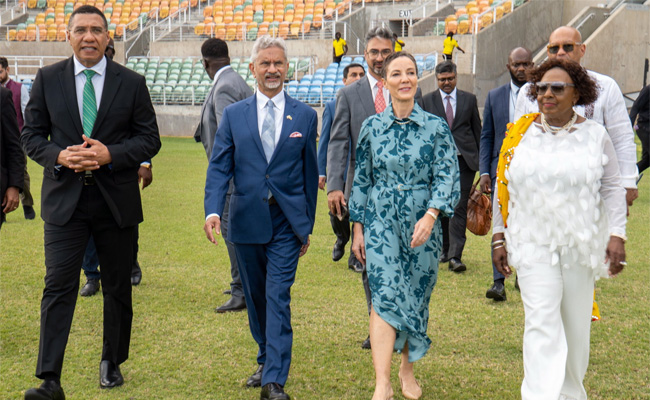
Kingston (PTI): External Affairs Minister S Jaishankar on Monday met Jamaican Prime Minister Andrew Holness and discussed ways to further deepen "political, economic and people-to-people cooperation."
Jaishankar also conveyed greetings from Prime Minister Narendra Modi to Holness.
"Pleased to call on Prime Minister @AndrewHolnessJM in Kingston. Conveyed the greetings of PM @narendramodi," Jaishankar posted on X.
"Discussed deepening our political, economic and people-to-people cooperation. Value his commitment towards further strengthening India-Jamaica relations," the post further read.
Also, the external affairs minister handed over 10 BHISHM (Bharat Health Initiative for Sahyog Hita & Maitri) Cubes as a gift to Jamaica.
"Formally handed over 10 BHISHM Cubes as a gift from India to Jamaica, in the presence of PM @AndrewHolnessJM, Health Minister @christufton and FM @kaminajsmith," Jaishankar posted on X.
"The BHISHM Cube mobile hospital system, designed for rapid deployment, will help Jamaica during disasters and emergencies. The gift of these cubes is a statement of friendship, a commitment to disaster preparedness, and an outcome of innovation," the post said.
Jaishankar arrived in Kingston on Saturday evening, marking the first leg of his nine-day tour of Jamaica, Suriname, and Trinidad and Tobago, aimed at further strengthening India's strategic and cultural ties with the Caribbean nations.
Earlier in the day, he interacted with the Indian diaspora and discussed India's ongoing transformation in infrastructure, human development and technology-driven governance and entrepreneurship with them.
He also highlighted the cricket bond between both countries as India gifted a scoreboard to Jamaica.
A scoreboard was dedicated at Sabina Park in Kingston. It is the home of the Jamaica cricket team and is the only Test cricket ground in the Caribbean island nation.
The minister expressed hope that the new scoreboard would witness many memorable innings, including those symbolising the enduring friendship between the two countries.
Cricket has long been a strong cultural bridge between India and Jamaica, which is part of the West Indies cricket team.
Jamaican players, including Chris Gayle, Courtney Walsh and Michael Holding, have played a major role in shaping the legacy of West Indies cricket in the international arena, contributing to its dominance in earlier decades and its continued global appeal.