SP's Swami Prasad Maurya asks why Lakshmi has 4 hands, gets rebuked by party
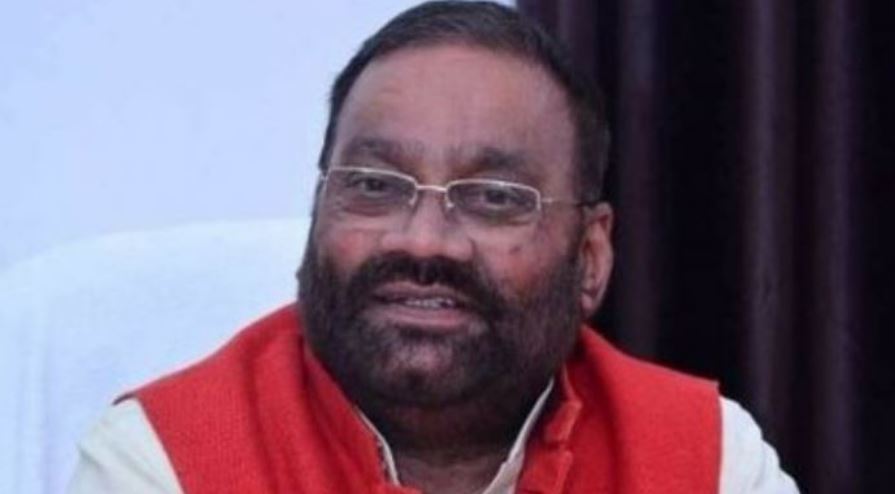
Lucknow, Nov 13: Samajwadi Party leader Swami Prasad Maurya's asking on X how Goddess Lakshmi can have four hands has attracted sharp rebuke from many, including his own party, whose spokesperson asked him to "stop harming the party."
The leader had earlier made headlines with his controversial remarks on Ramcharitmanas and Badrinath.
Among those who took exception to his comment were leaders from the Congress and the BJP.
Maurya in a post on X on Sunday, said he worshipped his wife on Diwali as she is the Lakshmi of his house, and in a true sense, a homemaker.
"... every child born in every religion, caste, race, colour and country of the whole world has two hands, two legs, two ears, two eyes and a nose with two holes. There is only a head, stomach and back; if a child with four hands, eight hands, ten hands, twenty hands and a thousand hands has not been born till date, then how can Lakshmi be born with four hands?" Maurya said in his post.
"If you want to worship Goddess Lakshmi, then worship and respect your wife who is a goddess in true sense because she fulfils the responsibility of nurturing, happiness, prosperity, food and care of your family with great devotion," read his post.
Taking an apparent dislike to what he said, SP spokesperson IP Singh asked him to stop harming the party.
He said the party does not subscribe to Maurya's remarks, which he said are his "personal views."
"When you were a cabinet minister in BJP for 5 years, you were afraid of making indecent comments on Goddess Lakshmi ji and Lord Ganesha... Stop harming the party," he wrote on X.
"Samajwadi Party respects all religions. Mainpuri's MP sister @dimpleyadav ji has returned after visiting Baba Kedarnath ji on Nov 5. Samajwadi Party has full faith in Hindu religion," Singh added.
Congress leader Acharya Pramod Krishnam on Monday said it seems Maurya has been making his comments as part of an agenda to hurt the sanatan dharma.
"... he has been continuously giving statements that have hurt the sentiment of the Hindus. Seeing and hearing his statement, it seems that he is targeting Sanatan Dharm as part of some agenda," Krishnam told PTI.
"... he should apologise for this. I urge Yogi Adityanath ji to impose a ban on statements of Swami Prasad Maurya and his speech. It seems that Swami Prasad Maurya has taken a 'supari' to finish off the SP," he added.
BJP's national spokesperson Gaurav Bhatia in a post on X said, "Hurts Hindu sentiments. He is determined to take down Akhilesh Yadav. This is a demon in a human body. Akhilesh Yadav is silent. Is all this happening only on his orders?"
Maurya on Monday said this was not the first time he said such a thing and that he had said it Last Diwali too.
"I believe everyone has the freedom to celebrate festivals. I am of the view that in true sense, the housewife is the Goddess Lakshmi of the house. Our culture also says where women are respected, there is happiness and prosperity, that home is a heaven, that is where great people reside," he told PTI.
"If the Lakshmi of the house is the housewife, then worship her, respect her, give her importance. This will increase the respect of women not only in India, but all over the world," he said.
Maurya insisted he did not mean to hurt anyone with his remark.
On X, he said, "I have only done what is practical, true, scientific, and eternal. I respect Sanatan. And, I stand by what I wrote on X. I wrote it Thoughtfully."
Maurya, a prominent OBC leader in Uttar Pradesh, who had defected to the SP from the BJP just before the 2022 Assembly elections, had earlier too stoked controversies commenting on the Ramcharitmanas and Hindu temples.
The BJP considers "Brahmin religion," which is followed by only 10 per cent of the people, as the "Hindu religion" but there exists nothing like "Hindu religion," he had earlier said.
Earlier in the year, the SP leader triggered another row claiming that certain verses of Hindu epic Ramcharitmanas "insult" a large section of the society.
He had also claimed that before becoming a Hindu pilgrimage site in the eighth century, Badrinath used to be a Buddhist monastery.
#WATCH | Samajwadi Party (SP) leader Swami Prasad Maurya says, "...In the real sense, your wife is your 'Ghar ki Laxmi', as the manner in which she manages the household, worries about it and works towards its maintenance and prosperity - nobody else can do it...So, when she is… pic.twitter.com/nojvQpH9A2
— ANI UP/Uttarakhand (@ANINewsUP) November 13, 2023
दीपोत्सव के अवसर पर अपनी पत्नी का पूजा व सम्मान करते हुए कहा कि पूरे विश्व के प्रत्येक धर्म, जाति, नस्ल, रंग व देश में पैदा होने वाले बच्चे के दो हाथ, दो पैर, दो कान, दो आंख, दो छिद्रों वाली नाक के साथ एक सिर, पेट व पीठ ही होती है, चार हाथ,आठ हाथ, दस हाथ, बीस हाथ व हजार हाथ वाला… pic.twitter.com/CP5AjKODfq
— Swami Prasad Maurya (@SwamiPMaurya) November 12, 2023
5 वर्ष बीजेपी में आप कैबिनेट मंत्री रहे तब मां लक्ष्मी जी और भगवान गणेश जी पर अभद्र टिप्पणी करते हुए डरते थे।
— I.P. Singh (@IPSinghSp) November 13, 2023
आपकी बेटी बदायूं से सांसद हैं अपने को सनातनी बताती हैं कोई पूजा-पाठ नहीं छोड़ती। कम से कम आप अपने बेटे बेटी को समझा लेते।
पार्टी को नुकसान पहुँचाना बन्द करिये।
ये आपके… https://t.co/BRwXom9h4k pic.twitter.com/RL7uxGao8E
Let the Truth be known. If you read VB and like VB, please be a VB Supporter and Help us deliver the Truth to one and all.
Several Gurugram schools receive hoax bomb threats

Gurugram (PTI): Several Gurugram schools received another hoax bomb threat emails on Wednesday morning, prompting police to launch searches on the premises.
Police said the email was sent by the 'Khalistan National Army', with threats issued to Haryana Chief Minister Nayab Singh Saini to declare April 29 as the "40th Khalistan Declaration Day". It also threatened to bomb the Red Fort in Delhi.
Police said it was a hoax as no suspicious items were found after an intensive search.
Several schools, including Shri Ram, Amity, and the HDFC school, received threatening emails at 8.33 am, when classes had already begun, police said.
The school administrations became aware of the threats around 9 am and immediately informed the police, a senior police officer said.
The schools immediately implemented emergency protocols, with many declaring a holiday and asking parents to take their children home safely, the officer said.
A large number of anxious parents gathered outside the schools, as police and bomb squad teams reached the spots and started checks.
"Around 10 schools have approached the police from morning until now over bomb threats. Police teams are alert, and searches are underway on all the premises", the officer said.
As soon as the information about this email was received, police in Gurugram and Delhi swung into action and started investigation.
Schools immediately implemented emergency protocols upon receiving the mail. Many schools declared a holiday and sent messages to parents, asking them to take their children home. Large crowds of parents gathered outside the schools.
The schools were sanitised by sending a bomb disposal squad as well as a dog squad.
A senior police officer said that police teams thoroughly searched the school premises, classrooms, buildings, and surrounding areas. No suspicious objects or explosive materials were found during the investigation.
"Police teams are seriously investigating the entire matter. Cyber experts are being consulted to determine the authenticity of the email, its source, and the identity of the sender", added the officer.
This is the third time since January that schools have received fake bomb threats.
In March, at least a dozen schools in the city received bomb threat emails, which later turned out to be hoaxes.
Similarly, on January 28, as many as 13 schools received hoax bomb threats via email, forcing authorities to evacuate campuses and suspend classes.
Last month, police arrested a Bangladeshi national whose email ID was allegedly used to make a bomb threat for some payment.