'Staff ignored smoke, fled when blaze erupted,' say victims' kin after Jaipur hospital fire
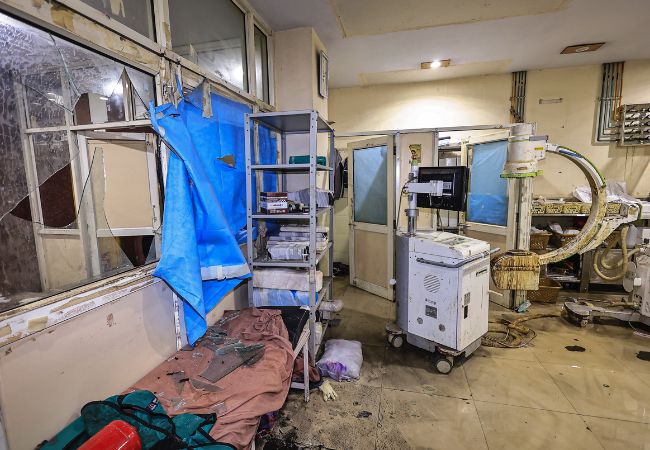
Jaipur (PTI): In the wake of the fire that killed six people at the Sawai Man Singh Hospital's Trauma Centre here, the victims' families accused the hospital staff of disregarding their warning about smoke and fleeing the premises when a blaze eventually broke out.
A fire on Sunday night at the hospital claimed the lives of six critically ill patients due to burns and suffocation.
The hospital is the biggest government-run facility in the state and treats patients from across Rajasthan, and caters to critically ill patients referred from district hospitals, as well as other states.
The trauma centre is located opposite the main hospital building on Tonk Road.
The fire broke out in a store room of an ICU on its second floor, where 11 patients were admitted – six of whom died. A second ICU on the same floor had 14 patients, all of whom were evacuated in time.
Those who died were Pintu from Sikar, Dilip and Bahadur from Jaipur, Shrinath, Rukmini, and Kusuma from Bharatpur.
The attendants of the patients alleged that the hospital staff ignored early warnings about the blaze and fled as the fire spread.
They also claimed that police pushed them away as they tried to get updates on the condition of their loved ones.
On Monday, family members protested outside the facility and shouted slogans against the state government, as Deputy Chief Minister Prem Chand Bairwa and Minister of State for Home Jawahar Singh Bedham visited the hospital.
Attendants of two patients earlier accosted Parliamentary Affairs Minister Jogaram Patel and Minister Bedham to complain about the staff's negligence.
"We noticed smoke and immediately informed the staff, but they did not pay any heed. When the fire broke out, they were the first to run. Now, we cannot get any information about our patients. We want to know their condition, but no one is telling us," one of the attendants said.
During Chief Minister Bhajanlal Sharma's visit to the hospital, some of the family members alleged that they were pushed away by the police.
Omprakash, a cousin of one of the victims, Pintu, told reporters about the hospital staff's alleged indifference.
"As soon as the smoke began to rise, we alerted the staff, but no one paid attention. It was not until 20 minutes later that the fire engulfed the entire ward. Instead of helping the patients, the hospital staff fled," he said.
Omprakash said it was horrific inside, and it took them more than 90 minutes to take his brother out.
"His body was not burnt, but his face was completely blackened from the smoke. When we took him outside, there were no doctors," he said.
The son of another deceased, Rukmani, recalled the moment the fire broke out.
"My mother was recovering well, but then this disaster happened. When the smoke began to fill the ward, there were 15 to 16 people there. Everybody tried to evacuate their patient," he said.
Jogendra, a relative of one of the patients, said the smoke was so thick that they could see nothing.
"No one helped my mother. My elder brother grabbed a torch from the hospital staff, found our mother, and brought her out. We could not save her... we could not do anything," he said.
Some of the attendants, who were outside the trauma building, tried to enter soon after the fire in a desperate bid to save their family members, but were pushed back by the staff.
Those inside were seen rushing the patients to safety, with some even wheeling beds outside the building.
Later in the day, the family members and relatives sat outside the trauma centre in protest.
Bedham promised the protesting family members "all possible help."
"The CM visited the hospital last night and gave strict instructions to officials. We are monitoring the situation and are in constant touch with him. Discussion with the agitating family members has been held. The government will extend all possible help," he told reporters.
Meanwhile, the state government has constituted a committee to investigate the cause of the fire and the hospital's response. The committee is tasked with reviewing the fire safety measures, the evacuation process, and the role of the hospital management during the emergency.
The Jaipur Police has formed a committee comprising experts from FSL and the fire department to investigate the incident.
The fire, which broke out due to a suspected short circuit, quickly spread smoke and toxic gas, making it impossible for the hospital staff to rescue all patients in time, it was claimed.
Trauma centre's in-charge Dr Anurag Dhakad described the situation as a "grave emergency."
"There were 11 patients in the ICU when the fire broke out. While five patients were successfully rescued, the rapid spread of smoke and toxic gas filled the ICU. We had our own firefighting equipment, which we used immediately. However, by the time we managed to rescue the five patients, the situation had worsened and toxic gas had spread extensively," he said.
Another senior doctor recounted the chaos.
"The on-duty residents informed us that a spark suddenly ignited, and soon after, the entire ward was filled with smoke. Nursing staff and ward boys moved quickly to evacuate patients from the ICU. However, the fire and smoke triggered panic in other wards as well. Attendants and hospital staff began evacuating patients with their beds to safety," Dr Jagdish Modi said.
He said that after the incident, patients were moved to alternate ICU wards. "We have since shifted patients back to their wards, and an observation team has been deployed to monitor the situation."
The ICU next to the one where the fire originated was also under threat. This ICU had 14 patients, who were relocated to another ward to ensure their safety.
Let the Truth be known. If you read VB and like VB, please be a VB Supporter and Help us deliver the Truth to one and all.
KKR defeat LSG via Super Over
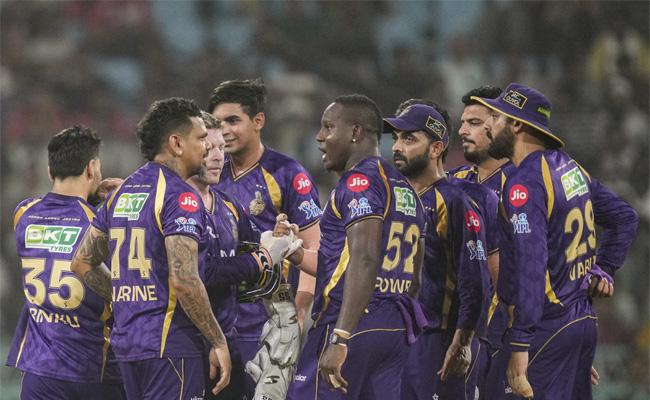
Lucknow (PTI): Kolkata Knight Riders edged Lucknow Super Giants via Super Overs in a battle between two bottom-placed teams in the IPL, here on Sunday.
Chasing a modest 156, LSG suffered a batting collapse and managed to tie the contest and take it to Super Over with No. 9 Mohammed Shami striking a last-ball six against a wayward Kartik Tyagi, who leaked 16 runs in the final over.
But Sunil Narine bowled a stunning Super Over conceding just one run and taking two wickets to give KKR an easy target.
Rinku Singh then finished the chase with a boundary off first ball from Prince Yadav.
Earlier the KKR were in deep trouble with 93/7 in 15 overs but Rinku smashed a sensational 83 not out from 51 balls including four sixes in a row in the final over to lift them to 155/7.
Cameron Green (34) was the only other batter to reach double-digit scores as KKR suffered a familiar batting meltdown with Mohsin taking his maiden fifer.
In reply, LSG continued their dismal show with the bat to succumb to their fifth loss in a row.
Brief Scores:
Kolkata Knight Riders 155/7; 20 overs (Rinku Singh 83 not out, Cameron Green 34; Mohsin Khan 5/23). Lucknow Super Giants 155/8; 20 overs (Rishabh Pant 42). KKR won via Super Over.