''Still a democracy?'': Priyanka Gandhi hits out over party leaders'' detention
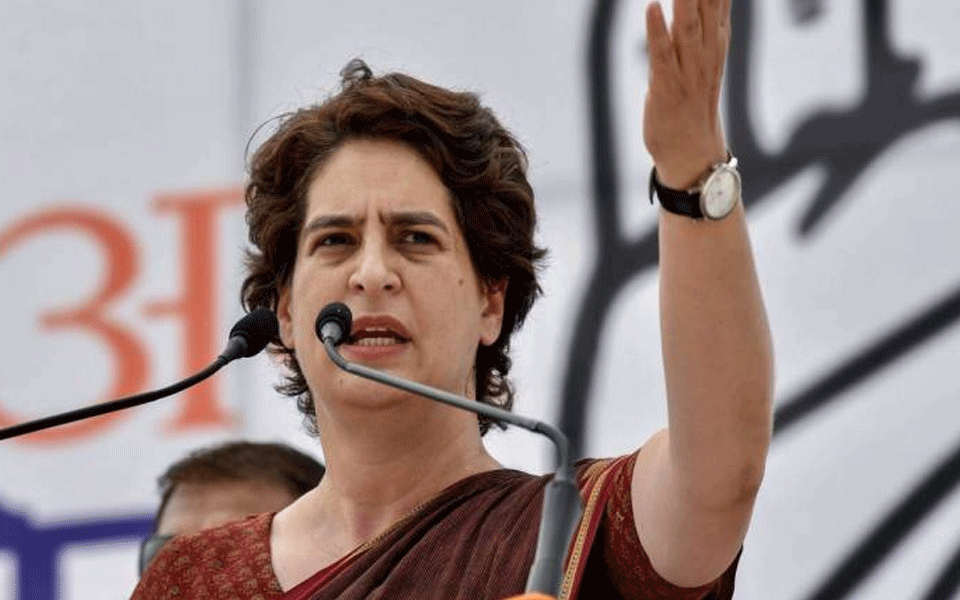
New Delhi: Congress leader Priyanka Gandhi Vadra hit out at the government on Saturday, asking on what grounds her party's leaders were taken into custody in Jammu and Kashmir.
She asked whether it was a crime to speak to the media after the state unit of the Congress was prevented from addressing a press conference on Friday as police detained its chief spokesperson Ravinder Sharma and place its Jammu and Kashmir president Ghulam Ahmed Mir under house arrest.
"On what grounds have Congress leaders in J&K been arrested? Is it a crime to speak to the media? It's now 15 days since ex CM's who respected and abided by the Constitution of India just like our leaders, have been under arrest (sic)," she said on Twitter.
"Even their families have not been allowed to communicate with them. Does the Modi-Shah Government believe India is still a democracy? (sic)," she said in the tweet with hashtag "StopIllegalArrestsInKashmir".
Senior Congress leader P Chidambaram dubbed the detention of Mir as "outrageously illegal" and hoped that courts will take cognizance of the matter.
In a series of tweets, the former finance minister said Mir is under house arrest in Jammu since Friday.
"There was no written order of detention. Outrageously illegal ... I hope the courts will act and secure the liberty of citizens," he tweeted.
On Friday, Congress leader Rahul Gandhi and Leader of Opposition in Rajya Sabha Ghulam Nabi Azad had condemned the arrest of Mir and senior leader Ravinder Sharma in Jammu.
"I strongly condemn the arrest of our J&K PCC Chief, Shri Ghulam Ahmed Mir & spokesperson, Shri Ravinder Sharma in Jammu today. With this unprovoked action against a national political party, the Govt has delivered democracy another body blow. When will this madness end?" Gandhi wrote on Twitter.
Azad said while the state and the central government were asserting that the situation was normal in Jammu and people were celebrating the Centre's decision to abrogate the constitutional provisions that gave a special status to Jammu and Kashmir, opposition leaders were not even allowed to address press conferences.
Let the Truth be known. If you read VB and like VB, please be a VB Supporter and Help us deliver the Truth to one and all.
11k litres of milk poured into Narmada river after religious event; environmentalists see red
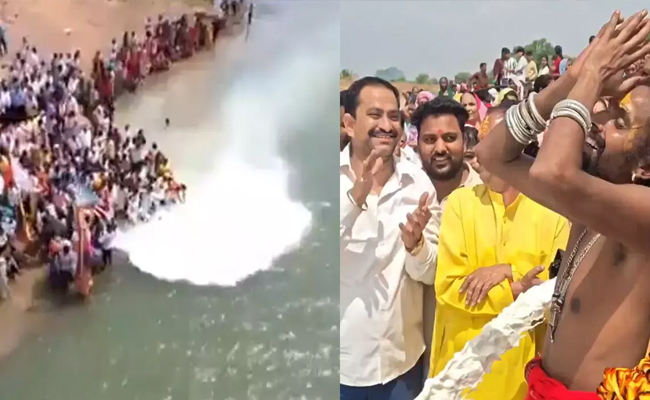
Sehore (PTI): Around 11,000 litres of milk were poured into Narmada river, often called the lifeline of Madhya Pradesh, in Sehore district on the culmination of a 21-day religious event as part of a sanctification ritual, prompting environmentalists to flag its negative impact on the ecosystem.
The event concluded at Satdev village in Bherunda area, located about 90 km from the district headquarters, with a 'mahayagna' on Wednesday.
The milk was offered to the river as part of rituals and prayers for the purity of the waters, the well-being of pilgrims and prosperity, organisers said.
The milk was brought in tankers to the riverbank and later poured into the flowing water amid chanting of mantras in the presence of a crowd of devotees.
However, environmentalists raised concerns over the practice, warning of its potential ecological impact.
"Such large quantities of organic matter can deplete dissolved oxygen in water, adversely affecting the river ecosystem. These impact local communities dependent on the river for drinking water and threaten aquatic life as well as domestic animals," noted environmentalist and wildlife activist Ajay Dube said.
Religious offerings should be symbolic and mindful, he asserted.
Renowned environmentalist Subhash Pandey said 11,000 litres of milk acts as a significant organic pollutant.
"It is highly oxygen-demanding and can lead to oxygen depletion, aquatic mortality, eutrophication (process of plants growing on river surface) and loss of potability. These effects are predictable from dairy-effluent chemistry and have been documented in similar incidents worldwide," Pandey pointed out.
Narmada originates at Amarkantak in the state and traverses 1,312 km westward to Maharashtra and Gujarat, emptying into the Arabian Sea via the Gulf of Cambay.
It is the largest west-flowing river in the peninsula, passing through a rift valley, and acts as a crucial water source for irrigation in MP, Gujarat and Maharashtra.