Supreme Court grants week's time to opposition leaders for filing reply on EC affidavit
Counting of VVPAT slips

New Delhi: The Supreme Court Monday asked 21 opposition leaders to file within a week their reply on the Election Commission's affidavit on their plea regarding Voter Verifiable Paper Audit Trail (VVPAT) slips in Lok Sabha polls.
The opposition leaders led by Andhra Pradesh Chief Minister N Chandrababu Naidu had sought that VVPAT slips of at least 50 per cent of voting machines in each assembly constituency be checked randomly during Lok Sabha polls next month.
A bench headed by Chief Justice Ranjan Gogoi asked senior advocate A M Singhvi, appearing for Opposition leaders, to file the reply by next Monday.
The poll panel had on Friday last sought dismissal of the petition.
In its affidavit, the EC had asserted in the apex court that opposition leaders have been unable to raise any ground for altering the existing system of random counting of VVPAT slips from one polling booth per assembly segment, which was "found to be most suitable" after due studies and tests.
The poll panel currently adopts a system of counting of VVPAT slips in one polling booth per assembly constituency in the Assembly polls and in one polling booth in each assembly segment for the Lok Sabha polls.
"Any further increase in the sample size of verification will lead to very negligible gain in the confidence level," the poll panel had said.
It had said the issues raised by parties have already been considered, studied and determined and the decision has been taken to conduct the present elections by adopting the prevalent system of counting of VVPAT slips.
The EC, which was asked on March 25 by the apex court to give its view on increasing the number of random sample surveys from one booth per assembly segment, had said that in the future elections it may consider suggestions for further improving the holding of polls in free and fair manner.
"It is submitted that with the imminent elections issues raised in the instant petitions are matters that have already been considered, studied and determined by the Election Commission of India and have since culminated in adopting the course of conduct of the imminent election in the present manner," the EC had said in its affidavit.
It had said the writ petition filed by 21 opposition leaders, "does not raise any ground or base for altering the existing system at this juncture and it is accordingly prayed that the present system as decided to be adopted for the imminent elections be continued with and the petition dismissed. "
The poll panel had maintained that it was always open to bringing about any improvements that would further the cause of free and fair elections.
"In so far as the grievances and reliefs prayed for in the instant writ petitions are concerned, these are all matters to which the Election Commission of India has applied itself, and after due studies and tests has arrived at the conclusion that the method as presently adopted has been found to be most suitable," the affidavit had said.
The poll panel had said that if at all with regard to future elections, any other suggestions that have not been considered are brought up, it would immediately look into the same in order to consider their efficacy and utility to the ultimate objective of conducting free and fair polls.
The affidavit had said that the 21 opposition leaders have not disclosed "even one specific instance for this Court to come to a conclusion that the existing system would in any manner adversely influence the free and fair elections."
Further, the poll panel had said that the petition does not raise any new or different apprehension or grievance as was raised in the earlier cases, nor brings out any grave or serious reason requiring a revamping of the system that has been adopted for the purpose of the conduct of the 2019 elections.
"It is further submitted that when the polls are imminent and polling is to commence from April 11, 2019, to now seek to alter the system adopted by the Election Commission of India at this stage might not be feasible," the affidavit had said.
In addition, the poll panel, which had opposed the petition of 21 opposition leaders, said 50 per cent VVPAT slip verification in each assembly segment of a Parliamentary Constituency or Assembly Constituency on an average shall enlarge the time required for counting to about six days.
"It is also relevant to mention that in many Assembly Constituencies, there are more than 400 polling stations, which will require about 8-9 days to complete the VVPAT slip count. It is pertinent to mention that demands for re-count that routinely arise of the VVPAT slips themselves, which will compound the time requirement," the affidavit had said.
It had further said that increased VVPAT slip counting will require extensive training and capacity building of election officials in the field and substantial increase of such officials will be required for deployment in the field.
Let the Truth be known. If you read VB and like VB, please be a VB Supporter and Help us deliver the Truth to one and all.
Stalin claims DMK secured 1.54 crore votes
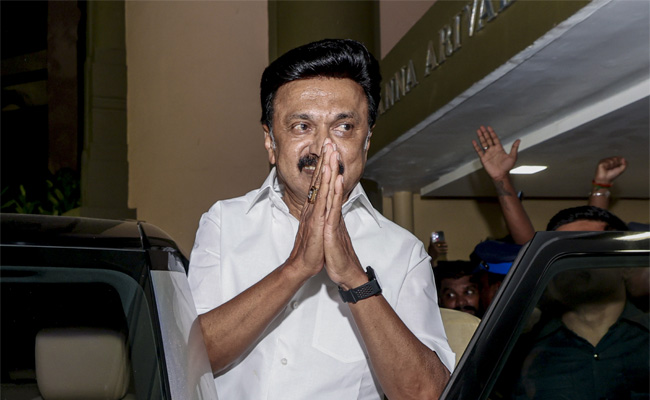
Chennai (PTI): DMK president M K Stalin on Tuesday, in a veiled reference to the TVK, claimed that the party that won additional constituencies has gained only 17.43 lakh more votes than the DMK.
He was referring to the April 23 Assembly polls where the DMK and its allies secured 74 seats, with the Dravidian party netting 59 constituencies.
In a statement, Stalin said, "the percentage difference in votes between us and them is just 3.52 per cent," in an apparent reference to the Vijay-led Tamilaga Vettri Kahzagam emerged victorious in the polls, the results of which were announced on Monday.
Claiming that the DMK alliance has secured 1.54 crore votes, Stalin said, "I consider each and every one of your votes as an invaluable token of trust".
Stating that DMK has been in power several times, he said "there is no victory we have not seen and there is no defeat we have not faced".
"Whether in victory or defeat, those who regard them equally and continue their journey toward their ideals are the comrades of the party", he said adding "you are the lifeblood and roots of the movement".
"The harvest of 1.54 crore votes is the fruit of your commitment", he said.
"What return can I offer for your hard work? With the feeling of being the chief worker, we will continue our journey," the DMK chief added.
Stalin said "if we are the ruling party, we will formulate schemes for the people. If we are the opposition party, we will fight for the people's demands. In that regard, now as a strong opposition party, we will continue to work for the people".
Asserting that the DMK will continue the journey of taking forward the policies of the century-old great Dravidian movement, protecting race, language, and nation, the DMK leader said "in our journey, I will not leave anyone behind. We will win again".