Supreme Court permits notification of uncontested seats in WB panchayat polls

New Delhi, Aug 24 : The Supreme Court on Friday permitted the notification of the results of about 21,000 uncontested seats in the recently held West Bengal panchayat polls, ruling out that there was no provision for the filing of e-nomination in the statute.
Of the 21,000 uncontested seats, 20,000 were won by the ruling Trinamool Congress (TMC).
Taking recourse to its plenary powers under Article 142, the bench of Chief Justice Dipak Misra, Justice A.M. Khanwilkar and Justice D.Y. Chandrachud, however, permitted the aggrieved candidates who could not file their nomination papers in the seats that went uncontested, to move the election tribunal within 30 days.
Both the Bharatiya Janata Party and the Communist Party of India-Marxist had alleged that the ruling party people had obstructed them from filing the nomination papers.
Holding that there was no provision for e-filing of the nomination papers, Justice Chandrachud said that any challenge to an election should take place in accordance with the procedure known to law.
He said obstruction to filing nomination papers is a serious matter.
The top court verdict came on a plea by the West Bengal State Election Commission, challenging the Calcutta High Court's May 8 order permitting e-nominations and reading the provision of the Information Technology Act into the Representation of People Act.
On July 3, the apex court had said that it would examine whether the high court, in exercise of its powers under Article 226 of the Constitution, could permit e-filing of the nomination papers by reading the provision of Information Technology Act into the Representation of People Act.
Let the Truth be known. If you read VB and like VB, please be a VB Supporter and Help us deliver the Truth to one and all.
3 Indians injured after fire breaks out in UAE's Fujairah due to drone attack
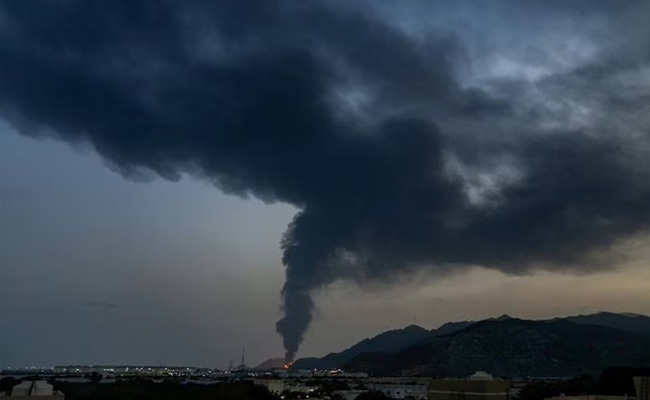
Dubai (PTI): Three Indian nationals were injured on Monday after a fire broke out on the Fujairah Petroleum Industries Zone (FOIZ) in the UAE following a drone strike originating from Iran, according to local media reports.
The relevant authorities in the eastern emirate of Fujairah confirmed that a fire has broken out in the FOIZ, resulting from a drone attack coming from Iran, the state-run WAM news agency reported.
Fujairah Civil Defence teams immediately responded to the incident and are continuing efforts to bring the fire under control, it added.
Three Indian nationals sustained moderate injuries after the fire broke out on the FOIZ, the Khaleej Times reported, quoting authorities in Fujairah.
The injured were taken to the hospital for treatment, it added.
In a post on X, the UAE's Ministry of Defence said that Iran launched four missiles toward various areas across the country. "Three were successfully engaged over the country's territorial waters, while one fell into the sea," it said.
The ministry urged the public to comply with all public safety procedures when warning messages are issued to the public.
Authorities have urged the public not to circulate rumours and to rely only on official sources for information, Gulf News reported.