Supreme Court rules 'creamy layer' must be excluded from SC/ST reservations
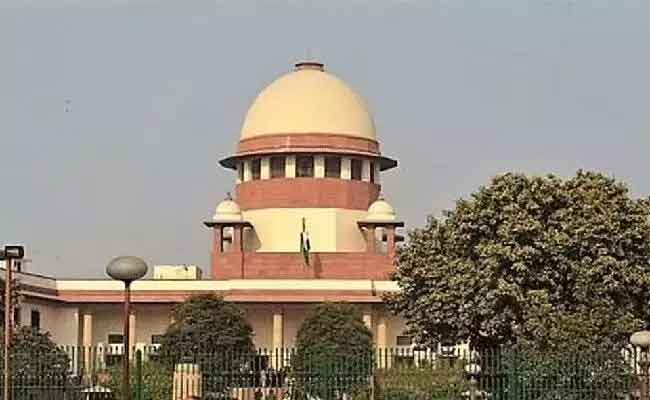
New Delhi: In a significant ruling, the Supreme Court has mandated that the 'creamy layer' among Scheduled Castes (SCs) and Scheduled Tribes (STs) be excluded from reservation benefits. This decision aims to ensure that reservations reach those who are genuinely disadvantaged within these communities.
Currently, the 'creamy layer' concept applies exclusively to reservations for Other Backward Classes (OBCs). The Court’s judgment, delivered by Chief Justice of India DY Chandrachud and Justices BR Gavai, Vikram Nath, Bela Trivedi, Manoj Misra, and Satish Chandra Sharma, allows for the sub-classification of SCs and STs. Justice Trivedi was the sole dissenting voice.
The ruling requires states to develop a policy to identify and exclude the creamy layer among SCs and STs. Justice Gavai emphasized that this step is crucial for achieving true equality as guaranteed by the Constitution. He argued that individuals from SC backgrounds who have benefited from reservations should not be compared to those who have not received such benefits.
Justice Vikram Nath supported this view, asserting that the creamy layer principle applicable to OBCs should also be extended to SCs. Justice Pankaj Mithal proposed that reservations should be limited to the first generation, with subsequent generations not being eligible if the first generation has already benefited from them.
Justice Satish Chandra Sharma concurred with Justice Gavai, asserting that identifying the creamy layer within SCs and STs should be a constitutional imperative.
The ruling builds on the 2018 decision in Jarnail Singh v. Lacchmi Narain Gupta, where the Court had observed that applying the creamy layer principle to SCs and STs does not alter the Presidential List under Articles 341 and 342 of the Constitution. Justice RF Nariman, in that case, noted that the purpose of reservations is to uplift backward classes to ensure they can compete equally with other citizens, which is undermined if the creamy layer within these classes monopolizes reservation benefits.
Let the Truth be known. If you read VB and like VB, please be a VB Supporter and Help us deliver the Truth to one and all.
Two injuries, one DNF, a DQ as India end messy World Relays campaign
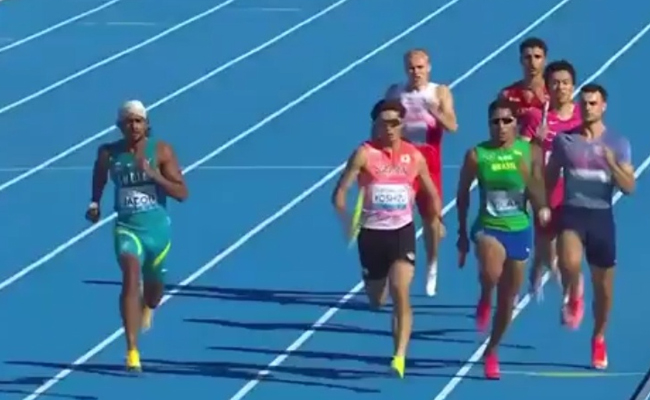
Gaborone (Botswana) (PTI): Amoj Jacob and Ragul Kumar got injured during the men's 4x400m and 4x100 races respectively as India ended their World Athletics Relays campaign in disappointment on the second day of competitions here on Sunday.
The Indian camp had high hopes of making the 2027 World Championships in the men's 4x400m relay but the team did not finish (DNF) the race as Jacob suffered cramps and pulled out of the race after taking the baton from the first leg runner Dharamveer Choudhary. Rajesh Ramesh and Vishal TK were to run in the third and fourth legs.
Those teams which could not qualify for the 2027 Beijing World Championships by reaching the final round of each of the six relay events on Saturday were given another chance in the second qualification round on Sunday.
The top two teams in each of the two heats (in all six relay events) booked the Beijing ticket on Sunday.
India will now have to try and qualify for the World Championships through the Top Lists of the World Athletics, which is a long and tedious process.
In the men's 4x100m race, third leg runner Ragul Kumar fell down the track after failing to hand over the baton inside the exchange zone to fourth leg runner Gurindervir Singh, which clearly showed the lack of coordination among the runners.
Harsh Santosh Raut and Animesh Kujur ran the first two legs.
The Indian quartet was disqualified and Kumar was seen being taken away from the Field of Play with the help of the volunteers.
It was a comedy of errors in the case of the women's 4x100m race, which saw the baton being dropped during an exchange between first leg runner Tamanna and second runner Nithya Gandhe, though the Indians finished the race in 53.09 seconds.
Gandhe started running quite a distance, but after realising that the baton was not in her hand, she turned and ran back to pick it up.
The only silver-lining for the Indian contingent was the national record time in the mixed 4x100m relay race, though the quartet of Ragul Kumar, Nithya Gandhe, Animesh Kujur and Sneha SS finished sixth in heat number two with a time of 41.35 seconds, bettering the previous national mark of 42.30 seconds set in March in Chandigarh.
The mixed 4x400m relay quartet of Theerthesh P Shetty, Kumari Saloni, Nihal William and Rashdeep Kaur ended at fifth in heat number one with a time of 3 minutes and 19.40 seconds.
On Saturday, all the five Indian relay teams had failed to make it to the respective final rounds and thus missed out on the 2027 World Championships berths.