Sushma Swaraj says BJP will turn up poll heat on air strike sceptics
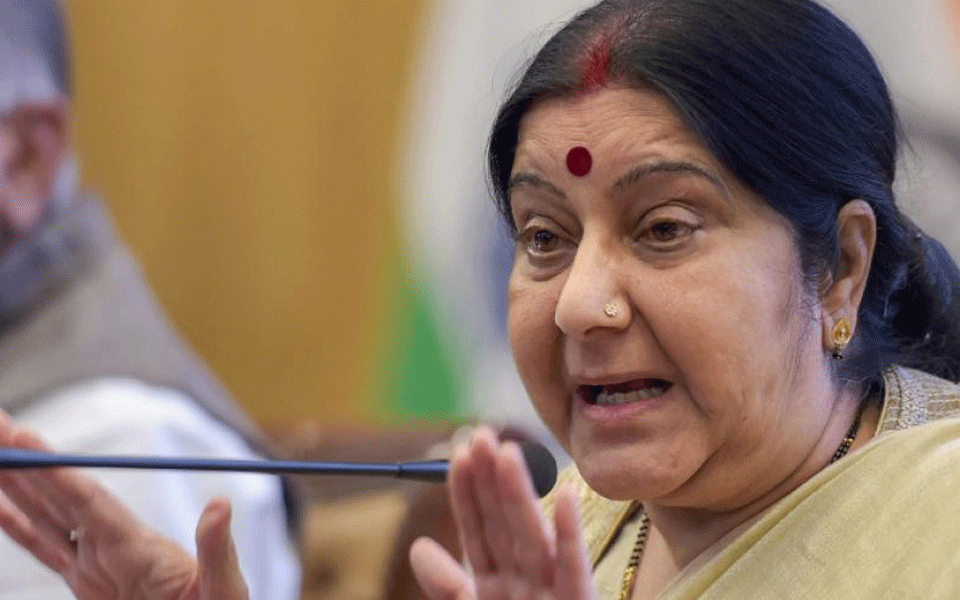
Mumbai: The BJP will use leaflets to ask people whether they would vote for parties that questioned the valour of the country's armed forces in connection with the February 26 air strike and the aerial engagement with Pakistan fighter jets the next day.
Speaking at a gathering of the BJP's women workers here on Sunday, senior leader and External Affairs Minister Sushma Swaraj signalled that the military action against Pakistan after the February 14 Pulwama attack would be a poll issue for the ruling party.
"We should ask questions about whether our jawans should count the dead bodies (after dropping bombs on terror camps) or return safely after carrying out the air strike. BJP workers should ask counter-questions to those who raise doubts about the impact of our air strike," Swaraj said.
The February 26 air strike is at the centre of a political slugfest with some opposition parties demanding that the Narendra Modi government furnish proof of its efficacy in terms of terrorist casualties at the Jaish-e-Mohammed camp that was bombed.
"We (BJP) should ask questions like whether you (voter) will support parties that side with separatists. We should ask people whether they want to vote for those who question the valour of our jawans," she said.
"We will have two leaflets of which one will be about these logical counter statements. BJP workers should use it during the poll campaign. The other leaflet will be about government welfare schemes for women. The two leaflets will be made available soon," Swaraj said.
Speaking at the function, Swaraj said, "This is my last public appearance before the model code of conduct comes into force. At the same time, it is my first rally to ensure a second term for Prime Minister Narendra Modi."
The country was full of nationalistic fervour now, she said, adding that she wanted its people to be safe under the leadership of Modi.
"I was also asked about this third surgical strike by a local BJP leader. I told him that the third surgical strike is going to be done by this country's voters on expectations and plans of the opposition," she said.
"It will prove predictions of political pundits wrong and there would be a mammoth mandate again in support of Prime Minister Narendra Modi. This will be the third surgical strike, which voters will do," she said.
Earlier, Union Home Minister Rajnath Singh had said on Saturday at a public rally in Karnataka that there had been three surgical strikes in the last five years.
Singh, however, had added that he would not reveal details of the the third cross-border action.
Swaraj also praised the Ujjwala Yojana, under which LPG cylinders are being given to rural families.
"Earlier, rural women had to waste time collecting wood, and then carry it on their heads. It used to cause hair loss among women. The smoke from the wood fire would affect their eyes. With this LPG scheme, we have prevented hair loss and eyes getting exposed to smoke," she claimed.
Let the Truth be known. If you read VB and like VB, please be a VB Supporter and Help us deliver the Truth to one and all.
Over 1 lakh students appear for NEET across TN
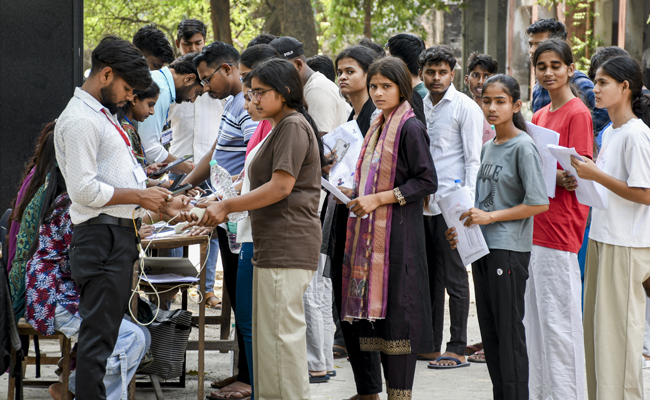
Chennai (PTI): About 1.4 lakh students appeared for the NEET 2026 exam for admission to medical degree courses across 31 centres in Tamil Nadu on Sunday.
Students claimed that the exam paper was easier than the previous year.
Organised by the National Testing Agency (NTA), 22.80 lakh students had registered for the National Eligibility cum Entrance Test (NEET) undergraduate exam nationwide.
NTA sources said that CCTV surveillance was installed at all examination centres, with feeds linked to centralised control rooms.
In view of the large candidate volume and prevailing summer conditions, the NTA ensured reliable power back-up, including generators at all centres, to ensure candidate comfort during the exam. Also, drinking water and on-site medical support were provided to students.
The sources further said that no malpractices were reported, especially in Chennai. The results of NEET are expected to be declared in June, 2026.