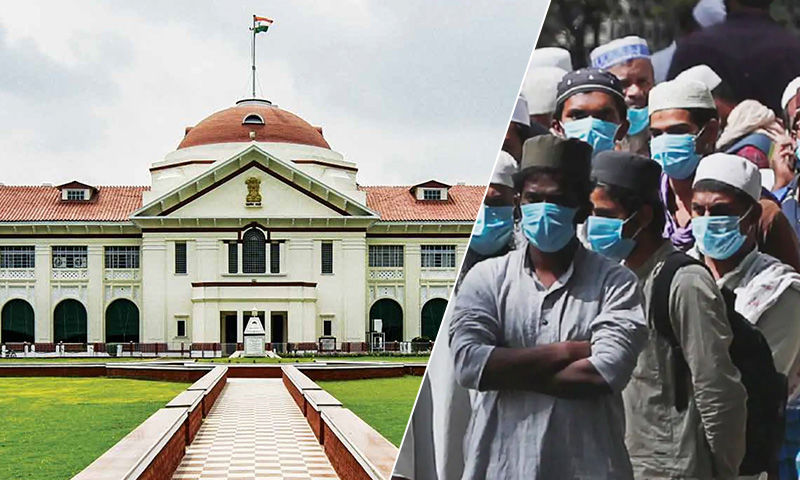
Tablighi Jamaat-'No material to show they indulged in prohibited tabligh activity'
Patna HC Quashes Cases Against 18 Foreign Nationals
This report was first published in www.livelaw.in and has been posted here without any alterations or editing. To read the original report, CLICK HERE
Noting that police didn't collect any material in any form to make a prima-facie view that the foreign nationals before the Court had indulged in religious/Tabligh work, the Patna High Court on Tuesday (22nd December) quashed entire Criminal Prosecution against 18 foreigners associated with Tablighi Jamaat.
The Bench of Justice Rajeev Ranjan Prasad specically said,
"The Chief Judicial Magistrate, Araria took cognizance of Prohibited offences and decided to issue summons to these foreign nationals in a routine and mechanical manner."
The Matter before the Court
There were two pleas before the Court. In the rst plea [Cr.W.J.C. No. 367/2020], 11 petitioners (Petitioner no. 1 to 9) were involved, who are foreign nationals and they entered India on tourist visa by road through West Bengal.
They visited the 'Nizamuddin Markaz', Delhi prior to Tablighi Conglomeration, thereafter they reached Araria in the State of Bihar on 11.03.2020 and they were residing in 'Rawahi Markaz' since 15.03.2020.
On the other hand, the Petitioner no. 10 and 11 are the permanent residents of the Araria District.
On 22nd March 2020, Janta Curfew was declared and from 24th of March the nation-wide lockdown for 21 days was declared.
It was their further case that the petitioners were stranded in 'Rewahi Markaz', they were screened by the administration and then the local administration put them in quarantine and they remained quarantined at Rewahi Markaz for the mandatory period as per government's Standard Operating Procedures (SOPs).
Further, the Bihar Police visited Rewahi Markaz on 12.04.2020 and registered an F.I.R.
According to the F.I.R., Maulana Tohid and Maulana Munif (petitioner no. 10 & 11) had told the informant that the nine Bangladeshi nationals were staying in the Markaz since 15.03.2020, they were called in the Markaz by the Maulana and they were involved in the spread of religious ideologies.
It was alleged that when the informant asked the Maulanas as to why no information about the stay of Bangaladesies nationals in the 'Rewahi Markaz' was made available to Narpatganj Police Station, the Maulanas were unable to satisfactorily answer the query of the informant.
The informant alleged that
(i) none furnishing of information about their visit within the police station and (ii) getting involved in the spread of religious ideologies by a foreign national who is visiting India on a tourist visa, are offences under Section 14 and 14(C) of the Foreigners Act, 1946 (hereinafter referred to as the 'Foreigners Act' or 'the Act of 1946').
During the pendency of the Writ Application, a Charge sheet was led in this case under Sections 14 and 14 (C) of the Foreigners Act.
The Chief Judicial Magistrate, Araria had, vide order dated 01.10.2020, taken cognizance of the offences under the aforesaid provisions and summons have been issued to petitioners.
Similar facts and charges were involved in the Second Writ Petition [Cr.W.J.C. No. 369 of 2020]
The question before the Court
The whole matter was related to a question as to whether the F.I.Rs. in question are disclosing a violation of Visa conditions in terms of Section 14(b) of the Act of 1946 or that the petitioners may be said to have abetted the offence punishable under Sections 14, 14-A or 14-B so as to attract a penalty envisaged under Section 14-C of the Act of 1946.
Court's Observations
Firstly, the Court observed that the Circular dated November 20, 1996 [issued by Union Ministry Of Home Affairs] states that the foreign nationals entering India on Tourist Visas, if found indulging in religious/Tabligh work, action including their deportation under the Foreigners Act should be taken.
At the same time, the circular has claried that attending Tabligh Jamat Ijtemah (congregations) does not amount to Tabligh work prohibited under instructions.
[NOTE: Tabligh work does include place to place preaching; speaking from Tabligh platform/canvassing during congregations etc and action against foreign nationals indulging in these activities is to be taken.]
Secondly, perusing the circulars dated April 15, 2015, the Court noted that the Government is well aware of the fact that the foreign nationals visiting India on Tourist Visa from some of the countries are usually staying at various 'Mosque'/ 'Madarsa'.
It is to be noted that the Union Ministry of Home Affairs has not banned or restricted stay of foreign nationals on Tourist Visa in the 'Mosque' / 'Madarsa'.
"Foreigners did not indulge in Religious/Tabligh Work"
In fact, the Court noted that what has been banned/prohibited is their indulgence/participation in the act of preaching, speaking from Tabligh platform/canvassing during congregation etc. only those foreign nationals are required to be prosecuted who have been found involved in the prohibited activities.
In this context, the Court said,
"In these two cases (instant cases) the foreign nationals were staying in the 'Markaz' and the 'Mosque' respectively with effect from a date before the imposition of the Lock-down 1.0. Before the imposition of the Lock-down at no point of time the 'BOI' /local Police Station identied these foreign nationals as those involved in religious/Tabligh work.
The Court further said,
"They have not been seen addressing any congregation or preaching religious ideologies. In course of investigation also police has not collected any material in any form to make a prima-facie view that these foreign nationals who are before this Court had indulged in religious/Tabligh work."
Circular Issued by BOI (Bureau of Immigration)
Further, the Court took into account the circular dated 02.04.2020 (issued Bureau of Immigration) which talks of nding out and tracking down all those foreign nationals who had visited India on Tourist Visa, had moved out to different States and Districts in India and were involved in Tabligh Jamaat activities rstly in the premise of Tabligh Jamaat Markaz Nizamudin, New Delhi and thereafter, in different places.
Now, since they couldn't indulge in such activities without obtaining permission from the Ministry of Home Affairs, Government of India for this purpose, as per the circular, penal action were required to be taken against them.
In fact, the 'BOI' had to identify the foreign nationals who participated in Tabligh activities on a tourist visa and 'BOI' had to take penal actions for Visa violation.
However, the 'BOI' didn't come out with any identication as regards these petitioners. No such facts were placed before this Court.
Importantly, the Court noted that for the act of identication of the foreign nationals, it would involve the collection of some material against them to show their involvement in Tabligh activities, but no such material was put forth before the Court.
The Court remarked,
"There is absolutely no material in the case diary to even prima-facie suggest that these foreign nationals had indulged in the preaching of their religious ideologies or that they had addressed any congregation on the 'Markaz' and the 'Mosque' platform. The allegation of preaching religious ideologies is thus not supported by any material. It is an unfounded allegation."
In absence of any material, the Court said, the Chief Judicial Magistrate, Araria took cognizance of the offences and decided to issue summons to these foreign nationals in a routine and mechanical manner.
Reporting regarding the stay of foreign nationals on Tourist Visa in the 'Markaz' and the 'Mosque
In both the Writ petitions, it was argued that Reporting regarding the stay of foreign nationals on Tourist Visa in the 'Markaz' and the 'Mosque was not required to be done.
The Court analysed Foreigners Act and Foreigners Order, 1948 as amended up-to-date, and observed that a question arises as to whether a place inside the premises of the 'Markaz' or 'Mosque' specially meant for a stay of foreign nationals visiting India on a tourist visa from some of the countries would fall within the meaning of the word 'boarding house' or the 'rest house'?
As in case these premises are found to be involved in being used as a 'boarding house' or a 'rest house' for the travelers coming from a foreign country, then by virtue of their use, the keepers of such premises shall be responsible to comply with the requirements of reporting as envisaged under the Foreigners Order, 1948 as amended up-to-date.
Answering the question, the Court noted that the Management of these 'Mosque'/ 'Markaz' have created infrastructures in form of buildings/apartments either attached to the 'Mosque'/ 'Markaz' or in the vicinity inside the premises and those infrastructures are being managed by the management of the 'Mosque'/ 'Markaz'.
The Court also said,
"These infrastructures are being used as a boarding house/rest house. The foreign nationals are being accommodated in such infrastructures/buildings /apartments by the management of the 'Mosque'/ 'Markaz', therefore by applying an extended meaning those places would be covered within the meaning of word 'boarding house' and 'rest house'."
The Court further came to the conclusion that in no case a foreign national who has entered India on a tourist visa and stays in a 'Mosque' or 'Markaz' or 'Madarsa' may be allowed to contend that he would not be required to furnish information in terms of paragraph 16 of the Foreigners Order 1948 (as amended vide Foreigners (Amendment) Order 2016) to the keepers of the premises.
However, the Court added,
"The foreign nationals are, however, not under obligation to furnish form 'C'. In the present case the allegations that the foreign nationals had not reported about their stay to the local police station is a misconceived kind of allegation and based on a misconception of law.
At the same time, the Court opined that the management of the 'Mosque'/ 'Markaz' / 'Madarsa' is obliged to report the stay of a foreign national in their premises to the Registering Authority and/or that they have to allow Police Ocer or an authorized person to inspect the records.
Importantly, the Court held, "Any attempt to contend that in case of a free stay of foreign nationals in such premises the keepers of such premises would not be liable to keep the Register in form 'B' or furnish information to the Registering authority in form 'C' under Foreigners Order 1948 would frustrate the object of the various statues and it would defeat the very object of keeping complete information as to whereabouts of the foreign national who has entered India on any kind of Visa."
Court's Order
The Court concluded that so far as the foreign nationals (petitioner nos. 1 to 9 of Cr.W.J.C. No. 367 of 2020 and petitioner nos. 2 to 10 of Cr.W.J.C. No. 369 of 20200) were concerned, their prosecution for the offences alleged under Section 14 and 14-C of the Act of 1946 had no basis to proceed.
Accordingly, the order taking cognizance and issuance of summons as also the entire criminal prosecution against them was thereby quashed.
However, since the Court found from the admitted facts on the record that the foreign nationals were staying in the 'Markaz' and the 'Mosque' respectively in these cases from a date prior to the imposition of the lock-down 1.0, but the same was not reported to the competent authority by the management of the 'Markaz' and the 'Mosque' respectively and that a prima-facie case was found to issue summons to petitioner nos. 10 and 11 in Cr.W.J.C. No. 367 of 2020 and to petitioner no. 1 in Cr.W.J.C. No. 369 of 2020, the Court did not interfere with the impugned orders in so far as it related to them.
Lastly, the respondents were directed to take steps forthwith to deport the foreign nationals (petitioners in the two writ applications) to their respective countries.
Case title – Md. Enamul Hasan v. UOI and others [Criminal Writ Jurisdiction Case No.367 of 2020] & M. Enamul Hasan v. UOI and others [Criminal Writ Jurisdiction Case No. 369 of 2020]
Click Here To Download Order
Courtesy: www.livelaw.in
Let the Truth be known. If you read VB and like VB, please be a VB Supporter and Help us deliver the Truth to one and all.
Ordinance issued to increase number of Supreme Court judges from 34 to 38
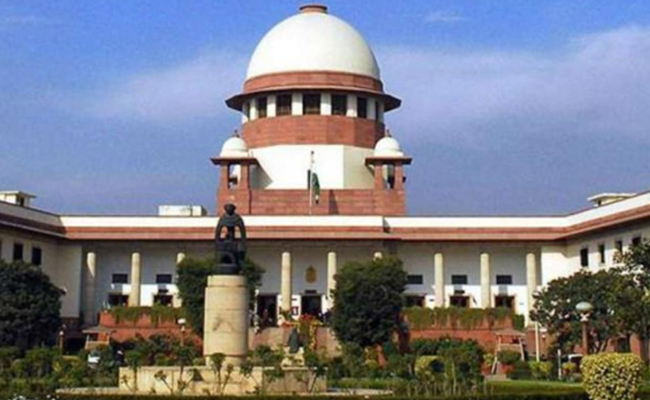
New Delhi (PTI): The government has promulgated an ordinance to increase the strength of the Supreme Court from the present 34 judges to 38, including the Chief Justice of India.
The law ministry notified the ordinance on Saturday, which amended the Supreme Court (Number of Judges) Act, 1956, to increase the sanctioned strength of the top court.
So far, the sanctioned strength of the top court was 34, including the Chief Justice of India (CJI). Now, the number of judges has been increased by four, taking the sanctioned strength to 38.
The top court will now have 37 judges, other than the CJI.
With the apex court having two vacancies at present, and the ordinance coming into force immediately, the Supreme Court Collegium will now have to recommend six names for appointment as judges in the top court.
A bill will be brought in the Monsoon Session of Parliament to convert the ordinance – an executive order – into a law passed by Parliament.
The Union Cabinet had cleared a draft bill on May 5 to increase the number of apex court judges.
The strength of the Supreme Court was last increased from 30 to 33 (excluding the CJI) in 2019.
The Supreme Court (Number of Judges) Act, as originally enacted in 1956, put the maximum number of judges (excluding the CJI) at 10.
This number was increased to 13 by the Supreme Court (Number of Judges), Amendment Act, 1960, and to 17 by another amendment to the law.
The Supreme Court (Number of Judges) Amendment Act, 1986, augmented the strength of judges from 17 to 25, excluding the CJI.
A fresh amendment in 2009 further increased the strength from 25 to 30.
Article 124(3) of the Constitution lists the qualifications required to become a Supreme Court judge.
An Indian citizen who has either served as a high court judge for at least five years, or as an advocate for 10 years, or is a distinguished jurist, can be appointed to the top court.
The strength of the Supreme Court is increased based on the recommendations of the CJI, who writes to the Union law minister. After consulting the finance ministry, the Department of Justice under the law ministry moves the Cabinet with a draft bill.