Teen farmer whose 13 cows died of food poisoning gets financial help from Celebrities, govt

Idukki: Two days after a young dairy farmer suffered a devastating loss, with as many as 13 of his 20 cows dying from suspected food poisoning, offers of new cows and financial assistance poured in from various quarters at their farm in this mountainous district of Kerala on Tuesday.
State ministers J Chinchu Rani and Roshy Augustine visited 15-year-old Mathew, the distressed young farmer, at his house in Velliyamattom village this morning and offered support and assistance from the state government.
Besides Kerala ministers, actor Jayaram also lent a helping hand to the teenaged Kerala farmer.
While the ruling CPI (M) offered to give two cows, business giant Lulu group handed over an amount of Rs five lakh to the family to buy 10 cows. Actor Jayaram, known for his love of animals, also visited the boy's house and handed over a cheque of Rs 5 lakh to buy new cows and rebuild his farm.
ALSO READ: Young dairy farmer loses 12 cattle to suspected poisoning in Kerala
Jayaram said the film crew of the Malayalam movie 'Abraham Ozler', in which he stars, has opted to cancel the scheduled trailer launch event on January 4, and instead decided to donate the Rs 5 lakh allocated for it to Mathew's family.
Additionally, Jayaram conveyed to Mathew that actors Mammootty and Prithviraj will also be contributing financial aid of Rs 1 lakh and Rs 2 lakh, respectively.
Earlier, Animal Husbandry Minister Chinchu Rani said that steps would be taken to hand over five insured cows to the young farmer soon. Cattle feed for one month would also be made available to him free of cost at the earliest, she said after visiting the young farmer and his family.
Furthermore, a financial assistance of Rs 45,000 from the Kerala Co-operative Milk Marketing Federation (Milma) would also be ensured for the distressed farmer, she added.
''All five cows will be of good breed. They will be given after they are insured. If any casualty happens to the cattle, he would get back the entire amount,'' she told reporters.
The minister, accompanied by Water Resources Minister Augustine, also advised Mathew to grow grass on unused properties in the area to ensure good-quality feed for the cattle.
Actor Jayaram, after handing over the cheque, said he could understand the sorrow of the young farmer and his family over the deaths of their dear cows.
''Everything will be alright soon,'' the actor said, consoling them.
He also told the farmer that he would help him buy high-bred cows from Krishnagiri in Tamil Nadu at a good price.
After learning about the plight of the teenaged farmer from the media, Lulu Group chairman M A Yusuffali directed his company officials to visit their home and provide immediate assistance.
CPI(M) sources revealed that the party's state secretary, M V Govindan, contacted Mathew and his family members over the phone to offer consolation. He also extended the offer of providing them with two cows.
Thirteen of Mathew's 20 cows died on Sunday, following which he became distressed and was hospitalised.
Preliminary reports suggest that the cattle might have been affected by a poisonous substance called hydrocyanic acid (HCN) present in the tapioca skin used as feed, a non-conventional but cost-effective food for cattle, a government official said.
Three of the cows that survived are under treatment, while another cow with four calves has survived.
The losses incurred by Mathew is estimated to be around Rs 6 lakh, officials said, adding that unfortunately, the family had not insured the cows.
The boy, who took over the farm two years ago at the age of 13 after his father's untimely demise, relied on tapioca leaves as an economical alternative to conventional cattle feed.
Mathew's brother George and younger sister assist him with managing the farm.
Let the Truth be known. If you read VB and like VB, please be a VB Supporter and Help us deliver the Truth to one and all.
India, New Zealand ink free trade agreement
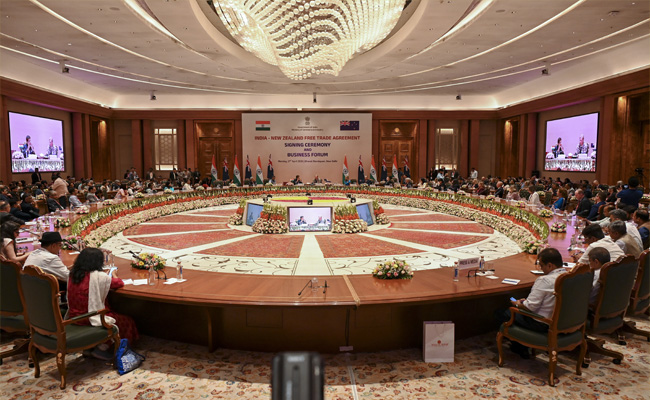
New Delhi (PTI): India and New Zealand on Monday inked a free trade agreement, aimed at boosting two-way commerce and investments.
The pact was signed by Commerce and Industry Minister Piyush Goyal and visiting New Zealand's Trade and Investment Minister Todd McClay.
The FTA provides duty-free access for 100 per cent of India's exports to New Zealand, covering all tariff lines or produce categories, and is expected to significantly boost MSMEs and employment by enhancing competitiveness in labour-intensive sectors such as textiles, apparel, leather, footwear, gems and jewellery, engineering goods, and processed foods.
Earlier, New Zealand maintained peak tariffs of up to 10 per cent on key Indian exports, including ceramics, carpets, automobiles, and auto components.
With zero-duty market access from entry into force as New Zealand's other trade partners, Indian products will be fully competitive in that country, enjoying a level playing field.
ALSO READ: Cal HC urges EC to dispose of TMC complaint over police observer's meeting with BJP nominee
Significantly, India also secured duty-free inputs for its manufacturing sector, including wooden logs, coking coal, and waste and scraps of metals, lowering production costs and enhancing the global competitiveness of the Indian industry.
On the other hand, India has offered tariff liberalisation on 70.03 per cent of tariff lines covering 95 per cent of bilateral trade value, while keeping 29.97 per cent of tariff lines excluded to protect India's sensitive sectors.
The products that are kept in exclusion are mainly -- dairy (milk, cream, whey, yoghurt, cheese etc.), animal products (other than sheep meat), agricultural products (onions, chana, peas, corn, almonds), sugar, artificial honey, animal, vegetable or microbial fats and oils, arms and ammunition, gems and jewellery, copper and articles thereof (cathodes, cartridges, rods, bars, coils), aluminium and articles thereof (ingots, billets, wire bars) among others.
On 30 per cent of tariff lines of New Zealand, India will provide duty elimination on goods such as wood, wool, sheep meat, and leather-raw hides.
Similarly, 35.60 per cent of tariff lines are subject to phased elimination over 3, 5, 7, and 10 years, including petroleum oil, malt extract, vegetable oils, selected electrical and mechanical machinery, and peptones.
New Zealand products which enjoy tariff reductions include wine, pharmaceutical drugs, polymers, aluminum, iron and steel articles, and goods that only 0.06 per cent fall under tariff rate quotas, including Manuka honey, apples, kiwi fruit, and albumins, including milk albumin.
The FTA also includes a commitment to facilitate USD 20 billion in investment into India.
A rebalancing clause is incorporated into the Agreement to provide a framework for addressing any shortfall in investment delivery, thereby ensuring robust and tangible economic outcomes.
Total bilateral trade in goods and services reached USD 2.4 billion in 2024.