There were issues between Sena and BJP, but resolved now: Uddhav Thackeray
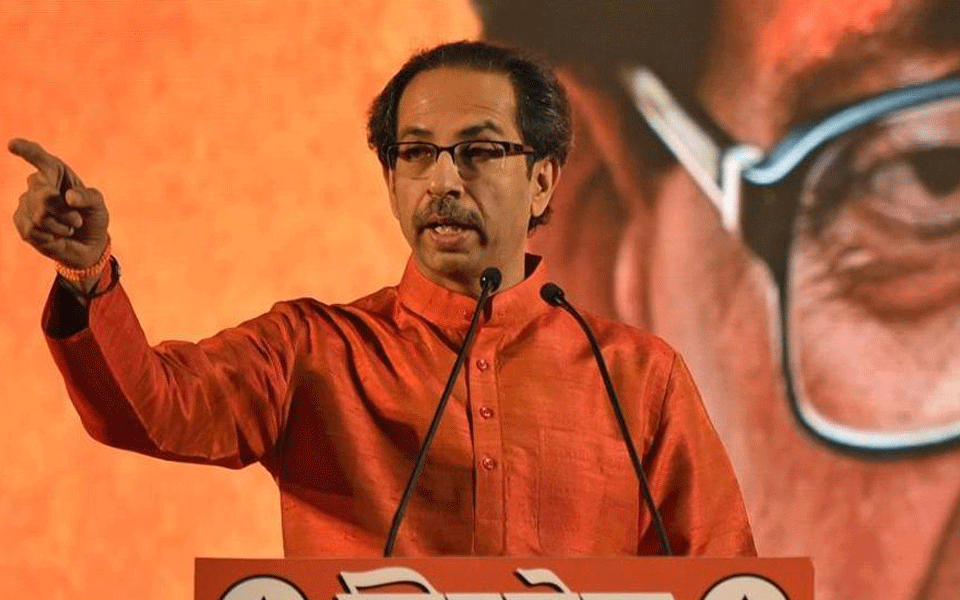
Ahmedabad: Shiv Sena chief Uddhav Thackeray Saturday said although there were differences between his party and the BJP earlier, all the issues have been resolved now.
He also said the two parties had similar goals and their ideologies and hearts were woven together.
Thackeray also praised Prime Minister Narendra Modi, saying the opposition had no leader that matches his stature.
He was speaking at a rally here ahead of filing of nomination by BJP chief Amit Shah for the Gandhinagar Lok Sabha seat.
Apart from Thackeray, Union ministers Rajnath Singh and Nitin Gadkari and Shiromani Akali Dal (SAD) supremo Parkash Singh Badal and Lok Janshakti Party (LJP) founder Ram Vilas Paswan were present on the stage.
Thackeray said he took part in the rally to give his best wishes to Shah.
"Many people will raise eyebrows why I am here, many people are happy that I am here, but some have stomach pain due to it," Thackeray said.
"Some people were rejoicing that the two parties with the same ideology are fighting with each other. We had some manmutav (bad feeling) and matbhinnata (difference of opinion). But when Amit Shah came to my house and we sat and held talks, all the issues were resolved," he said.
"We have similar goals. Our ideologies and hearts are woven together. We have come together because Hindutva is what binds us," he added.
"My father (Bal Thackeray) taught us that whatever we do, we should not do it from behind. We had raised people's issues. We have never back-stabbed and never will," he said.
"Shiv Sena and BJP have the same ideology of Hindutva. My father used to say Hindutva is our breath. But if our breath stops how can we survive?" he asked.
Thackeray said whatever happened in the last five years between the Sena and the BJP was past now.
"We should not forget our history of partnership of 25 years that preceded these five years. We were just two parties carrying the saffron flag, nobody was ready to align with us except Badal sahib.
"We were nowhere, but started walking, taking the saffron flag with us. Twenty-five years passed and our dream of hoisting the saffron flag in Delhi was realised. Today, our thinking is one, our ideology is one and our leader is also one," he said.
The Shiv Sena and the BJP were engaged in a bitter war of words in Maharashtra for the last five years of the NDA rule, though they were sharing power both at the Centre and state levels.
Before the 2019 election, there were doubts whether the two parties would join hands or not. However, finally both the saffron parties decided to patch up and fight the elections together.
He said the opposition parties might have joined hands, but the Shiv Sena and the BJP are joined by hearts.
"They have 56 leaders in a rally joining hands. It's good...they should join hands, even if they do not get along well. But Shiv Sena and BJP we are joined by hearts," he said.
"They (opposition) have started pulling each others' legs even before the polls as everyone wants to become the prime minister and I am not sure how long it will go," he said.
He said the opposition has no leader that matches the stature of Modi.
"I would like to ask who their leader is. If they organise a rally, will their supporters shout one name like you people shout," Thackeray said, following which people started shouting 'Modi, Modi'.
"Who is against us (in opposition)?...Nobody in this election. You will only see saffron saffron and saffron," he said.
Let the Truth be known. If you read VB and like VB, please be a VB Supporter and Help us deliver the Truth to one and all.
EAM Jaishankar meets Jamaican PM, gifts over 10 BHISHM Cubes
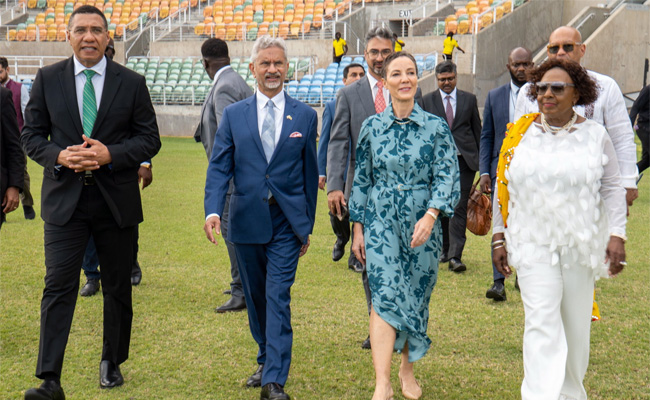
Kingston (PTI): External Affairs Minister S Jaishankar on Monday met Jamaican Prime Minister Andrew Holness and discussed ways to further deepen "political, economic and people-to-people cooperation."
Jaishankar also conveyed greetings from Prime Minister Narendra Modi to Holness.
"Pleased to call on Prime Minister @AndrewHolnessJM in Kingston. Conveyed the greetings of PM @narendramodi," Jaishankar posted on X.
"Discussed deepening our political, economic and people-to-people cooperation. Value his commitment towards further strengthening India-Jamaica relations," the post further read.
Also, the external affairs minister handed over 10 BHISHM (Bharat Health Initiative for Sahyog Hita & Maitri) Cubes as a gift to Jamaica.
"Formally handed over 10 BHISHM Cubes as a gift from India to Jamaica, in the presence of PM @AndrewHolnessJM, Health Minister @christufton and FM @kaminajsmith," Jaishankar posted on X.
"The BHISHM Cube mobile hospital system, designed for rapid deployment, will help Jamaica during disasters and emergencies. The gift of these cubes is a statement of friendship, a commitment to disaster preparedness, and an outcome of innovation," the post said.
Jaishankar arrived in Kingston on Saturday evening, marking the first leg of his nine-day tour of Jamaica, Suriname, and Trinidad and Tobago, aimed at further strengthening India's strategic and cultural ties with the Caribbean nations.
Earlier in the day, he interacted with the Indian diaspora and discussed India's ongoing transformation in infrastructure, human development and technology-driven governance and entrepreneurship with them.
He also highlighted the cricket bond between both countries as India gifted a scoreboard to Jamaica.
A scoreboard was dedicated at Sabina Park in Kingston. It is the home of the Jamaica cricket team and is the only Test cricket ground in the Caribbean island nation.
The minister expressed hope that the new scoreboard would witness many memorable innings, including those symbolising the enduring friendship between the two countries.
Cricket has long been a strong cultural bridge between India and Jamaica, which is part of the West Indies cricket team.
Jamaican players, including Chris Gayle, Courtney Walsh and Michael Holding, have played a major role in shaping the legacy of West Indies cricket in the international arena, contributing to its dominance in earlier decades and its continued global appeal.