Three-member panel probing Vikas Dubey's encounter gives clean chit to police
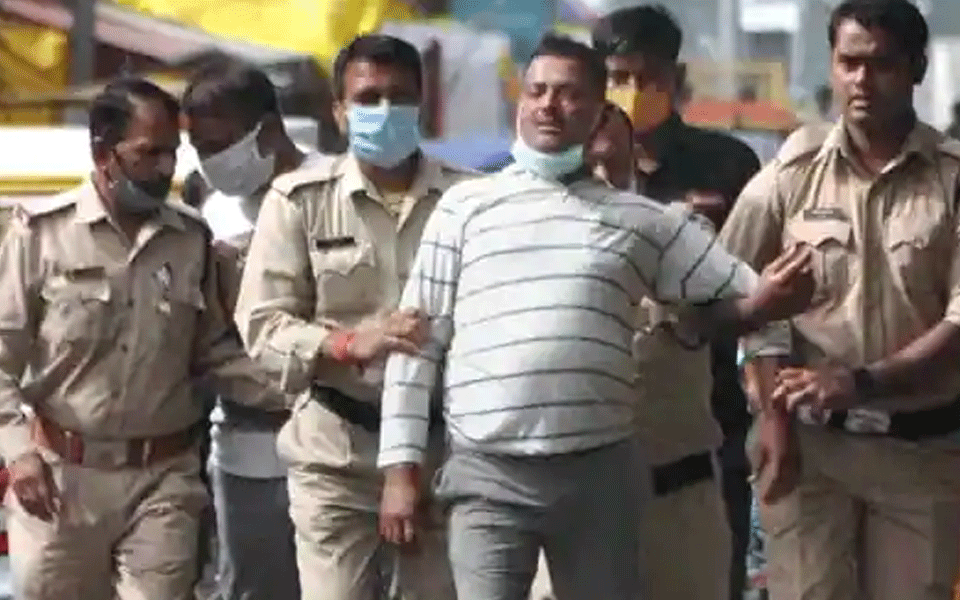
Lucknow(PTI): A three-member commission probing the encounter of gangster Vikas Dubey has given a clean chit to police, stating their version of events about his death were supported by evidence.
The commission said that Kanpur ambush in which eight cops were killed occurred because of "poor planning" by the police as it did not assess the situation correctly and there was "total failure" of Kanpur local intelligence.
Parliamentary Affairs Minister Suresh Khanna tabled the report in the Uttar Pradesh Assembly on Thursday.
"The evidence adduced in the (Dubey encounter) case supports police's version of the incident. The injuries suffered by policemen could not be self-inflicted or fabricated. Dr RS Mishra, who was on the panel of doctors, conducted the post-mortem and clarified that the injuries found on his person (Dubey) could be caused as per the version of police," the report said.
"Nobody came forward from the public and media to controvert the police version and no evidence is filed in rebuttal. Richa Dubey, wife of Vikas, filed an affidavit calling the incident a fake encounter but she did not appear before the commission," it said, adding that in such eventuality, no suspicion or doubt arises about the police's version of the incident.
A magisterial inquiry conducted by Chief Metropolitan Magistrate Kanpur Nagar has a similar finding.
Eight police personnel, including deputy superintendent of police, were killed during a raid on Dubey's house at Bikru village in Kanpur district on the night of July 2-3, 2020.
Later, Dubey was killed in an encounter when a police vehicle carrying him from Ujjain to Kanpur met with an accident and he tried to escape from custody, the police had said.
The commission comprised Justice (Retd) BS Chauhan, Justice (Retd) SK Agarwal and former UP director general of police KL Gupta. It had submitted a 824-page report to the state government on April 21.
The commission said there is "sufficient material on record" to show that Vikas Dubey and his gang were patronised by the local police, revenue and administrative officials.
"He (Vikas) and his associates had been in touch with such officials, and the officers were also communicating with them. If any person lodged any complaint against Vikas or his associates, the complainant was always humiliated by the police. Even if higher authorities gave directions to lodge a complaint, the local police dictated the terms," it said.
Though his name appeared in the list of top 10 criminals in the circle, he did not feature among top 10 criminals of the district, it said, adding that the members of his gang were included in a peace committee to resolve communal disputes.
"His wife was elected as a Zila Panchayat member and his brother's wife was elected as Bikru village's pradhan. They were both living in Lucknow. If any person of the area wanted help from them, he would contact Vikas Dubey and he would resolve their problem. The elected people never came into the picture," the report said.
Most of his family members had arms licences, and recommendations for them had been made by competent authorities by concealing material facts of their involvement in criminal cases. Their position was the same when it came to issuance of passports in their favour and/or grant of fair price shop licences, the commission noted.
"Investigation in any case lodged against them (Dubey's gang) was never impartial. Sections relating to serious offences were dropped before filing the chargesheet. During the trial, most of the witnesses turn hostile. Vikas Dubey and his associates got bail orders from courts easily and quickly as there was no serious opposition by state authorities or government advocates," it added.
"He was involved in 64 criminal cases. State authorities never considered it appropriate to engage a special counsel for his prosecution," it said, adding the state never moved any application for cancellation of bail or approached a superior court for cancellation of any bail orders.
In most of the cases, the high court had granted interim relief to Dubey, staying the proceedings before subordinate courts in criminal cases, and he remained under the protection of such orders for 13-14 years, it said.
The commission said the HC granted bail to Dubey and his associates mainly on the ground that he had been acquitted in a large number of cases, without attempting to know under what circumstances he was acquitted and how and why the witnesses turned hostile in most of the cases.
About the ambush, it said some police personnel posted in Chaubeypur police station had intimated Dubey about the impending raid which gave him an opportunity to call his associates with arms.
"There was a total failure of intelligence unit in Kanpur in collecting information about criminal activities and possession of sophisticated weapons (legal and illegal) by Vikas Dubey and his gang. No proper caution was taken while preparing for the raid, as 38/40 police personnel reached village Bikru and none of them was wearing a bulletproof jacket. Only 18 of them had arms, the rest had gone empty-handed or with sticks," the report said.
The incident occurred because of "poor planning" by the police as it did not assess the situation correctly.
"In fact, it did never expect that Dubey would retaliate with sophisticated weapons and his associates would take positions on on the roofs of houses. They were unaware that some police officials of Chaubeypur had already informed Dubey about the raid," it said.
Let the Truth be known. If you read VB and like VB, please be a VB Supporter and Help us deliver the Truth to one and all.
Lakhimpur Kheri violence case: SC expresses disappointment over non-production of witnesses in trial
New Delhi (PTI): The Supreme Court on Friday expressed disappointment over the non-production of witnesses in the ongoing trial against Ashish Mishra, son of former Union minister Ajay Mishra, and others in the 2021 Lakhimpur Kheri violence case.
A bench of Chief Justice Surya Kant and Justice Joymalya Bagchi said the status report filed before it by the Uttar Pradesh government has not assigned any reason whatsoever for the non-production of witnesses.
It noted that no witnesses have been examined in the trial for the last two months.
"We direct the presiding judge to take lawful measures to secure the presence of witnesses," the bench said.
It asked the trial judge to make an endeavour to conclude the trial in a time-bound manner, and also to file a status report before it.
The trials in two cases related to the incident are going on before a court in Uttar Pradesh.
The bench noted that in the first case, out of 131 witnesses to be examined, 44 have been examined, 15 have been discharged and 72 are still to be produced.
In the second FIR, out of 35 witnesses, 26 have been examined and nine were left, it said.
Senior advocate Siddharth Dave, appearing for Ashish Mishra, said that as per the latest status report filed by Uttar Pradesh, 44 witnesses have been examined so far in the first FIR.
"No witnesses have been examined in the last two months," Dave said.
He argued that the last status report filed by the state in March also said that 44 witnesses had been examined.
"What have you done from March till today?" the bench asked the counsel appearing for Uttar Pradesh.
The state's counsel said that 3-4 witnesses were summoned for the recording of their deposition during the trial.
The bench said at least 7-8 witnesses should be summoned instead of three or four for a day, so that even if some of them do not turn up, the trial court could proceed with the recording of statements of those appearing before it.
The top court also wondered how official witnesses can remain absent during the trial.
"We are disappointed to note that the so-called status report does not assign any reason whatsoever for non-production of witnesses...," the bench said.
Advocate Prashant Bhushan, appearing for the relatives of the farmers who were allegedly mowed down in the incident, said the apex court will have to do something regarding the manner in which the trial was going on.
The bench noted that besides the two FIRs, another FIR was registered in October last year concerning alleged witness intimidation.
It said that, as per the state's status report, the chargesheet was filed against the main accused in that case.
The bench noted that the status report reveals that, as far as Ashish Mishra is concerned, his alleged role in the third case is still being investigated.
The top court directed the investigating officer of the third case to conclude the pending probe and ensure that the appropriate report is filed before the concerned court within four weeks.
The bench posted the next hearing in the Lakhimpur Kheri violence case for July.
On October 3, 2021, eight people, including four farmers, were killed in Tikunia in Lakhimpur Kheri district during a protest by farmers against Deputy Chief Minister Keshav Prasad Maurya's visit to the area.
Four farmers were mowed down by a sports utility vehicle. A driver and two BJP workers were then allegedly lynched by angry farmers. A journalist also died in the violence.
In one of the cases, the trial court in December 2023 framed charges against Mishra and 12 others for alleged murder, criminal conspiracy and under other penal laws in the case of the farmers' deaths, paving the way for the trial.