TMC claims 63-year-old man tried to end life in Bengal's Cooch Behar over SIR fear
Cooch Behar (PTI): The TMC on Wednesday claimed that a 63-year-old man in West Bengal's Cooch Behar attempted suicide fearing harassment due to the Special Intensive Revision (SIR) of electoral rolls, and accused the BJP and the Election Commission of triggering panic across the state.
Police said Khairul Sheikh, a resident of Jitpur in Dinhata, allegedly consumed poison as "he was anxious over his name being wrongly recorded in the 2002 voter list". He is currently undergoing treatment at the Cooch Behar district hospital.
"We learnt that he was anxious for several days after discovering that his name had been incorrectly recorded in the 2002 voter list," a senior police official told reporters, adding that the exact reason behind his suicide bid would be clear once his condition improves.
The incident comes a day after a 57-year-old man in North 24 Parganas' Panihati allegedly took his own life, leaving behind a note blaming the NRC for his death.
The twin incidents have fuelled fresh political confrontation in the state over the SIR drive.
After meeting the family of the deceased in Panihati, TMC national general secretary Abhishek Banerjee said, "I have heard that one more person has tried to end his life in Cooch Behar. He is presently hospitalised and under doctor's observation. We wish him a speedy recovery."
The TMC escalated its attack through a strongly worded post on X, saying, "Two lives. Two tragedies. One cause. BJP's politics of hate. How many more lives will it take, Narendra Modi, for you to stop weaponising citizenship?"
Meanwhile, Chief Minister Mamata Banerjee, while virtually inaugurating from Kolkata the ‘Saras Mela’ in the Darjeeling Hills, turned towards North Bengal Development Minister Udayan Guha, and said, "I just heard a person consumed pesticide in your district. Please go to the residence of the person by this evening."
She, however, did not specify or elaborate.
TMC leader Partha Pratim Roy alleged widespread panic among former enclave residents in Cooch Behar, claiming they fear being declared "outsiders in their own land".
"The Commission must take responsibility. Two consecutive incidents show how the SIR is affecting lives," he said.
The BJP has dismissed the allegations, saying the SIR process is a routine exercise to clean the voter rolls.
"The allegations are baseless. They are trying to give a political twist to every incident," a local BJP leader said.
The EC has not yet commented on the controversy.
Police said investigations are underway to determine whether both incidents were linked to the ongoing verification drive.
Let the Truth be known. If you read VB and like VB, please be a VB Supporter and Help us deliver the Truth to one and all.
Madhu Kishwar booked over alleged misleading content on social media
Chandigarh (PTI): Academician Madhu Kishwar has been booked on charges of criminal defamation, promoting enmity and other offences by Chandigarh police following a complaint by a resident alleging circulation of forged and misleading content on social media.
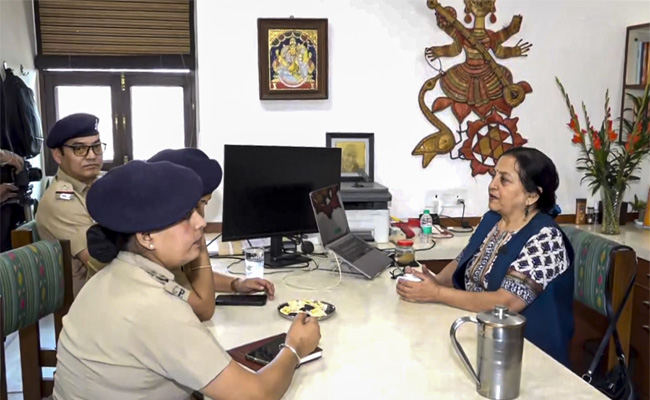
A Chandigarh police team on Tuesday served notice to Kishwar in Delhi, asking her to join the investigation in the case.
Sarita Roy, the Station House Officer of Sector-19 police station in Chandigarh, where the FIR was filed, told reporters in the national capital that the notice was issued under Section 35(3) of the BNSS and that Kishwar has been asked to appear and present her side.
Kishwar and some other social media users have been booked under various sections of Bharatiya Nyaya Sanhita, including 196 (criminalises acts that promote enmity, hatred, or ill-will between groups based on religion, race, language), 336 (1) (forgery) and 356 (criminal defamation), and the IT Act, according to the FIR.
ALSO READ: 21 hours raid fetch nothing for ED, claims Karnataka Cong MLA’s son
They have also been charged under Section 353 (penalises making, publishing, or circulating false information that cause public mischief...) and those related to cheating and forgery under the BNS.
According to a statement by the Chandigarh police, a city-based complainant on April 19 alleged that some forged and misleading social media posts and video clips with obscene text and content were being circulated by various social media users, misidentifying the person in the video.
The complainant alleged that it is a deliberate act of creating a false electronic record using obscene words and phrases, having knowledge and sufficient reason to believe that the posts are misleading and false, with the intent to cause damage or injury.
The video, which circulated with the intent to cause harm to the reputation of a constitutional authority and to disturb public peace and tranquillity, should be investigated, and appropriate action should be taken, the complainant said.
The complainant said the person seen in the video is a travel vlogger whose wife regularly posts updates about their activities on social media. The original video was shared from her social media account.
"As per the statement of the woman, she disclosed that the person in the video shared from her account is her husband. Statements of her husband and another lady in the video have also been recorded during preliminary investigation," said the police statement, adding that further probe is underway.
Meanwhile, Kishwar, in a social media post, said that a Chandigarh police team had visited her late Monday night to serve her notice regarding the FIR registered against her.
"Since the law forbids the police to visit or arrest women after dark and before sunrise, I spoke on phone to the leader of the delegation. She told me that their team has come to serve notice regarding an FIR registered against me in Chandigarh. I insisted that they go by the law and come in the morning," she wrote on X.