Twitterati’s stunned on PM Modi's emoji use on official 'X' account, sparks parody speculation
The PM used emojis in his text response to India Today Journalist Aroor's 'Meltdown-e-Azam' video
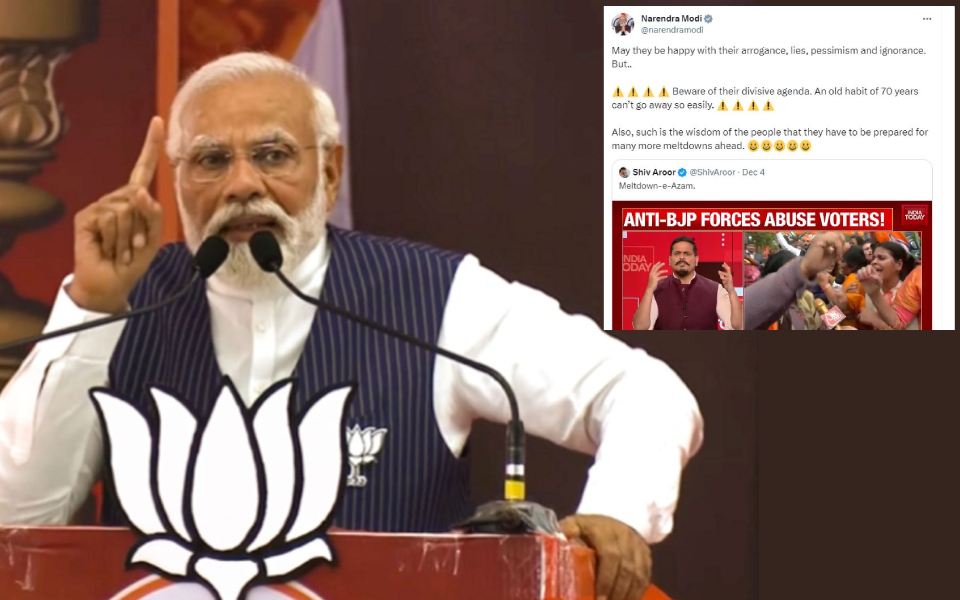
New Delhi: In the aftermath of Prime Minister Narendra Modi's call for the opposition to ‘leave the practice of negativity,’ his response to a ‘X’ post by India Today senior executive editor Shiv Aroor has sparked curiosity and speculation among netizens.
India Today Journalist Aroor had shared a clip from his show with the caption "Meltdown-e-Azam," criticizing what he saw as a "laundry list of excuses” following the saffron party’s victory in the Hindi heartland.
PM Modi's use of emojis in his response raised questions about the authenticity of the account, with some users wondering if it was a parody or if the account had been compromised. Some netizens even suggested that BJP IT cell chief Amit Malviya should use his own account to post.
PM Modi responding to Shiv aroor’s post, wrote, "May they be happy with their arrogance, lies, pessimism and ignorance. But..⚠️⚠️⚠️⚠️Beware of their divisive agenda. An old habit of 70 years can’t go away so easily. ⚠️⚠️⚠️⚠️ Also, such is the wisdom of the people that they have to be prepared for many more meltdowns ahead. 😀😀😀😀😀.”
Both Modi's reaction and Journalist Aroor's original post centered on the same theme of frustration following the BJP's electoral success in 3 states, which also echoed the Prime Minister's sentiments expressed in Parliament on Monday.
During the parliamentary session, PM Modi advised the opposition to move forward instead of expressing frustration over the assembly poll defeat. "The country has turned down negativity. We always have a conversation with our opposition friends ahead of the session, and also always seek cooperation from everyone. This time also all such processes have been completed," he said.
The PM further suggested the opposition to venture further leaving behind the practice of negativity of the last 9 years. “Instead of making plans for venting frustration over defeat, they should learn from this defeat. If they move forward with positivity this session, the country will change its perspective towards them. A new door could open for them,” he added.
In the meantime, Aroor, on his show, and a clip of which he shared on social media, highlighted what he perceived as a "meltdown" following the BJP's victory, criticizing the excuses made by commentators and analysts. The journalist slammed those attributing the saffron party’s success to Hindutva, pointing to stereotypes such as, “ Voters in the Hindi heartland have low literacy. Voters in the Hindi heartland have higher fertility. Voters in the Hindi heartland prefer Hindutva. Voters in the Hindi heartland have rewarded big business. Voters have appeased fascism. Shivraj Singh Chouhan has defeated Modi. BJP has done manipulation in the heartland. Kamal Nath has defeated Rahul Gandhi. Bhupesh Baghel has betrayed the Gandhis. Cow belt always drags India down. Hindi heartland is full of communal bigots. For a majority of Indians, only religion matters, etc…” about voters in the Hindi heartland.
Aroor continued his jibe stating that, “south India is more aware than north India…people go to south for jobs and then vote the BJP to power in the north…And finally being defeated is no big deal because vote share figures have largely held firm.”
Meltdown-e-Azam. pic.twitter.com/elvcTmcYGo
— Shiv Aroor (@ShivAroor) December 4, 2023
May they be happy with their arrogance, lies, pessimism and ignorance. But..
— Narendra Modi (@narendramodi) December 5, 2023
⚠️ ⚠️ ⚠️ ⚠️ Beware of their divisive agenda. An old habit of 70 years can’t go away so easily. ⚠️ ⚠️ ⚠️ ⚠️
Also, such is the wisdom of the people that they have to be prepared for many more meltdowns… https://t.co/N3jc3eSgMB
Let the Truth be known. If you read VB and like VB, please be a VB Supporter and Help us deliver the Truth to one and all.
Karnataka health dept mandates heat stroke units across hospitals
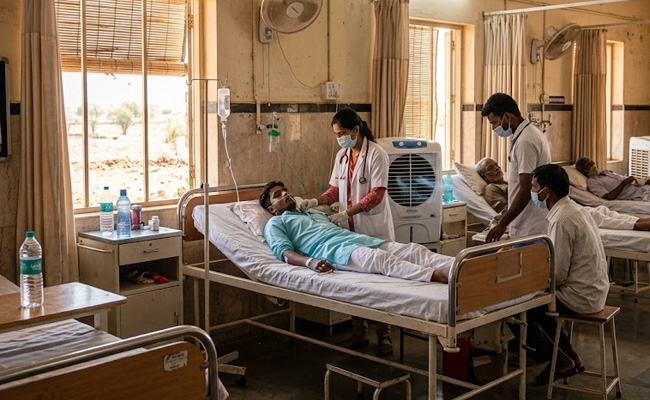
Bengaluru (PTI): The Karnataka government on Friday directed state-run health facilities to set up dedicated ‘heat stroke management rooms’ to address risks from extreme temperatures, officials said.
In a circular issued, the Commissionerate of Health and Family Welfare Services said community health centres should earmark two beds, taluk hospitals five beds, and district hospitals 10 beds for heat stroke management.
The circular, issued under the National Action Plan on Heat-Related Illnesses, stated that these facilities must be made operational every year, including in 2026, from March 1 to July 31.
All doctors and paramedical staff have been instructed to undergo training in the management of Heat-Related Illnesses (HRI).
It also directed all health institutions to establish ORS corners and equip heat stroke management rooms with essential facilities such as fans, ice cubes, and thermometers.
All health facilities at every level have been instructed to submit daily reports on HRI cases through the Integrated Health Information Platform (IHIP), the circular said.
The health department said the measures aim to prevent heat stroke-related complications and deaths amid rising temperatures and has directed authorities concerned to submit compliance reports on implementation.