UN chief warns world leaders of 'an age of reckless disruption and relentless human suffering'
_vb_27.jpeg)
United Nations (AP): With global peace and progress under siege, the United Nations chief challenged world leaders Tuesday to choose a future where the rule of law triumphs over raw power and where nations come together rather than scramble for self-interests.
Secretary-General Antonio Guterres said the UN's founders faced the same questions 80 years ago, but he told today's world leaders at the opening of their annual gathering at the General Assembly that the choice of peace or war, law or lawlessness, cooperation or conflict, is “more urgent, more intertwined, more unforgiving.”
“We have entered in an age of reckless disruption and relentless human suffering,” he said in his annual “State of the World” speech. “The pillars of peace and progress are buckling under the weight of impunity, inequality and indifference.”
But despite all the internal and external challenges facing the UN, he and General Assembly President Annalena Baerbock pleaded with its members not to give up. “If we stop doing the right things, evil will prevail,” Baerbock said in her opening remarks.
Looking broadly at the changing world, Guterres said it is becoming increasingly multi-polar – certainly a nod to rising economic powers China and India but a slap to the US insistence on superpower status. The UN chief said a world of many powers can be more diverse and dynamic but warned that without international cooperation and effective global institutions there can be “chaos.”
President Donald Trump insisted in a nearly hour-long speech that the US has the strongest borders, military, friendships “and the strongest spirit of any nation on the face of the earth.” He boasted, “This is indeed the golden age of America.”
As for the U, he told the assembly chamber that the 193-member world body failed to help him end and alleviate conflicts which he said many believe merit the Nobel Peace Prize.
“All they seem to do is write a really strongly worded letter,” and not follow up, he said as he portrayed the UN as an ineffectual institution, from its policies to even its escalators. One of them had stopped unexpectedly as he and first lady Melania Trump were riding it toward the Assembly hall, and his teleprompter also wasn't working.
A UN official said the United Nations understands that someone from the president's party who ran ahead of him inadvertently triggered the stop mechanism on the escalator. The official, speaking on condition of anonymity because of the sensitivity of the issue, said the White House was operating the teleprompter for the president.
Trump reiterated that the UN has “tremendous, tremendous potential” but now delivers “empty words – and empty words don't solve war.”
But his tone shifted at a meeting with Guterres soon after. “Our country is behind the United Nations 100%,” Trump told the UN chief. “I may disagree with it sometimes, but I am so behind it because the potential for peace at this institution is great.”
Guterres said the first obligation of world leaders is to choose peace, and without naming any countries, he urged all parties -- including those in the Assembly chamber – to stop supporting Sudan's warring parties.
He also didn't name Israel but used his strongest words against its actions in Gaza, saying the scale of death and destruction are the worst in his nearly nine years as secretary-general, and that “nothing can justify the collective punishment of the Palestinian people.”
While Guterres has repeatedly said only a court can determine whether Israel has committed genocide in Gaza, he referred to the case South Africa brought to the UN's highest court under the genocide convention by name – and stressed its legally binding provisional measures, first and foremost to protect Palestinian civilians.
Since the International Court of Justice issued that ruling in January 2024, Guterres said, killings have intensified, and famine has been declared in parts of Gaza. He said the court's measures “must be implemented – fully and immediately.”
Israeli-Palestinian conflict takes centrestage
With global support for a Palestinian state growing, Israel's war in Gaza is taking centrestage. But humanity's myriad conflicts, rising poverty and heating planet will also be in the spotlight.
Turkey's President Recep Tayyip Erdogan began his speech voicing regret at the absence of Palestinian President Mahmoud Abbas, who was denied a visa by the US.
He said he was standing at the assembly podium “for our Palestinian brothers and sisters whose voices are being silenced” while recognition of the state of Palestine is increasing is increasing. He thanked all countries that have done so and called on those that haven't to do so “as soon as possible.”
Indonesia's President Prabowo Subianto also gave strong support to the Palestinians and warned the assembly that “Human folly, fuelled by fear, racism, hatred, oppression and apartheid threatens our common future.”
“Every day we witness suffering, genocide and a blatant disregard for international law and human decency,” the head of the world's most populous Muslim nation said. “In the face of these challenges, we must not give up. … We must draw closer, not drift further apart.”
The General Assembly's big week of meetings began Monday with events including a conference on the Israeli-Palestinian conflict.
Tuesday's speakers also include Brazilian President Luiz Inacio Lula da Silva, Jordan's King Abdullah II, French President Emmanuel Macron, South Korea's President Lee Jae Myung and South African President Cyril Ramaphosa.
Da Silva — speaking first, under a longtime tradition dating to when Brazil was the only nation that volunteered to lead off — worried aloud that the UN's authority was waning.
Geopolitical problems keep getting more complex
While the debate's theme is “Better Together,” observers can expect a rundown of ways in which the world is falling apart.
Gaza already has seized attention at the General Assembly. Monday's conference, co-chaired by France and Saudi Arabia, focused on garnering support for the longstanding idea of a two-state solution to the Israeli-Palestinian conflict.
Let the Truth be known. If you read VB and like VB, please be a VB Supporter and Help us deliver the Truth to one and all.
Single higher education regulator bill tabled in LS; Oppn flags ‘centralisation,' JPC likely
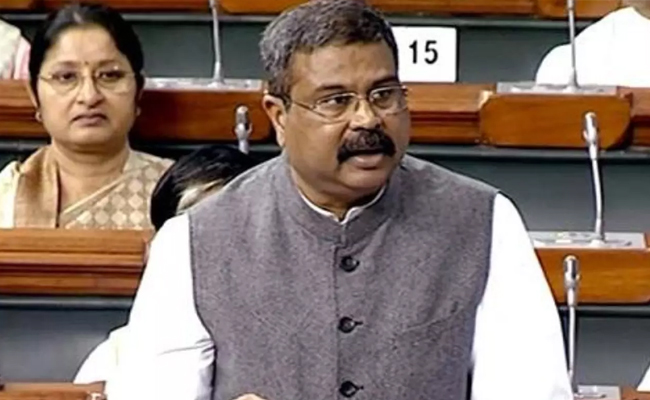
New Delhi: A bill to set up a 13-member body to regulate institutions of higher education was introduced in the Lok Sabha on Monday.
Union Education Minister Dharmendra Pradhan introduced the Viksit Bharat Shiksha Adhishthan Bill, which seeks to establish an overarching higher education commission along with three councils for regulation, accreditation, and ensuring academic standards for universities and higher education institutions in India.
Meanwhile, the move drew strong opposition, with members warning that it could weaken institutional autonomy and result in excessive centralisation of higher education in India.
The Viksit Bharat Shiksha Adhishthan Bill, 2025, earlier known as the Higher Education Council of India (HECI) Bill, has been introduced in line with the National Education Policy (NEP) 2020.
The proposed legislation seeks to merge three existing regulatory bodies, the University Grants Commission (UGC), the All India Council for Technical Education (AICTE), and the National Council for Teacher Education (NCTE), into a single unified body called the Viksit Bharat Shiksha Adhishthan.
At present, the UGC regulates non-technical higher education institutions, the AICTE oversees technical education, and the NCTE governs teacher education in India.
Under the proposed framework, the new commission will function through three separate councils responsible for regulation, accreditation, and the maintenance of academic standards across universities and higher education institutions in the country.
According to the Bill, the present challenges faced by higher educational institutions due to the multiplicity of regulators having non-harmonised regulatory approval protocols will be done away with.
The higher education commission, which will be headed by a chairperson appointed by the President of India, will cover all central universities and colleges under it, institutes of national importance functioning under the administrative purview of the Ministry of Education, including IITs, NITs, IISc, IISERs, IIMs, and IIITs.
At present, IITs and IIMs are not regulated by the University Grants Commission (UGC).
Government to refer bill to JPC; Oppn slams it
The government has expressed its willingness to refer it to a joint committee after several members of the Lok Sabha expressed strong opposition to the Bill, stating that they were not given time to study its provisions.
Responding to the opposition, Parliamentary Affairs Minister Kiren Rijiju said the government intends to refer the Bill to a Joint Parliamentary Committee (JPC) for detailed examination.
Congress Lok Sabha MP Manish Tewari warned that the Bill could result in “excessive centralisation” of higher education. He argued that the proposed law violates the constitutional division of legislative powers between the Union and the states.
According to him, the Bill goes beyond setting academic standards and intrudes into areas such as administration, affiliation, and the establishment and closure of university campuses. These matters, he said, fall under Entry 25 of the Concurrent List and Entry 32 of the State List, which cover the incorporation and regulation of state universities.
Tewari further stated that the Bill suffers from “excessive delegation of legislative power” to the proposed commission. He pointed out that crucial aspects such as accreditation frameworks, degree-granting powers, penalties, institutional autonomy, and even the supersession of institutions are left to be decided through rules, regulations, and executive directions. He argued that this amounts to a violation of established constitutional principles governing delegated legislation.
Under the Bill, the regulatory council will have the power to impose heavy penalties on higher education institutions for violating provisions of the Act or related rules. Penalties range from ₹10 lakh to ₹75 lakh for repeated violations, while establishing an institution without approval from the commission or the state government could attract a fine of up to ₹2 crore.
Concerns were also raised by members from southern states over the Hindi nomenclature of the Bill. N.K. Premachandran, an MP from the Revolutionary Socialist Party representing Kollam in Kerala, said even the name of the Bill was difficult to pronounce.
He pointed out that under Article 348 of the Constitution, the text of any Bill introduced in Parliament must be in English unless Parliament decides otherwise.
DMK MP T.M. Selvaganapathy also criticised the government for naming laws and schemes only in Hindi. He said the Constitution clearly mandates that the nomenclature of a Bill should be in English so that citizens across the country can understand its intent.
Congress MP S. Jothimani from Tamil Nadu’s Karur constituency described the Bill as another attempt to impose Hindi and termed it “an attack on federalism.”
_vb_22.jpeg)