UN report warns India heading towards groundwater depletion tipping point
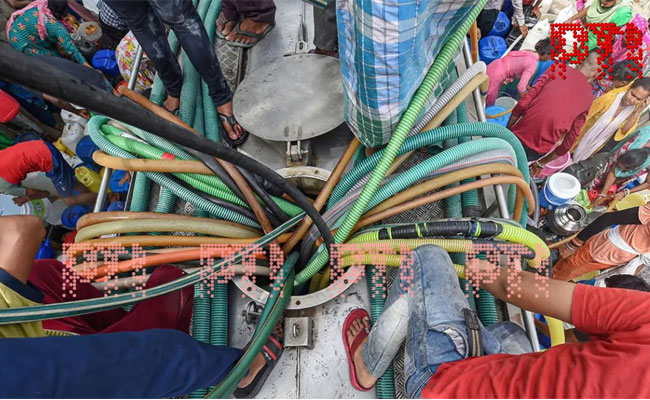
New Delhi (PTI): Some areas in the Indo-Gangetic basin in India have already passed the groundwater depletion tipping point and its entire northwestern region is predicted to experience critically low groundwater availability by 2025, according to a new report by the United Nations.
Titled "Interconnected Disaster Risks Report 2023" and published by the United Nations University Institute for Environment and Human Security (UNU-EHS), the report highlights that the world is approaching six environmental tipping points: accelerating extinctions, groundwater depletion, mountain glacier melting, space debris, unbearable heat and an uninsurable future.
Environmental tipping points are critical thresholds in the Earth's systems, beyond which abrupt and often irreversible changes occur, leading to profound and sometimes catastrophic shifts in ecosystems, climate patterns and the overall environment.
Around 70 per cent of groundwater withdrawals are used for agriculture, often when above-ground water sources are insufficient. Aquifers play a crucial role in mitigating agricultural losses caused by drought, a challenge expected to worsen due to climate change.
However, the report warns that the aquifers themselves are approaching a tipping point. More than half of the world's major aquifers are depleting faster than they can naturally replenish. When the water table falls below a level accessible by existing wells, farmers may lose access to water, posing a risk to entire food production systems.
Some countries, like Saudi Arabia, have already exceeded the groundwater risk tipping point, while others, including India, are not far from it.
"India is the world's largest user of groundwater, exceeding the use of the United States and China combined. The northwestern region of India serves as the bread basket for the nation's growing 1.4 billion people, with the states of Punjab and Haryana producing 50 per cent of the country's rice supply and 85 per cent of its wheat stocks.
"However, 78 per cent of wells in Punjab are considered overexploited and the northwestern region as a whole is predicted to experience critically low groundwater availability by 2025," the report says.
Jack O'Connor, the lead author and senior expert at UNU-EHS, said, "As we approach these tipping points, we will already begin to experience the impacts. Once crossed, it will be difficult to go back. Our report can help us see risks ahead of us, the causes behind them and the urgent changes required to avoid them."
Let the Truth be known. If you read VB and like VB, please be a VB Supporter and Help us deliver the Truth to one and all.
Right to vote under threat, must be made fundamental right: Cong's Jairam Ramesh
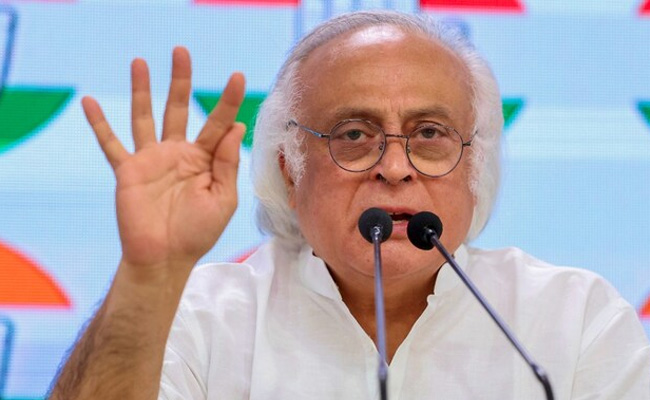
New Delhi (PTI): Congress leader Jairam Ramesh alleged on Thursday that the right to vote is under threat and the time has come when it should be made a fundamental right for citizens.
Speaking with reporters, Ramesh lashed out at Chief Election Commissioner (CEC) Gyanesh Kumar, saying the Election Commission (EC) has never been as compromised as it has been under him.
"The rot started under his predecessor. This man is a player and not a neutral observer," the Congress leader said, slamming Kumar.
Kumar is completely compromised and has become a player in elections, he alleged.
"Home Minister Amit Shah had talked about three Ds -- detect, delete and deport. So we want to know how many non-Indian citizens have been detected, how many have been deleted and how many have been deported," Ramesh said, adding that the right to vote is now under threat.
On opposition parties submitting a fresh notice in the Rajya Sabha, seeking to move a motion for the CEC's removal, the Congress leader said they will continue to make efforts for Kumar's removal as he is "compromised".
Ramesh also batted for the right to vote to be recognised as a fundamental right.
"I believe that the time has come that the right to vote should be made a fundamental right. It is a statutory right, it is not a fundamental right. Fundamental rights are justiciable," he said.
The former Union minister said this was discussed in the Constituent Assembly, but it was eventually decided that it should be made part of the Constitution.
B R Ambedkar and Jagjivan Ram had warned that in the future, governments might try to disenfranchise voters, he added.
"Once and for all, include the right to vote as a fundamental right for Indian citizens," Ramesh asserted.