Uniform tax on small, big cars will not augur well for auto industry growth: Maruti Suzuki Chairman
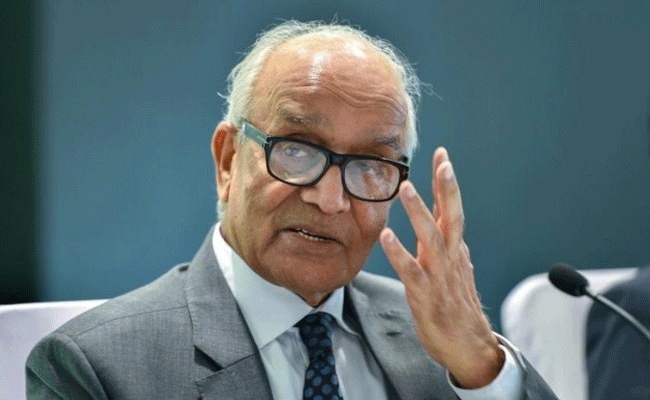
New Delhi (PTI): The regulatory burden is the highest on small cars, a key segment of the Indian automobile industry and having a uniform tax structure across all segments of vehicles will not augur well for the sector growth, according to Maruti Suzuki India Chairman RC Bhargava.
He also said India's economic growth rate could be higher if the manufacturing sector grows fast, which 'unfortunately' has remained a laggard despite the best efforts of the Narendra Modi-led government at the Centre due to implementation gaps at the ground level.
"The burden of regulatory changes on the small cars is far higher than the regulatory burden on big cars and that is changing the whole market behaviour. People who are buying small cars are not buying small cars in near the same numbers. Personally, I think it's not a good thing, either for the car industry or the country," Bhargava said in an interaction on Monday evening.
For the healthy growth of the automobile industry, there must be a steady increase in the number of new customers in the car parc. The base of ownership of cars must be increasing every year. Only then when the whole pyramid becomes a larger one, which is able to balance itself, he added.
"I don't see that as becoming an inverted pyramid and the car industry becomes an industry where in India there is hardly any growth in the small segment and all the growth takes place in the higher segments. So, that factor has to be kept in mind, the regulatory effect on the car, and that's one argument for not having a uniform rate of tax on all small and big cars," Bhargava asserted.
He was responding to a query on his views about having a uniform tax rate across all segments of automobiles.
At present, automobiles are taxed at 28 per cent GST with additional cess ranging from 1 per cent to 22 per cent depending on the type of vehicle. Cars imported as completely built units (CBU) attract customs duty ranging between 60 per cent and 100 per cent, depending on engine size and cost, insurance and freight (CIF) value being less or above USD 40,000.
Bhargava, however, said for electric cars, GST has been kept at 5 per cent "whether it's a small electric car or big electric car. There's no differential tax rate there. So, there is already that uniform taxation happening".
He also lamented that the auto sector continues to be heavily taxed, which in a way has affected the growth of the industry.
"Throughout our history," he said all motor vehicles "have been in the highest tax brackets".
In response to a query on the impact of clarification on the definition of SUVs for taxation purposes, he said it "confirms that they should charge 22 per cent (cess) when four conditions are met, which puts it into the 50 per cent kind of tax bracket".
"You can't grow an automobile industry with 50 per cent taxation. Where in the world has an industry like automobiles grown with 50 per cent taxation, but it's the wisdom of the policymakers and the political leadership," Bhargava noted.
He said that compared to developed markets like Europe and Japan, where per capita income is far higher, taxes on cars in India are much higher.
"Now, somebody needs to think about that, should cars be charged more than the average rate of taxation...? If it is, then we are, in some way, accepting the thing that cars or luxury products should be taxed more than non-luxury products, which is the old socialist way of thinking and taxation," he said.
On the overall growth of the economy, he said India is doing well with "a growth rate of nearly 7 per cent" although next year it looks difficult to achieve that rate "because there are too many international events, which are in the sense of negative headwinds for us or in the rest of the world".
"The growth rate could be higher if manufacturing in India could grow fast. Unfortunately, manufacturing in India has still remained a laggard. Mr Modi has given great emphasis to a whole lot of reforms and changes have happened but for some reason, we are not able to make the sort of progress we should be making, something that we need to look at," Bhargava said.
He pointed out that one of the main reasons for not achieving the desired growth in the manufacturing sector is due to the gaps in implementation at the ground levels despite the Centre pushing with policy reforms.
At a time when India is looking to improve its economic growth, GDP and employment creation, manufacturing is a key input for that, Bhargava said.
Let the Truth be known. If you read VB and like VB, please be a VB Supporter and Help us deliver the Truth to one and all.
Power struggle in ruling Cong has 'created massive confusion' in Karnataka: BJP leader Ashoka
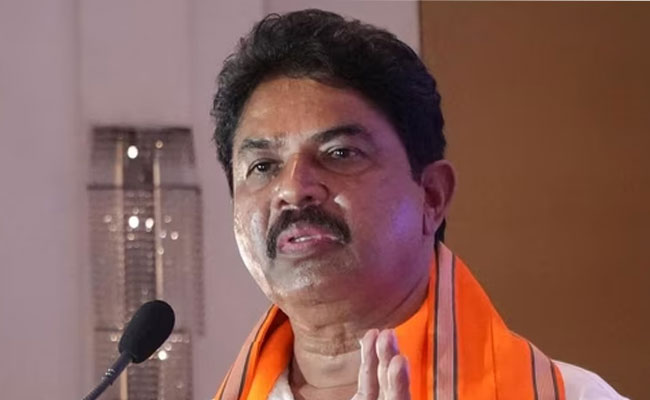
Bengaluru (PTI): BJP leader R Ashoka on Friday claimed that the ongoing power struggle between Chief Minister Siddaramaiah and his deputy D K Shivakumar has created massive confusion in Karnataka.
He remarked that the proverb “when two people fight, the third one benefits” has come true, as AICC President Mallikarjun Kharge is also now making efforts to become Chief Minister.
Speaking to reporters here, Ashoka said the entire government has turned into a house of confusion due to the alleged power tussle.
Kharge’s new statement has only added to the chaos, he said.
Congress chief Mallikarjun Kharge had on Friday said that no date has been fixed yet to discuss possible leadership change in Karnataka.
This came a day after Kharge said there was no change of CM in Karnataka "for now" and that the leadership issue in the state would be resolved soon.
The BJP leader said that Kharge too has aspirations and that he was cheated earlier.
"Perhaps he has received a green signal from the Congress high command to become CM. Everyone is already saying Kharge should become CM. Kharge himself has declared, “I am ready to become CM.” Despite many attempts in the past, he never became CM. Now he is trying to seize the opportunity," the Leader of Opposition in the state assembly said.
According to him, the situation in Congress has perfectly become a case of “two people fighting, third one benefits.”