US dream shattered, 311 Indians land in Delhi after deportation from Mexico
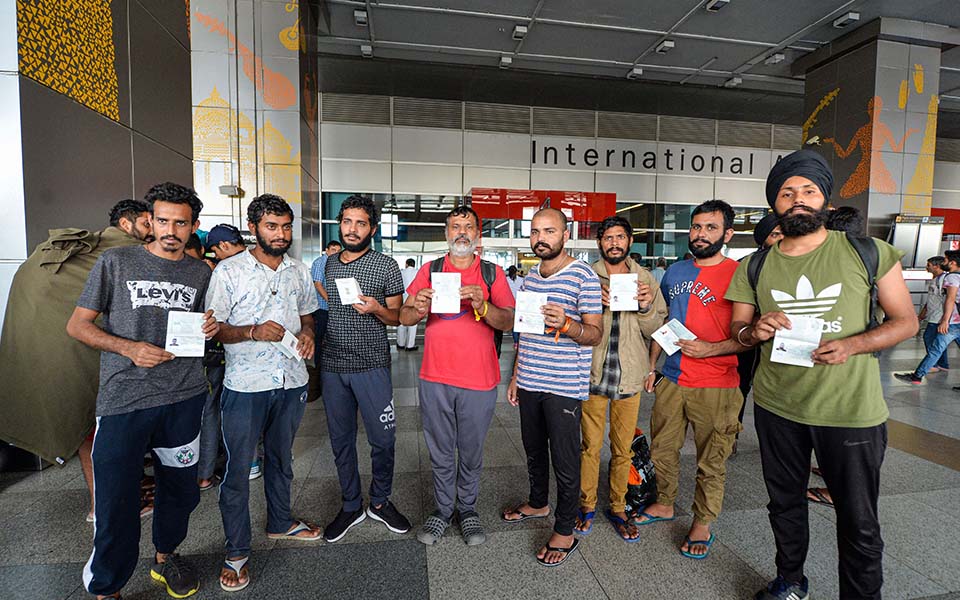
New Delhi, Oct 18: More than 300 Indians, including one woman, who were deported by Mexican immigration authorities for illegally entering the country to sneak into the US, landed here on Friday morning, their American dream of a better life and jobs in the US shattered.
The 311 Indians were sent back to India on a chartered flight and were accompanied by 74 Mexican officials, officials here said.
Carrying stories of walking through jungles and spending lakhs of rupees to achieve their dreams only to be ignominiously caught and sent back, they landed back home after a journey that lasted more than 36 hours. The flight itself was 11 hours, first from Mexico to Spain, and then on to the Indian capital.
"We landed around 5 am in the morning and the formalities took several hours. We could exit the airport only around 1 pm," Jashanpreet Singh, one of the deportees, said.
Most of those deported are from Punjab and Haryana.
According to a press release issued by Mexico's National Migration Institute (INM) on Wednesday, the Indian nationals, who did not have a condition of regular stay in the country, were deported from the Toluca City International Airport on a Boeing 747 aircraft to New Delhi.
The deportees, who were accompanied by Federal Migration agents as well as members of the National Guard, were gathered in the Acayucan Migration Station in Veracruz to carry out their identification and subsequent transfer, the statement said.
The people were presented to immigration authorities in the states of Oaxaca, Baja California, Veracruz, Chiapas, Sonora, Mexico City, Durango and Tabasco.
Among those who returned home was 19-year-old Mandeep Singh who had left Patiala in June.
Mandeep, who has passed school and left home with the US dream in his heart, said he travelled through seven countries, with the first stop being Ecuador and the last stop Mexico.
"For seven days, we walked through the dense jungles of Panama. We finally reached Mexico in September 12. We were just 800 kilometres away from the US before the Mexican authorities hauled and deported us," he said.
Mandeep said he saw several corpses, believed to be people who wanted to migrate just like him, while crossing the Panama jungles.
Sahil Malik, slightly older at 22, said he had left Delhi on June 5 for Ecuador. He said they reached Mexico using different modes of transport and often crossed the borders in buses.
Kamaljit Kaur, 34, from Jalandhar, the only woman to be deported said she spent Rs 53 lakh to reach the US -- including for herself, her husband and son.
Sombir Saini also complained of bad living conditions in Tapachula refugee Camp in Mexico.
In June, US President Donald Trump in June threatened tariffs on all Mexican imports if the country did not put a check on people entering America through Mexico's borders.
Mexico had agreed to boost security on the border and expand its policy of taking back migrants.
Let the Truth be known. If you read VB and like VB, please be a VB Supporter and Help us deliver the Truth to one and all.
Work underway on 'One Nation, One Election'; positive discussions ongoing: Modi
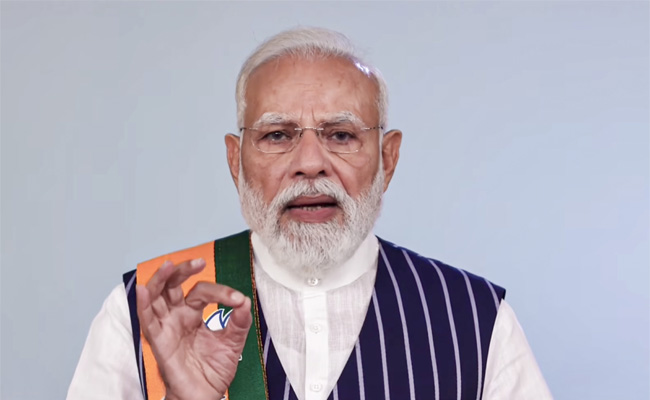
New Delhi (PTI): Prime Minister Narendra Modi on Monday said the "mission is still ongoing" for implementing the BJP's two key agendas, the Uniform Civil Code (UCC) and 'One Nation, One Election', with serious discussions underway and positive progress made.
Virtually addressing an event marking the BJP's 47th Foundation Day, Modi also said it was the saffron party that first raised the issue of women's reservation in 1994. He added that the current BJP-led central government is fully committed to ensuring that the Women's Reservation Act -- which would provide 33 per cent reservation for women in the Lok Sabha and state assemblies -- is implemented in the 2029 general elections.
Targeting the Congress, he said BJP workers endured many hardships -- such as the Emergency and oppression -- under the grand old party's rule. Many BJP workers even sacrificed their lives, he said, citing states such as West Bengal and Kerala "where violence has been turned into a political culture".
"Our mission is still ongoing. On Uniform Civil Code, 'One Nation, One Election' and other issues, serious discussions are taking place in the country, and we have achieved tremendous progress on those fronts," Modi said.
He said the BJP aims to make the country developed and self-reliant, and will continue to march in that direction.
Under the 'One Nation, One Election' system, the Modi government proposes to conduct simultaneous elections to the Lok Sabha and state assemblies. The UCC seeks to create the same set of laws for everyone across the country, irrespective of religion, especially with regard to marriage and adoption.
Modi said the BJP is sincerely striving to face every challenge.
ALSO READ: 2 Indian nationals accused of drug trafficking arrested in Nepal
"There are countless works that were the result of the BJP's honest efforts, such as the repeal of hundreds of black laws from the British era, the construction of a new Parliament building, 10 per cent reservation for the poor in the general category, triple talaq ban, the Citizenship Amendment Act, the construction of the Ayodhya Ram temple," he said.
The prime minister said the BJP had first proposed women's reservation in 1994 in Vadodara.
"We had also decided that we would encourage women in our party organisation as far as possible. When we came to power, we fulfilled that promise. Now we are fully dedicated to ensuring that the Nari Vandan Adhiniyam (Women's Reservation Act) is implemented in the 2029 general elections," he said.
Referring to the ongoing West Asia conflict, Modi said the BJP believes in the idea of 'Vasudhaiva Kutumbakam' (the world is one family) even in times of war.
He said there was a time when India took pride in maintaining equal distance from every country, but now it is moving ahead by keeping close relations with each country.
Highlighting that the BJP-led National Democratic Alliance (NDA) has completed 25 years of existence, Modi said it is the only coalition that has been working in the country's interest and for public welfare.
"The BJP has set an example in coalition politics. The consistent expansion of the NDA is proof that it is an all-inclusive coalition. It works by prioritising regional aspirations," he said.
Modi said people have seen dynastic politics, which is still prevalent in some parts of the country, and the Left governance model, but the BJP's governance model is unique.
"Under our governance model, policies and governments are stable," he said.
Modi said the BJP has its own agenda and aims, and besides handling the current crisis, the party-led government is preparing the country for the future.
"Works are ongoing on issues such as the demographic change, infiltration, corruption, dynastic politics, and freeing people from a colonial mindset. The BJP has to make the country free from all these challenges. This responsibility can be fulfilled only by the BJP," he said.
Referring to the abrogation of Article 370 (which gave special status to Jammu and Kashmir) in 2019, Modi said that for decades, the law was a hurdle in fully integrating Jammu and Kashmir with the rest of the country.
"People thought it was impossible to scrap Article 370, but we had promised to abrogate it. We have completed the task," he said.
He said the BJP has been maintaining a consistent stand on issues like national security and terrorism, and now new technologies are being installed for border security, border villages are being developed, and the backbone of Naxalism has been crushed.
He said under the "vast and sacred banyan tree" of the Rashtriya Swayamsevak Sangh, the BJP was inspired to step into politics with good intentions and integrity.
"In the initial few decades, we devoted our energy to setting policies for the organisation," he said, adding that the BJP cannot forget that in 1984, the Congress won a record number of seats, but the country also witnessed how they betrayed the people.
"This increased people's trust in the BJP, and slowly we began to win seats. At that time, two types of political ideologies existed: one was power-driven, and the other was service-oriented.
"The politics that prioritised power gradually declined, and service-oriented politics gained massive public support. Today, we are proud that through our conduct, we have established a new principle in Indian politics: the principle of nation first," he said.
Earlier, in an X post, Modi greeted BJP workers on the party's foundation day. The BJP was formed on April 6, 1980.
"Our party has always been at the forefront of serving society, guided by the principle of India First. Our 'karyakartas' are known for their selfless service, unwavering dedication and a deep passion towards good governance. They have worked tirelessly at the grassroots, ensuring maximum people are connected to our ideology and work.
"We also remember the countless workers whose dedication, sacrifice and perseverance have shaped the party's growth over decades," he said.
Modi said the BJP stands as a party that places the well-being of people at the centre of its vision, and this is reflected in the work at the Centre and in various states.
"BJP remains committed to building a Viksit Bharat. May our collective resolve continue to drive this vision forward and take India to new heights of progress and prosperity," he said.