Uttarakhand: One killed, 11 missing, three rescued after landslides, flooding hit Chamoli villages
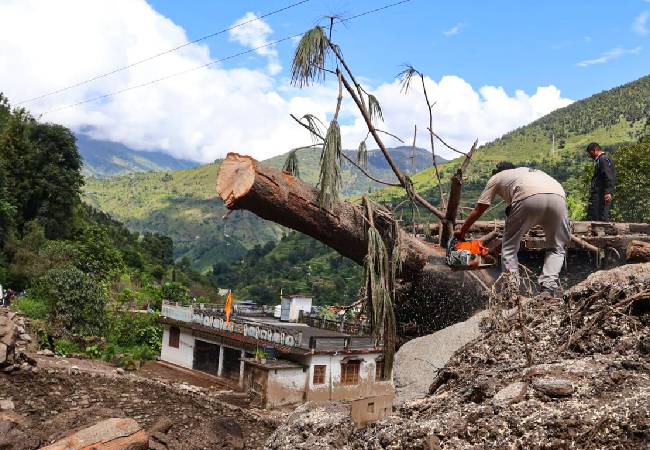
Gopeshwar (PTI): One person has been killed, 11 people are feared trapped under debris and 20 have been injured as landslides and flooding triggered by heavy rain flattened more than 30 houses in four villages of Uttarakhand's Chamoli district on Thursday.
One body was recovered from the debris, while three people -- two women and a child -- were rescued alive in Kuntari Lagaphali village, the State Emergency Operation Centre (SEOC) in Dehradun said.
The deceased was identified as Narendra Singh (42), it said.
Eleven people -- seven from Kuntari Lagaphali and two each from Kuntari Lagasarpani and Dhurma -- are missing, the SEOC said.
Chief Minister Pushkar Singh Dhami had told reporters earlier in Dehradun that 14 people were missing following the landslides.
All four affected villages come under the Nandanagar area, about 260 km from Dehradun and 50 km from the Chamoli district headquarters at Gopeshwar. Nandanagar is already reeling from land subsidence.
The disaster struck Kuntari Lagaphali, Kuntari Lagasarpani, Sera and Dhurma, Dhami told reporters after reviewing the situation.
"Thirty-three houses, several shops and cowsheds were destroyed by the debris in four villages -- Kuntari Lagaphali, Kuntari Lagasarpani, Sera and Dhurma -- following heavy rain. Fourteen people are missing and around 20 have been injured," he said.
More than 200 people have been affected in the rain-related incidents, he added.
Around 150 to 200 villagers in Kuntari Lagaphalki have been moved to safe places, the SEOC said, adding that search-and-rescue operations are being conducted by the NDRF, SDRF, ITBP, police and fire brigade personnel in the villages under the supervision of the district magistrate and superintendent of police.
Those seriously injured, including a child who sustained head injuries, are being airlifted to the All India Institute of Medical Sciences (AIIMS) in Rishikesh, Dhami said.
The chief minister took stock of the situation in Nandanagar by speaking to Chamoli District Magistrate (DM) Sandeep Tiwari via video-conferencing and asked him to accelerate the relief-and-rescue operations in the affected areas.
He directed officials to ensure immediate restoration of roads, drinking water supply, electricity and network connectivity in the areas affected by rain. Adequate arrangements should be made for shelter, food, clean drinking water and other essential amenities for the disaster-hit people, Dhami said.
Doctors and medicines should be made available in the affected areas to ensure prompt medical assistance, he said.
In the Mokh valley area, heavy rain triggered flooding in the Moksha river, causing erosion in it from Dhurma to Sera, damaging dozens of buildings, including at least six houses, according to officials.
Tiwari said at least eight people, including four members of a family, are missing in Kuntari Lagaphali, where the landslide hit about half-a-dozen houses. At least two persons are missing in Dhurma, where the raging waters of the Moksha river have damaged multiple buildings, the DM said.
The access road to Nandanagar has been blocked by debris, he added.
The details of all those missing are awaited. They may be trapped under the rubble of the damaged buildings, the officials said.
A resident of Kuntari Lagaphali and the vice-president of the district branch of the Indian Red Cross, Nandan Singh, who is involved in the relief-and-rescue operations, said the swamp is hampering the rescue operations.
Torrents of mud and boulders rolled down from the hills at three locations in Kuntari Lagaphali, destroying everything on their way, he added.
When the landslide hit the houses, some of the people inside managed to escape, Singh said, adding that they sustained injuries.
Land subsidence hit parts of Nandanagar in August, with cracks appearing in the walls of many houses. Their residents were shifted to safe locations.
The landslides hit two days after heavy rain and cloudbursts in Dehradun and nearby areas breached several roads, washed away bridges and damaged houses, killing 21 people and leaving 17 missing.
Let the Truth be known. If you read VB and like VB, please be a VB Supporter and Help us deliver the Truth to one and all.
PM unveils development projects worth over Rs 4,000 crore in Sikkim

Gangtok (PTI): Prime Minister Narendra Modi on Tuesday launched development projects worth over Rs 4,000 crore in Sikkim while attending the closing ceremony of the state's 50 years of statehood celebrations.
The projects span a wide range of sectors such as infrastructure, connectivity, healthcare, education, power, urban development, environment, tourism and agriculture, the officials said.
These projects are aimed at accelerating holistic and inclusive development in Sikkim.
The PM's visit marks an important milestone in the golden jubilee year of Sikkim's statehood and reflects the government's "continued commitment to the rapid and sustainable development of the Himalayan state", the officials said.