VB Election Coverage: Here are all the updates from Rajasthan's Assembly Election 2023
New Delhi: Vote counting for three key states in the heartland and one significant southern state, considered a crucial indicator before the upcoming Lok Sabha elections, is set to commence at 8 am. The Mizoram votes, initially scheduled for counting on Sunday, will now take place on Monday following objections raised about the Sunday counting schedule.
In 2018, Rajasthan, known for its alternating support between the Congress and the BJP over the past three decades, delivered an unexpected outcome by preventing either party from securing a majority. The Congress, falling one seat short of the required 101 in the 200-member assembly, managed to form the government with support from Mayawati's Bahujan Samaj Party.
Here are all the updates from Rajasthan's vote counting for 2023 Assembly Elections:
7:00 PM: Incumbent Rajasthan Chief Minister Ashok Gehlot tenders resignation from his post
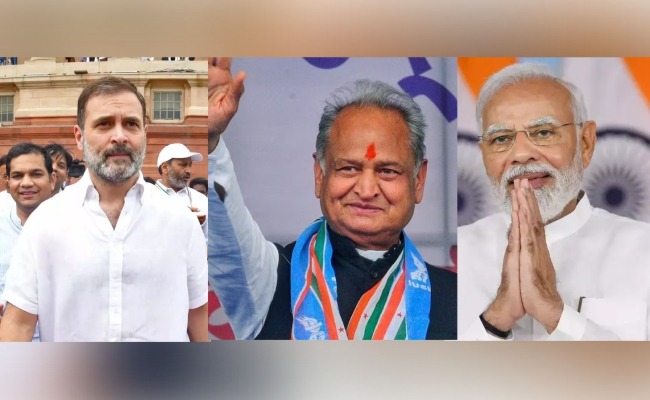
4:30 pm: The results in Chhattisgarh, Madhya Pradesh and Rajasthan indicate that the people of India are firmly with politics of good governance and development, which the BJP stands for: PM Modi
4:15 pm: I am a Jansevak (public servant), I will serve the state even without any post, says Ashok Gehlot.
3:40 pm: Rajasthan Assembly Speaker CP Joshi defeated by BJP's Vishvaraj Singh
3:25 pm: Sources indicate Ashok Gehlot was set to visit Raj Bhavan at 5:30 pm to submit his resignation to Governor.
3:15 pm: Rajasthan assembly election result: Ashok Gehlot wins Sardarpura seat by over 26,000 votes
3:15 pm: BJP has won 12 seats and is leading in 103 more while the Congress has secured 2 seats and is leading in another 67 seats: EC data at 3pm
3:00 pm: BJP candidate Diya Kumari wins Vidhyadhar Nagar assembly seat with margin of 71,368 votes: EC
1:45 pm: Spiritual leader & Alwar MP Mahant Balaknath among frontrunners for Rajasthan CM post
1:20 pm: BJP's Vasundhara Raje, former chief minister of the state, wins from Jhalrapatan
1:00 pm: Rajasthan chief electoral officer Praveen Gupta on Sunday said that 12 to 17 rounds of counting of votes have been completed and the final result is expected to be declared by 1.30pm.
12:40 pm: There will be a change and Congress will win the elections, Congress MP Pramod Tiwari says
12:25 pm: BJP sailing with lead on 111 seats, Congress leading on 73.
12:10 am: Congress spokespersom Supriya Shrinate said results in Rajasthan disappointing for Congress.
11:50 am: Ashok Gehlot, Sachin Pilot, Vasundra Raje, and Baba Balaknath all maintain leads on their respective seats.
11:35: BJP leading Congress on more than 50 seats now. BJP leading on 114, Congress on 63.
11:20 am: BJP leading on 109 seats in Rajasthan, Congress leads on 71. BSP leads 1, OTH leading on 19.
11:00 am: BJP lead on 108 seats, Congress leads on 69, BSP leads on 2.
10:45 am: BJP leader Satish Poonia - who is contesting against Congress' Prashant Sharma from Amber constituency - trails
10:30 am: Sachin Pilot regains lead in Tonk.
10:15 am: Sachin Pilot still trailing from Tonk, Gehlot maintains lead. Vasundara Raje, Baba Balaknath also leading on their respective seats.
10:10 am: BJP leader Vasundhara Raje is leading from Jhalrapatan with over 7,000 votes
10:00 am: BJP strengthens lead. Goes ahead on 108 seats, Congress leading on 78 seats.
9:45 am: BJP leads on 105, Congress on 79. 3 for BSP and OTH leads on 12.
9:30 am: Congress leader Sachin Pilot loses lead, now trailing on Tonk seat.
9:25 am: BJP extends lead on 107 seats, Congress leading on 77.
9:15 am: BJP crosses magic number in terms of lead. Gains lead on 100 seats.
9:00 am: BJP takes lead on 78 seats, Congress on 72. BSP yet to take lead on any seats, OTH lead on 3.
8:50 am: BJP candidate Baba Balaknath maintains lead on Tijara seat.
8:45 am: Congress, BJP both extend leads on 50+ seats in Rajasthan. BJP leads on 54, Congress on 51.
8:40 am: Ashok Gehlot, Sachin Pilot, Vasundara Raje all lead on their respective seats.
8:35 am: Congress heavyweight Kamal Nath leads on Chhindwara seat.
8:30 am: Congress leading on 26 seats, BJP in lead on 24 seats.
8:25 am: Congress, BJP neck-to-neck in Rajasthan. Lead on 17, 16 seats respectively.
8:20 am: Congress leads on 14 seats, BJP follows with lead on 13 seats.
8:15 am: BJP leads on 10 seat while Congress maintains pace by leading on another 10 seats in early trends.
8:00 am: Counting of votes begin in Rajasthan.
Let the Truth be known. If you read VB and like VB, please be a VB Supporter and Help us deliver the Truth to one and all.
4 held for sexually assaulting woman, girl on moving bus after social media alert in UP's Agra

Agra (UP) (PTI): Four people were arrested, after a prompt response by police following a social media alert, for allegedly sexually assaulting a woman and a girl inside a moving bus here, officials said on Tuesday.
According to an official police statement, at 12:27 am on April 27, information was received on the social media platform X about an incident of sexual assault on a bus travelling from Kanpur to Ahmedabad, which was approaching Namner crossing in Agra.
Acting under the direction of Police Commissioner Deepak Kumar, the Agra Police social media team immediately alerted the Rakabganj police station within minutes and coordinated with the victims to confirm the incident and obtain the exact location, it stated.
Police teams launched intensive checking at Namner crossing and intercepted the bus as it reached the spot. The four accused involved in the incident were apprehended on the spot, and legal action was initiated against them, the statement said.
The police said the swift response and coordination between the social media team and field units ensured timely action, bringing relief to the victims and other passengers, who expressed gratitude towards the police, it added.