Victims of road mishap in Delhi turn out to be thieves on the run, held

New Delhi (PTI): A routine call about a road accident in Delhi's Kapashera ended up exposing a trio of thieves, leading to their arrest and the recovery of stolen goods, police said on Monday.
The thieves were in the police station speaking to officers about the accident when the victim of the theft was registering his complaint, they said.
According to officials, a PCR call was received around 8.13 pm on Wednesday regarding a collision between a scooter and a car near Kapashera, they said.
"When a police team reached the spot, they noticed that the two men on the scooter seemed unusually nervous and eager to settle the matter quickly," a senior police officer said.
The duo -- identified as Rohit Ravidas (25) and Karamjeet (28), both residents of Sonia Gandhi Camp -- aroused further suspicion when one of them was found carrying a mobile phone that he couldn't unlock.
A few pointed questions from the team turned the supposed accident case into a crime investigation.
"During sustained questioning, the men confessed to having committed a house theft in the early hours of the same day in Gopalji Colony in Kapashera. They admitted to stealing a bag and three mobile phones from one Lal Chand," he added.
At their instance, the complainant's stolen bag was recovered, and police soon tracked down their associate, Pankaj (33), also from Sonia Gandhi Camp. He was found in possession of another stolen mobile phone that had been sold to him by the duo.
Police said Rohit and Karamjeet are habitual offenders who steal from houses and pass on the loot to Pankaj, who sells it and divides the proceeds. One of the stolen phones was said to be already sold, they said.
Investigations revealed that Rohit is involved in four previous cases, while Pankaj has two prior cases, police added.
Let the Truth be known. If you read VB and like VB, please be a VB Supporter and Help us deliver the Truth to one and all.
Madhu Kishwar booked over misleading content on social media
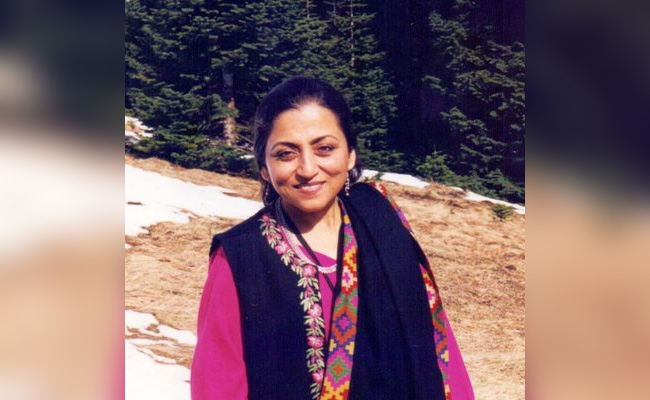
Chandigarh (PTI): Madhu Kishwar has been booked following a complaint by a Chandigarh resident over the alleged circulation of forged and misleading content on social media.
An FIR has been lodged against Kishwar and some other social media users under relevant sections, including 196 (criminalises acts that promote enmity, hatred, or ill-will between groups based on religion, race, language), 336 (1) (forgery) and 356 (criminal defamation) of Bharatiya Nyaya Sanhita and the IT Act at Police Station Sector-26 here.
According to an official statement issued by the Chandigarh police on Monday, a city-based complainant on April 19 alleged that some forged and misleading social media posts and video clips with obscene text and content were being circulated by various social media users, misidentifying the person in the video.
Further investigation into the matter is underway.
As per the complainant, it is a deliberate act of creating a false electronic record using obscene words and phrases, having knowledge and sufficient reason to believe that the posts are misleading and false, with the intent to cause damage or injury.
The video, which circulated with the intent to cause harm to the reputation of a constitutional authority and to disturb public peace and tranquility, should be investigated, and appropriate action should be taken, according to the complainant.
As per the complainant, the person seen in the video is a travel vlogger whose wife regularly posts updates about their activities on social media. The original video was shared from her social media account.
"As per the statement of the woman, she disclosed that the person in the video shared from her account is her husband. Statements of her husband and another lady in the video have also been recorded during preliminary investigation," said police in the statement.
Meanwhile, Kishwar, in a social media post, said a team of Chandigarh police had visited her late Monday night to serve her notice regarding the FIR registered against her.
"Since the law forbids the police to visit or arrest women after dark and before sunrise, I spoke on phone to the leader of the delegation. She told me that their team has come to serve notice regarding an FIR registered against me in Chandigarh. I insisted that they go by the law and come in the morning," she wrote on X.