Vikram lander observes temperature variation on lunar surface, records high of 70 degree Celsius
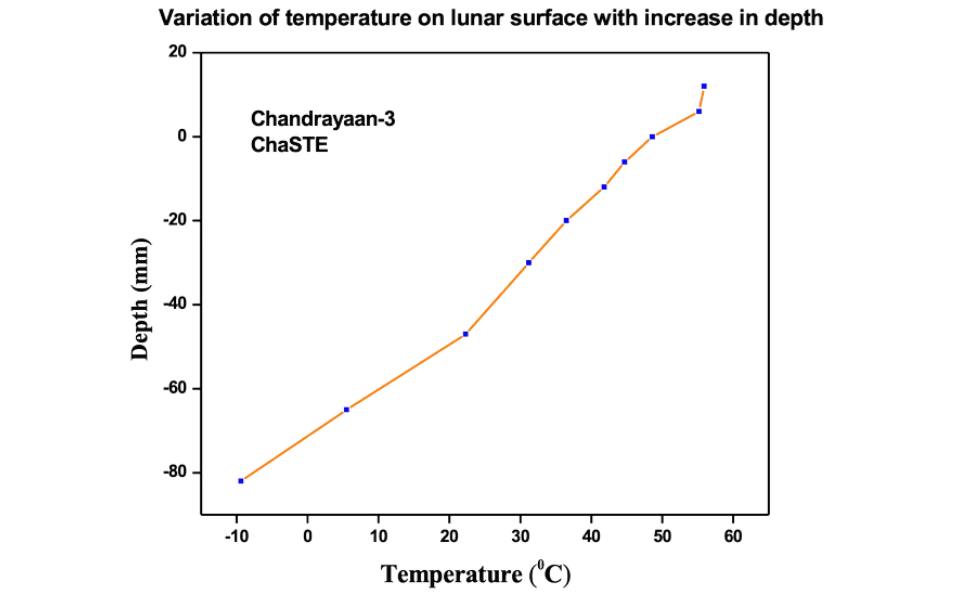
Bengaluru, Aug 27: ISRO on Sunday released a graph of the temperature variation on the lunar surface and a senior scientist of the space agency expressed surprise over the high temperature recorded on the Moon.
The national space agency said Chandra's Surface Thermophysical Experiment (ChaSTE) payload onboard Chandrayaan-3's Vikram lander measured the temperature profile of the lunar topsoil around the pole to understand the thermal behaviour of the Moon's surface.
"Here are the first observations from the ChaSTE payload onboard Vikram Lander. ChaSTE (Chandra's Surface Thermophysical Experiment) measures the temperature profile of the lunar topsoil around the pole to understand the thermal behaviour of the moon's surface," ISRO said in an update on social media platform 'X'.
Speaking about the graphic illustration, ISRO scientist B H M Darukesha told PTI: "We all believed that the temperature could be somewhere around 20 degree centigrade to 30 degree centigrade on the surface but it is 70 degree centigrade. This is surprisingly higher than what we had expected."
The space agency said the payload has a temperature probe equipped with a controlled penetration mechanism capable of reaching a depth of 10 centimetres beneath the surface.
"The probe is fitted with 10 individual temperature sensors. The presented graph illustrates the temperature variations of the lunar surface/near-surface at various depths, as recorded during the probe's penetration. This is the first such profile for the lunar south pole. Detailed observations are underway," ISRO said in a statement.
Scientist Darukesha explained, "When we go two to three centimetres inside the Earth, we hardly see two to three degree centigrade variation whereas there (in Moon), it is about 50 degree centigrade variation. This is something interesting."
The temperature dips to minus 10 degree Celsius below the lunar surface, the senior scientist said, adding that the variation is from 70 degree Celsius to minus 10 degree Celsius.
ISRO said the ChaSTE payload was developed by a team led by the Space Physics Laboratory (SPL) of the space agency's Vikram Sarabhai Space Centre (VSSC) in collaboration with Physical Research Laboratory (PRL), Ahmedabad.
India on August 23 scripted history as ISRO's ambitious third Moon mission Chandrayaan-3 touched down on the lunar surface, making it only the fourth country to accomplish the feat, and first to reach the uncharted south pole of Earth's only natural satellite.
Prime Minister Narendra Modi on Saturday announced that the spot where Chandrayaan-3 Vikram lander touched down would henceforth be called 'Shiv Shakti Point', and the site where the Chandrayaan-2 lander crash-landed on the Moon's surface in 2019 would be known as 'Tiranga Point'.
Besides, August 23 would be celebrated as 'National Space Day' to mark the day when Chandrayaan-3 lander touched down on the lunar surface, Modi said.
Chandrayaan-3 Mission:
— ISRO (@isro) August 27, 2023
Here are the first observations from the ChaSTE payload onboard Vikram Lander.
ChaSTE (Chandra's Surface Thermophysical Experiment) measures the temperature profile of the lunar topsoil around the pole, to understand the thermal behaviour of the moon's… pic.twitter.com/VZ1cjWHTnd
Let the Truth be known. If you read VB and like VB, please be a VB Supporter and Help us deliver the Truth to one and all.
Allen, Raghuvanshi, Green power KKR to 29-run win over GT
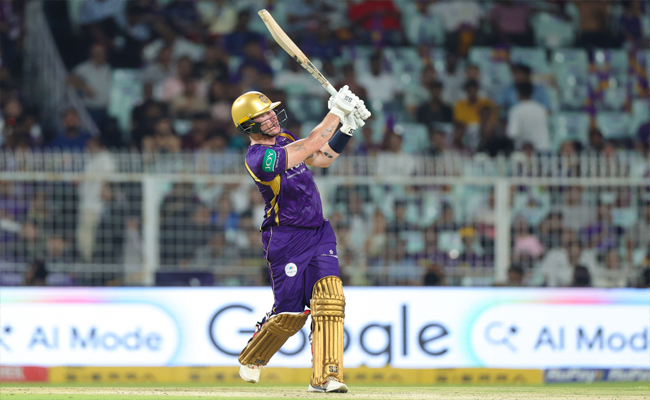
Kolkata (PTI): Finn Allen blasted a 35-ball 93, while Angkrish Raghuvanshi hit an unbeaten 44-ball 82 as Kolkata Knight Riders kept their playoff hopes alive with a 29-run win over Gujarat Titans in the IPL match here on Saturday.
Sent in to bat, Allen went on a six-hitting spree, smashing 10 maximums and four boundaries to add 95 off 41 balls with Raghuvanshi (82).
Raghuvanshi then shared another 108 off 53 balls with Cameron Green (52 not out) to power KKR to a challenging 247 for 2.
In reply, GT could manage 218-4, riding on skipper Shubman Gill's 49-ball 85 and a 35-ball 57 from Jos Buttler. Opener Sai Sudarsan was retired hurt but returned to make a 28-ball 53 not out.
Sunil Narine (2/29) claimed two wickets and Saurabh Dubey snapped one for KKR.
For GT, Mohammed Siraj (1/50), Sai Kishore (1/38) were the wicket-takers.
Brief Score:
KKR: 247 for 2 in 20 overs (Finn Allen 93, Angkrish Raghuvanshi 82 not out, Camero Green 52 not out; Mohammed Siraj 1/50).
GT: 218 for 4 in 20 overs (Shubman Gill 85, Sunil Narine 2/29).