Voting for DU Students Union elections begins
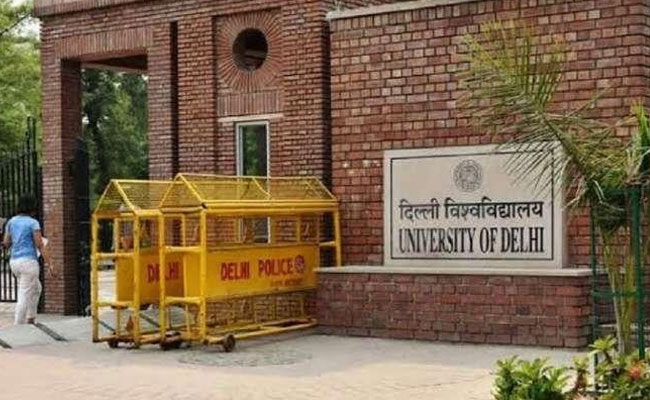
New Delhi (PTI): Voting for the Delhi University Students' Union (DUSU) elections began on Friday here at the north and south campuses of the university.
Students from different DU colleges are casting their votes to elect new representatives for the central panel positions of president, vice president, secretary and joint secretary.
Around 1.40 lakh students are eligible to cast their votes.
Voting will take place in two phases -- students from morning colleges will cast their vote till 1 pm and those from evening colleges from 3 pm till 7.30 pm.
A total of 21 candidates are vying for the positions with eight candidates contesting for the post of president, five for vice-president, and four each for the posts of joint secretary and secretary.
The RSS-affiliated Akhil Bharatiya Vidyarthi Parishad (ABVP), the Congress-backed National Students' Union of India (NSUI), and the left-wing alliance of the All India Students' Association (AISA) and Students' Federation of India (SFI) are the key players this year.
The battle for the post of president is expected to be a tight race between ABVP's Rishabh Chaudhary, NSUI's Rounak Khatri and AISA's Saavy Gupta.
Rishabh Chaudhary, who hails from from Ganaur, Sonipat, is a graduate of Shyam Lal College and is currently a student in the Department of Buddhist Studies. Saavy Gupta contesting as an AISA candidate is a third-year law student at Law Centre-2.
The vice president post is a contest between ABVP's Bhanu Pratap Singh, NSUI's Yash Nandal and Ayush Mondal of the AISA.
The ABVP has fielded Mitravinda Karanwal as its candidate for the post of secretary. Karanwal, a third-year student of History (Hons) at Laxmibai College, is up against NSUI's Namrata Jeph Meena and SFI's Anamika K for the post. Anamika is currently pursuing a master’s degree in Political Science.
For the joint secretary position, ABVP's Aman Kapasia, a graduate of Hindi (Hons) from PGDAV Evening College, will face off against NSUI's Lokesh Choudhary and SFI's Sneha Aggarwal.
Meanwhile, the Delhi High Court has halted the counting of votes of the Delhi University Students Union (DUSU) elections till posters, hoardings and graffiti that have been put up are removed and public property is restored. The court passed the order on Thursday.
Currently, the RSS-affiliated ABVP holds most seats in the students body with the posts of president, vice president and secretary with them. The Congress's student wing NSUI holds the secretary's post.
Let the Truth be known. If you read VB and like VB, please be a VB Supporter and Help us deliver the Truth to one and all.
Bhojshala case: Disputed structure built from remains of pre-existing temples, claims ASI
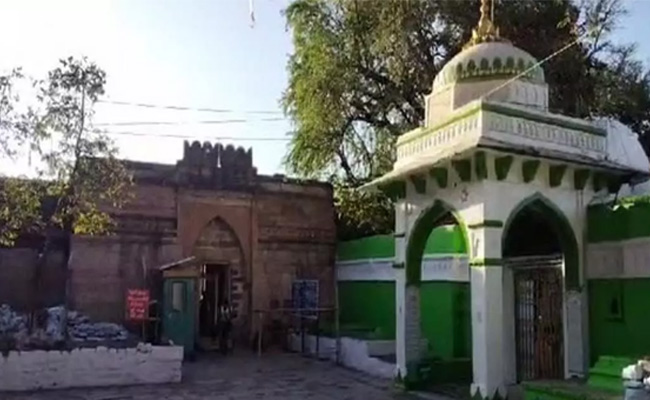
Indore (PTI): The ASI has told the Madhya Pradesh High Court that a massive structure dating back to the Paramara kings' rule existed at the disputed Bhojshala temple-Kamal Maula mosque complex, and the current structure was built from the remains of temples.
The Archaeological Survey of India (ASI) made the claim on Tuesday based on its 98-day scientific survey and over 2,000-page report.
The Hindu community considers Bhojshala a temple dedicated to Vagdevi (Goddess Saraswati), while the Muslim side claims the monument as the Kamal Maula Mosque. The disputed complex is protected by the ASI.
During the hearing before Justices Vijay Kumar Shukla and Alok Awasthi of the HC's Indore bench, Additional Solicitor General Sunil Kumar Jain, representing the ASI, presented a detailed account of the scientific survey conducted two years ago at the complex.
Referring to the ASI's survey report, he said, "Retrieved architectural remains, sculptural fragments, large slabs of inscriptions with literary texts, Nagakarnika inscriptions on pillars, etc, suggest that a large structure associated with literary and educational activities existed at the site. Based on scientific investigations and archaeological remains recovered during the investigations, this pre-existing structure can be dated to the Paramara period."
It can be said that the existing structure was made from the parts of earlier temples, based on scientific investigations, survey and archaeological excavations conducted, study and analysis of retrieved finds, study of architectural remains, sculptures, and inscriptions, art and sculptures, Jain said quoting the report.
Summarising the report, he also drew the court's attention to the fact that the archaeological study identifies that many architectural components, such as pillars and beams, were originally part of temple structures before being repurposed for a mosque.
"The evidence of this transition includes Sanskrit and Prakrit inscriptions that were damaged or hidden, alongside sculptures of deities and animals that were often mutilated or defaced," Jain contended.
The report also states that "all Sanskrit and Prakrit inscriptions are older than the Arabic and Persian inscriptions, indicating that users or engravers of the Sanskrit and Prakrit inscriptions occupied the place earlier".
In light of the Muslim side's earlier objections, the bench wanted to know why there were some discrepancies in the ASI's responses regarding the status of the disputed complex in the cases filed over the years.
The Additional Solicitor General argued that earlier studies of the complex involved only officials, while the current survey involved scientists and the use of advanced technologies such as Ground Penetrating Radar (GPR).
The hearing in the Bhojshala case will continue on Wednesday.
The high court has been regularly hearing four petitions and one writ appeal regarding the religious nature of the Bhojshala temple-Kamal Maula mosque complex since April 6.