'Watch out': VP Dhankhar cautions against Congress leaders' 'Bangladesh can happen in India' remark
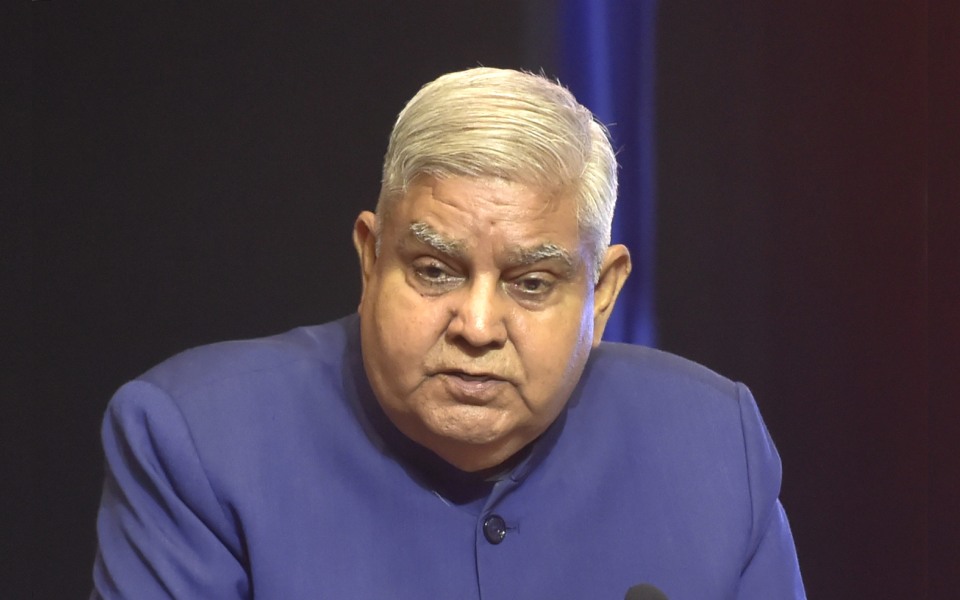
Jodhpur, Aug 10: Taking strong exception to some remarks by a few Congress leaders comparing the situation in Bangladesh with India, Vice President Jagdeep Dhankhar on Saturday said efforts by some to infuse a narrative that what happened in our neighbourhood is bound to happen in our country is deeply concerning.
"How can a citizen of this country having been a Member of Parliament, and the other who has seen enough of Foreign Service takes no time in saying that what happened in the neighbourhood will happen in India," Dhankhar said while addressing the legal fraternity here at a platinum jubilee function of the Rajasthan High Court.
"Efforts by some to infuse a narrative that what happened in our neighbourhood is bound to happen in our Bharat, is deeply concerning," he said.
Though Dhankhar did not name anyone, he was apparently referring to the recent remarks by senior Congress leaders Salman Khurshid and Mani Shankar Aiyar.
At a recent event, Khurshid had said what is happening in Bangladesh can happen in the country though "everything may look normal on the surface".
Aiyar had compared the situation in Bangladesh with that of India.
Dhankhar also said anti-national forces are using the "platforms of our constitutional institutions to hide or legitimise their actions".
He asserted that national interest cannot be calibrated. "It is the supreme precedence, the only precedence, and we are committed to nation being first, before anything else."
The Rajya Sabha Chairman also said that legislature and Parliament cannot script judgements, similarly judiciary cannot legislate or impart directives that are beyond legislation.
"The role of all institutions are well delineated in the Constitution... it will be dangerous if there is incursion in the domain of one constitutional constitution by the other," he said.
Posing a question to the audience, he asked if these institutions (Legislature/ Executive/Judiciary) are working in their areas or are they in expansion mode to operate in the area of other.
Emphasising the strength of all the three pillar institutions of the country, Dhankhar said their vulnerability would imperial our democracy and derail our development trajectory.
"Our institutions are being exploited by these forces to set a narrative not only anti-national but also aimed at derailing our democracy. So let's work together with the nation-first sentiments. Work to insulate our institution from nefarious designs for our democracy and if they manage to make some inroads, don't be silent, neutralise them", he appealed.
"The forces inimical to Bharat are trying impede our growth and are operating at multiple levels tainting, tarnishing, targeting and diminishing our constitutional institutions," he said warning that falling prey to them will have dangerous consequences.
Terming the Emergency as the darkest period since independence, he said it was not worth forgetting and every Indian, specially young generation, should know about it.
"I implore each one of you to never forget the price of freedom and this vigilance must be dictated by your in-depth knowledge of the suffering of lakhs of people in this country during the draconian period of Emergency imposed by an individual," he said.
"During Emergency, liberty was held to ransom by one individual. Those arrested without any fault were barred from seeking any judicial help. The apex court overturned the verdicts of nine high courts, that had ruled in favour of the victims," he added.
Taking about the importance of judiciary, the vice president said that India takes pride in nurturing its robust judiciary that has always contributed to sustaining the democratic values of the country and development of the nation.
"Judicial system of a nation and its functionality define its democratic vibrancy. An independent justice system is essential to any shapes of governments as it is the lifeline of life as such," he said.
Let the Truth be known. If you read VB and like VB, please be a VB Supporter and Help us deliver the Truth to one and all.
Ordinance issued to increase number of Supreme Court judges from 34 to 38
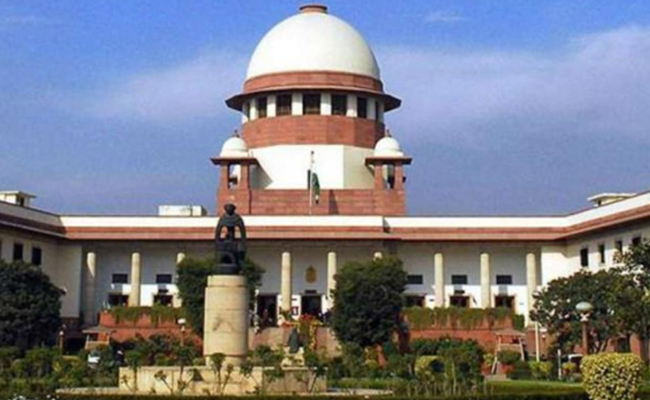
New Delhi (PTI): The government has promulgated an ordinance to increase the strength of the Supreme Court from the present 34 judges to 38, including the Chief Justice of India.
The law ministry notified the ordinance on Saturday, which amended the Supreme Court (Number of Judges) Act, 1956, to increase the sanctioned strength of the top court.
So far, the sanctioned strength of the top court was 34, including the Chief Justice of India (CJI). Now, the number of judges has been increased by four, taking the sanctioned strength to 38.
The top court will now have 37 judges, other than the CJI.
With the apex court having two vacancies at present, and the ordinance coming into force immediately, the Supreme Court Collegium will now have to recommend six names for appointment as judges in the top court.
A bill will be brought in the Monsoon Session of Parliament to convert the ordinance – an executive order – into a law passed by Parliament.
The Union Cabinet had cleared a draft bill on May 5 to increase the number of apex court judges.
The strength of the Supreme Court was last increased from 30 to 33 (excluding the CJI) in 2019.
The Supreme Court (Number of Judges) Act, as originally enacted in 1956, put the maximum number of judges (excluding the CJI) at 10.
This number was increased to 13 by the Supreme Court (Number of Judges), Amendment Act, 1960, and to 17 by another amendment to the law.
The Supreme Court (Number of Judges) Amendment Act, 1986, augmented the strength of judges from 17 to 25, excluding the CJI.
A fresh amendment in 2009 further increased the strength from 25 to 30.
Article 124(3) of the Constitution lists the qualifications required to become a Supreme Court judge.
An Indian citizen who has either served as a high court judge for at least five years, or as an advocate for 10 years, or is a distinguished jurist, can be appointed to the top court.
The strength of the Supreme Court is increased based on the recommendations of the CJI, who writes to the Union law minister. After consulting the finance ministry, the Department of Justice under the law ministry moves the Cabinet with a draft bill.