We can't call any part of Indian territory as Pakistan: CJI on K'taka HC Judge's remarks
New Delhi (PTI): The Supreme Court on Wednesday closed suo motu proceedings initiated over alleged objectionable comments made by a Karnataka High Court judge during court proceedings.
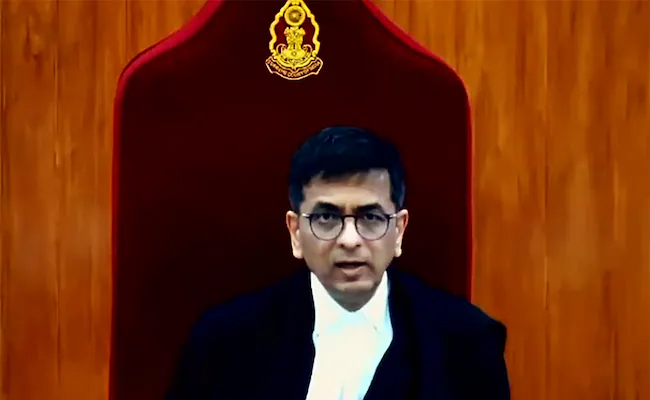
A five-judge bench headed by Chief Justice D Y Chandrachud noted that Karnataka High Court judge Justice Vedavyasachar Srishananda, who had made those observations, had on September 21 tendered an apology for his comments in the open court there.
"We can't call any part of the territory of India as Pakistan," the CJI observed.
The bench, also comprising Justices Sanjiv Khanna, B R Gavai, Surya Kant and Hrishikesh Roy, observed that courts have to be careful not to make comments in the course of judicial proceedings which may be construed as being misogynistic or for that matter prejudicial to any segment of the society.
"Casual observations may well reflect a certain degree of individual bias particularly when they are likely to be perceived as being directed to a particular gender or community," the bench said.
The top court had on September 20 taken suo motu cognisance of the high court judge's alleged objectionable comments against a woman lawyer during the court proceedings in a case and his reference to a Muslim-majority area in Bengaluru as "Pakistan" in another.
In video clips, which went viral on social media, Justice Srishananda was seen reprimanding a woman lawyer and reportedly made some objectionable comments when she intervened in an ongoing hearing.
The judge, in another case related to landlord-tenant dispute, referred to a Muslim-dominated locality in Bengaluru as "Pakistan".
"At this stage, we request the Registrar General of the High Court of Karnataka to submit a report to this court after seeking administrative directions of the Chief Justice of the High Court of Karnataka, in regard to the subject matter which has been referred to above," the apex court had said on September 20.
Let the Truth be known. If you read VB and like VB, please be a VB Supporter and Help us deliver the Truth to one and all.
Trump pauses Project Freedom, claims great progress for final agreement with Iran
Washington (PTI): President Donald Trump has suspended “Project Freedom,” to escort ships through the Strait of Hormuz, claiming progress in negotiations with Iran toward an agreement to end the war.
In a post on Truth Social on Tuesday, Trump said, “Great progress has been made toward a complete and final agreement with representatives of Iran.”
“Based on the request of Pakistan and other Countries, the tremendous Military Success that we have had during the Campaign against the Country of Iran and, additionally, the fact that Great Progress has been made toward a Complete and Final Agreement with Representatives of Iran, we have mutually agreed that, while the Blockade will remain in full force and effect, Project Freedom (The Movement of Ships through the Strait of Hormuz) will be paused for a short period of time to see whether or not the Agreement can be finalized and signed," Trump said.
Project Freedom was launched on Monday to escort ships, stranded due to the closure of the Strait of Hormuz, out to safety. Trump had announced the operation on Sunday and the US Central Command began implementing it the next day.
However, the Project led to friction in the vicinity of the narrow seaway, a key route for transporting one-fifth of the global oil supplies, with the UAE claiming that its ships were attacked by Iran. The US also claimed to have destroyed several Iranian small boats.
Trump’s statement on Truth Social came hours after US Secretary of State Marco Rubio announced that Operation Epic Fury, launched on February 28, had concluded as its objectives have been achieved.
"Operation Epic Fury is concluded. We achieved the objectives of that operation. We're not cheering for an additional situation to occur. We would prefer the path of peace. What @POTUS would prefer is a deal... that is, so far, not the route that Iran has chosen," Rubio told a press conference at the White House on Tuesday.
On Project Freedom, Rubio said the goal was to rescue almost 23,000 civilians from 87 different countries who were trapped inside the Persian Gulf and left for dead by the Iranian regime.
"This is not an offensive operation. This is a defensive operation, and what that means is very simple: there’s no shooting unless we're shot at first. We’re not attacking them, but if they're attacking us or they’re attacking a ship, you need to respond to that," Rubio said.