What is the Indus Waters Treaty suspended by India after Pahalgam attack
How does the treaty suspension affect Pakistan
_vb_46.jpeg)
New Delhi: In response to the recent terror attack in Pahalgam that killed 28 people, India on Wednesday announced the suspension of the 1960 Indus Waters Treaty (IWT) with Pakistan. The decision was part of a set of retaliatory measures aimed at pressuring Islamabad to withdraw its support for cross-border terrorism.
The announcement was made by Foreign Secretary Vikram Misri during a press conference held after a high-level meeting of the Cabinet Committee on Security (CCS) chaired by Prime Minister Narendra Modi. Misri stated that the treaty would remain suspended until Pakistan credibly and irrevocably abjures its support for terrorism.
What is the Indus Waters Treaty?
Signed on 19 September 1960 in Karachi, the Indus Waters Treaty was brokered by the World Bank and signed by then Indian Prime Minister Jawaharlal Nehru and Pakistan’s President Field Marshal Ayub Khan. The treaty outlines the division of the Indus River system between the two countries.
Under the agreement, India was given control over the eastern rivers, Ravi, Beas, and Sutlej, while Pakistan was allocated the waters of the western rivers, Indus, Jhelum, and Chenab. While India is permitted to generate hydroelectricity through run-of-the-river projects on the western rivers, Pakistan retains the right to raise objections on project designs.
The river system plays a crucial role in both countries’ agriculture and water supply. After the 1947 partition, Pakistan became the lower riparian state and India the upper riparian state, necessitating an agreement to prevent future disputes.
The treaty includes 12 Articles and 8 Annexures, and was known for surviving multiple Indo-Pak conflicts. India had already sent a notice to Pakistan in September last year seeking a review and modification of the treaty.
What can India now do under the suspension?
According to P. K. Saxena, former Indian Commissioner for Indus Waters:
- India may stop sharing water flow data with Pakistan
- India can build storage infrastructure on Western Rivers like the Indus, Jhelum, and Chenab
- Pakistan officials may be denied access to inspect Indian hydropower projects
- India can begin reservoir flushing techniques at projects like Kishenganga to improve dam longevity
However, Saxena clarified that immediate disruption of Pakistan’s water supply is unlikely, as India lacks the infrastructure to stop or divert river flows at present.
Legal implications and Pakistan’s options
The IWT does not include an exit clause, making unilateral withdrawal technically illegal. While it includes a dispute resolution mechanism (Article IX and Annexures F & G), this is limited to disputes within the treaty's scope, not enforcement of the treaty itself.
In 2016, Pakistani legal expert Ahmer Bilal Soofi said arbitration would be ineffective if India refuses to recognise the treaty, and Pakistan cannot approach the ICJ due to India’s reservations under the ICJ statute.
Longstanding tensions over Hydroelectric projects
Disputes over Kishenganga and Ratle hydroelectric projects in Jammu and Kashmir have long strained the treaty. In January 2023, India sent its first-ever notice seeking modification of the treaty, followed by a second notice in September 2024.
Pakistan has opposed the projects’ design, claiming they violate IWT provisions. Though these are "run-of-the-river" projects that do not obstruct river flow, Islamabad argues they could be misused to manipulate water supply.
India, citing Pakistan’s continued resistance, invoked Article XII(3), which allows modification of the treaty through mutual consent.
Role of neutral expert
In January 2025, Michel Lino, a Neutral Expert appointed by the World Bank, ruled that he was competent to adjudicate the dispute over the Kishenganga and Ratle projects. While Pakistan claimed the differences exceeded the expert's mandate, India argued they were well within the treaty’s provisions.
What happens next?
Pakistan is yet to officially respond to India’s suspension. However, the move is likely to escalate tensions, both diplomatically and politically. Given the treaty's pivotal role in Indo-Pak relations and South Asia’s water security, the consequences of this suspension could be profound and long-lasting.
Additional measures announced
Apart from suspending the treaty, the Indian government unveiled a series of other diplomatic and security steps:
1. Closure of Attari checkpost: The integrated checkpost at Attari has been shut. Pakistani nationals who entered through this route may return before 1 May 2025.
2. Visa cancellations: All SAARC Visa Exemption Scheme (SVES) visas previously issued to Pakistani nationals have been cancelled. Those already in India under SVES have 48 hours to leave.
3. Expulsion of defence advisors: India has declared all Defence, Military, Naval, and Air Advisors in the Pakistani High Commission in New Delhi as *persona non grata*. They have a week to leave the country.
4. Withdrawal of Indian advisors from Islamabad: India has also withdrawn its own Defence, Navy, and Air advisors from its High Commission in Islamabad, effectively nullifying those positions.
The decisions come amid growing domestic outrage over the attack in Jammu and Kashmir’s Pahalgam, where gunmen opened fire on tourists, killing 28 and injuring several others.
Let the Truth be known. If you read VB and like VB, please be a VB Supporter and Help us deliver the Truth to one and all.
CM Siddaramaiah alleges ‘criminal conspiracy’ in Sringeri recount, vows legal action
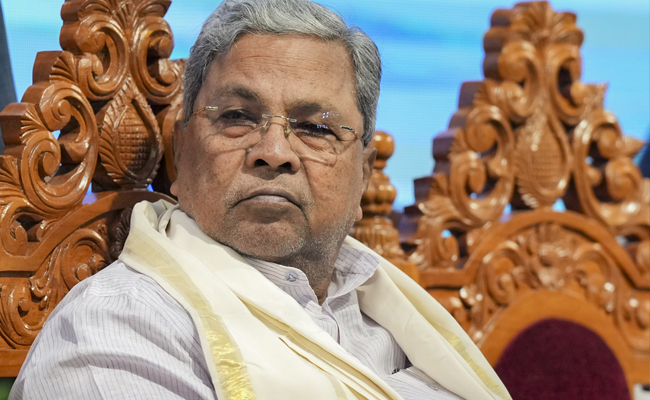
Bengaluru (PTI): Alleging a “criminal conspiracy” by BJP candidate D N Jeevaraj in the Sringeri Assembly poll recounting, Karnataka CM Siddaramaiah on Tuesday said the outcome was manipulated after valid postal ballot votes in favour of Congress leader T D Raje Gowda were tampered with during the recounting process.
Following a Karnataka High Court order on an election petition filed by Jeevaraj, challenging Raje Gowda’s election, the reverification and recounting were conducted on Saturday.
After the reverification and recount of postal ballots for the Sringeri Assembly constituency, votes polled in favour of Raje Gowda were reduced by 255, the returning officer said.
A report on the matter has been submitted to the Election Commission of India for further action, the officer added.
Congress leader Raje Gowda had won the 2023 Assembly polls from Sringeri by 201 votes, defeating his nearest rival Jeevaraj.
Addressing a press conference in Bengaluru, Siddaramaiah said the High Court had directed the recounting of postal ballots and that irregularities were noticed during the exercise conducted on May 2.
“This is a clear case of criminal conspiracy,” Siddaramaiah said, alleging that valid votes cast in favour of Raje Gowda were altered after being accepted by counting agents of all parties, including Congress, BJP, and JD(S).
He claimed that during the recounting of postal ballots, 255 votes were initially accepted as valid by all agents but were later tampered with by subordinate officials.
“There is a second mark on the votes polled in favour of Raje Gowda. They had accepted these as valid votes. Subsequently, another mark was made by officials. This is a clear case of criminal conspiracy,” he said.
When asked who was behind the alleged conspiracy, the CM replied, “It was hatched by Jeevaraj and others. It is planned.”
Siddaramaiah further alleged that the returning officer acted improperly by declaring the result despite the presence of an Election Commission observer during the recounting.
“Immediately after the counting, the returning officer announced the result. He should not have done so; this is against the law,” he said.
He pointed out that Raje Gowda had originally won by 201 votes, but after the recounting, the BJP candidate was declared the winner by 52 votes.
“The BJP has committed a criminal act of conspiracy. This is not vote chori but vote dacoity,” he alleged.
The CM said a police complaint had already been filed by Raje Gowda’s election agent, Sudhir Kumar, and emphasised the need for electoral integrity.
“We want transparency and free and fair elections. That is what our Constitution mandates,” he added.
Stating that the government would pursue legal remedies, Siddaramaiah said, “We are preparing an appeal challenging the returning officer’s announcement in a court of law.”
Responding to a separate query on elections in other states, the CM said there appeared to be an anti-incumbency factor in West Bengal, while results in Tamil Nadu were “surprising,” adding that Vijay’s party was emerging as the largest there.
Following the victory of party candidates in Bagalkote and Davanagere South, Siddaramaiah expressed confidence about future electoral prospects in Karnataka.
“Even in 2028, we will win the Assembly elections. We will come back,” the CM said.
Siddaramaiah added that he would order a forensic examination into the alleged tampering of postal ballots.