When Mumbai was held ‘hostage’: From double-decker bus to flat
Mumbai (PTI): Mumbai on Thursday witnessed a tense situation where several children were held captive, perhaps for the first time, but the metropolis is no stranger to hostage crises, which in the past have pushed it to the edge and tested police efficiency in non-terror cases.
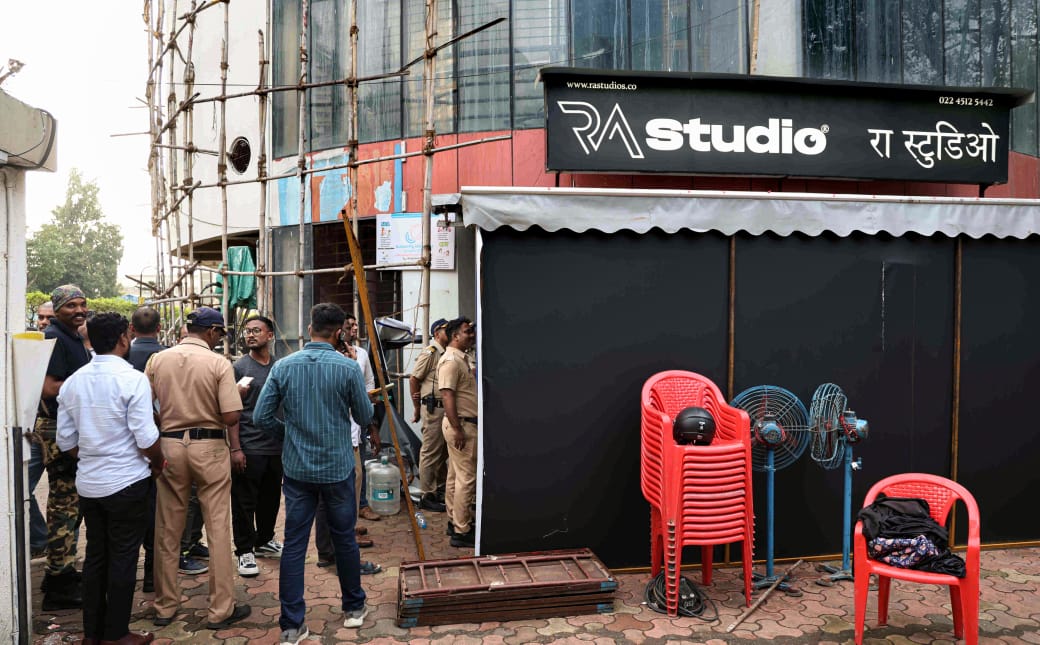
Police successfully concluded a nearly three-hour-long dramatic hostage situation, safely rescuing 17 children and two adults held at a studio in the Powai area by a person who died from a bullet injury sustained during police action.
The tense drama unfolded around 1:30 pm after the Powai police station received an alert that a person, identified as Rohit Arya (50), had taken 17 children hostage inside R A Studio in the Mahavir Classic building. The children, boys and girls between the ages of 10 to 12, had been called to the studio for an audition for a web series that had been ongoing for two days.
This may be the first of its kind situation in recent years in which a large number of children were held hostage, a police official said.
In the last decade or so, the financial capital has witnessed multiple hostage-taking scenarios.
In March 2010, a retired customs officer, Harish Marolia, had taken a 14-year-old girl hostage in suburban Andheri (West). The 60-year-old had held the girl, Himani, captive in his flat. Marolia had taken the step after an altercation with members of the housing society where the two resided, the official recalled.
Minutes before taking the girl hostage, Marolia had objected to construction work on one of the floors in his building. He had also threatened the housing society’s secretary by firing in the air.
The hostage drama came to a violent end when Marolia killed the teenager and he himself was subsequently shot dead by police.
In November 2008, a 25-year-old gunman from Bihar, Rahul Raj, held commuters in a double-decker civic-run bus hostage during the vehicle’s journey from Andheri. As the bus reached Bail Bazar in Kurla, nearly 100 policemen surrounded the bus.
When police asked Raj to surrender, he threw a currency note at them on which he had written that he had come to “kill” Maharashtra Navnirman Sena (MNS) president Raj Thackeray, whose party had launched an anti-migrant agitation in Mumbai targeting North Indians.
Police shot dead the 25-year-old, bringing a bloody end to the crisis.
“In hostage situations, the most important thing is to save the life and ensure minimum damage. Negotiations are done keeping these two objectives in mind,” Shailni Sharma, Assistant Commissioner of Police, Nagpur, explained while talking to PTI over the phone.
Sharma was the first woman officer of the Mumbai police, who was sent for training to London for handling hostage situations after the 26/11 Mumbai terror attacks.
She was also called to train National Security Guard (NSG) commandos in 2022 in successfully handling hostage scenarios.
“When there is no headway in negotiations (with the hostage-taker), the operation team takes decisions as per the need of the time," Sharma said.
In the 2010 Andheri hostage incident, Sharma was called to negotiate with Marolia, but by then, a police team had barged inside the flat where he had taken the girl captive and opened fire at her.
In 2013 and 2017, the police officer saved two women, who were trying to end their lives, by talking and convincing them not to take the extreme step.
During anti-CAA and NRC protests in Mumbai, Sharma was posted as senior police inspector in Nagpada and handled the agitations through talks.
Let the Truth be known. If you read VB and like VB, please be a VB Supporter and Help us deliver the Truth to one and all.
Karnataka tanks hold strong water storage: Minister Boseraju
Bengaluru (PTI): Karnataka Minister N S Boseraju on Tuesday said that minor irrigation tanks across the state are holding good water storage levels, with the 3,788 tanks under the department’s jurisdiction providing life-sustaining water to a large agricultural command area of approximately 4,45,009 hectares.
In a statement, the Minister for Minor Irrigation, Boseraju, said that according to the latest data released by the department, a vast majority of the 3,788 minor irrigation tanks in the state have maintained good water levels.
Detailing the storage status, the report said that even in peak summer, 165 tanks are full.
Additionally, 1,355 tanks have retained more than 51 per cent capacity, 1,143 tanks have water levels up to 50 per cent, and 959 tanks are at roughly 30 per cent storage capacity.
District-wise, Davanagere leads the state in water storage, with 27 tanks remaining full even during summer. Chikkamagaluru follows closely with 46 full tanks, indicating strong water retention.
Other top-performing districts include Hassan, Tumakuru, and Kolar.
Boseraju, who also holds the portfolio of Science and Technology, said 1,184 tanks are being actively filled through 145 tank-filling lift irrigation projects under the Minor Irrigation Department.
He attributed the strong water retention to good monsoon rainfall and effective water management strategies of the government.
“It is encouraging to see such a substantial volume of water stored across our minor irrigation tanks by the end of March, remaining largely intact even as summer progresses. The fact that 1,355 tanks are nearly full and 165 tanks are brimming is a testament to the success of our tank-filling programmes and rejuvenation initiatives,” he said.
“By ensuring a continuous flow of water to these tanks through lift irrigation projects across departments, as well as supplying treated and surface water to the Bayaluseeme districts, we have taken proactive measures to prevent them from drying out during the summer,” the minister said.
According to him, these data points confirm that efforts to build a water-secure Karnataka are yielding strong results at the grassroots level.
“This water wealth preserved in our tanks will bring direct benefits to lakhs of farmers across the 4,45,009-hectare command area,” he added.