Wife can't become absolute owner of property Willed for her lifetime, if maintenance taken care: SC
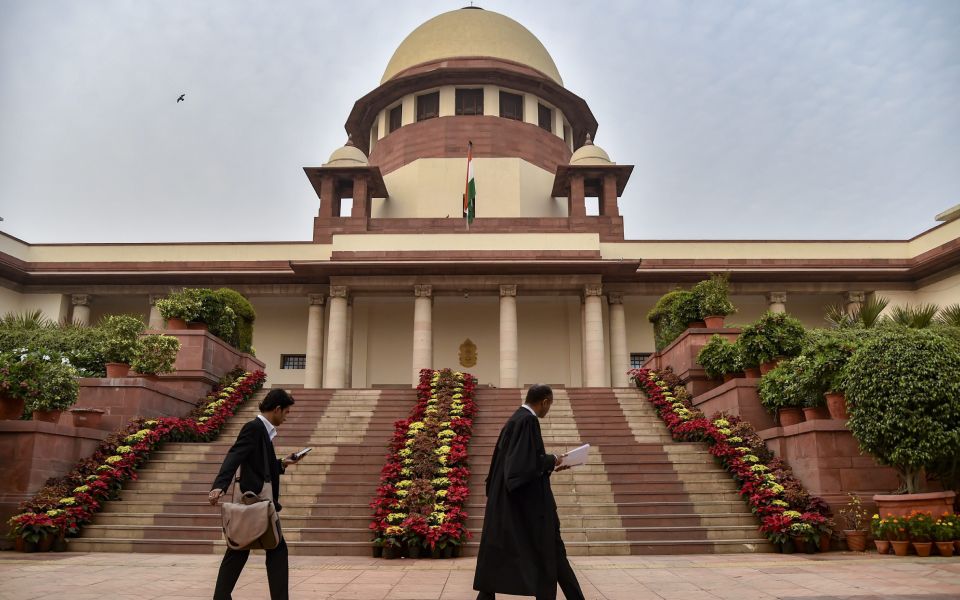
New Delhi, Feb 1: A Hindu male, owning self-acquired property executing a Will giving a limited estate to his wife, would not mature into an absolute right, if all other aspects including maintenance are taken care of, the Supreme Court on Tuesday said.
A bench of Justices Sanjay Kishan Kaul and MM Sundresh decided in the second round of litigation the ownership rights accrued half a century after testamentary disposition by a Will dated April 15, 1968, by one Haryana resident Tulsi Ram, who passed away on November 17, 1969.
In our view, the objective of sub-Section (2) is quite clear as enunciated repeatedly by this Court in various judicial pronouncements, i.e., there cannot be a fetter in an owner of a property to give a limited estate if he so chooses to do including to his wife but of course, if the limited estate is to the wife for her maintenance that would mature in an absolute estate under Section 14(1) of the said (Hindu Succession) Act , the bench said, while setting aside the order of High Court.
It added that sub-section (2) of Section 14 of the Hindu Succession Act would apply and this does inter alia apply to a Will, which may create an independent and new title in favour of females for the first time and is not a recognition of a pre-existing right .
The top court said that in such cases of a restricted estate in favour of a female is legally permissible and Section 14(1) of the Hindu Succession Act will not operate in that sphere.
The objective cannot be that a Hindu male who owned self-acquired property is unable to execute a Will giving a limited estate to a wife if all other aspects including maintenance are taken care of. If we were to hold so, it would imply that if the wife is disinherited under the Will it would be sustainable but if a limited estate is given it would mature into an absolute interest irrespective of the intent of the testator , the bench said.
It said that the testator in the present case Tulsi Ram had taken all care of the needs of maintenance of his wife by ensuring that the revenue generated from the estate would go to her alone.
He, however, wished to give only a limited lift interest to her as the second wife with the son inheriting the complete estate after her lifetime. We are, thus, of the view that it would be the provisions of Section 14(2) of the said Act which would come into play in such a scenario and Ram Devi only had a life interest in her favour , the bench said.
It said that people who have purchased land from the wife Ram Devi are in no better position than her and the sale deeds in favour of them cannot be sustained.
The bench said that there is no doubt that Section 14 of the Hindu Succession Act is to give rights of a property to a Hindu female and was a progressive step and its sub-section (1) makes it clear that it applies to properties acquired before or after the commencement of the said Act.
Any property so possessed was to be held by her as full owner thereof and not as a limited owner. The Explanation to sub-Section (1) of Section 14 of the said Act defines the meaning of property in this sub-section to include both movable and immovable property acquired by the female Hindu by inheritance or devise or a partition, or in lieu of maintenance or arrears of maintenance, or by a gift from any person, or by her skill or exertion, or by purchase or by prescription or in any other manner whatsoever, including stridhana , the bench said, adding that the explanation is quite expansive.
The Will bequeathed the Tulsi Ram's estate to his son, and his second wife Ram Devi (the first wife being deceased) under which land measuring 175 kanals and 9 marla, a residential house and a Bara in Village Jundla, Haryana was bequeathed half and half to them.
However, the nature of bequeathing was different for the two as the son was given absolute ownership rights to the extent of his share of land and property whereas the wife was given limited ownership for her enjoyment during her lifetime concerning her share of the land with a specific provision that she could not alienate, transfer or create third party rights over the same.
Tulsi Ram in his Will stated that the property was to vest absolutely in Son after the lifetime of his wife.
Let the Truth be known. If you read VB and like VB, please be a VB Supporter and Help us deliver the Truth to one and all.
Thumbay Group begins work on Sharjah’s first private integrated psychiatric, rehabilitation hospital
Sharjah: Thumbay Group has laid the foundation stone for the Thumbay Psychiatric and Rehabilitation Hospital at Sharjah Healthcare City, a 120-bed facility that the company says will be the region’s first private, fully integrated hospital dedicated to psychiatric care, neuro-rehabilitation and addiction recovery.
The groundbreaking ceremony was led by Dr. Abdelaziz Saeed Al Mheiri, who is also a member of the Sharjah Executive Council, in the presence of Dr. Thumbay Moideen.
Spread across 110,000 square feet, the hospital is being developed to address growing demand for specialised mental health and rehabilitation services in the UAE and the wider Gulf region.
The facility will include inpatient and outpatient services in psychiatry, neuro-rehabilitation, addiction treatment, child and adolescent mental health, and care for mood and anxiety disorders. It will also feature VIP inpatient villas designed to provide privacy and support long-term recovery.
A mosque, named the Thumbay Masjid, will be constructed within the campus and will be open to the public.
The hospital is being designed to meet standards for Commission on Accreditation of Rehabilitation Facilities (CARF), an internationally recognised accreditation system for rehabilitation facilities.
Speaking at the event, Dr. Abdelaziz Saeed Al Mheiri said the project reflects Sharjah’s commitment to strengthening healthcare infrastructure in all aspects of wellbeing.
“Mental health and rehabilitation have long needed dedicated infrastructure, and we are proud to support a private partner whose vision matches the ambition of this Emirate,” he said.
Dr. Thumbay Moideen said the project was a response to a growing need for specialised mental healthcare services in the region.
“We have spent over three decades building healthcare in this region, and the one conversation that has grown louder every year is mental health. Families have been carrying this quietly for too long. This hospital is our answer. It is purpose-built, not retrofitted, and it has been designed around dignity, recovery, and outcomes that families can trust,” he said.
Construction is scheduled to begin in June 2026, and the hospital is expected to become operational by mid-2027.
Once completed, the facility will become part of Thumbay Group’s network of healthcare, education and diagnostic institutions across the UAE.