Will beat BJP, no issues with Mayawati, have same blood: Bhim Army chief Chandrashekhar
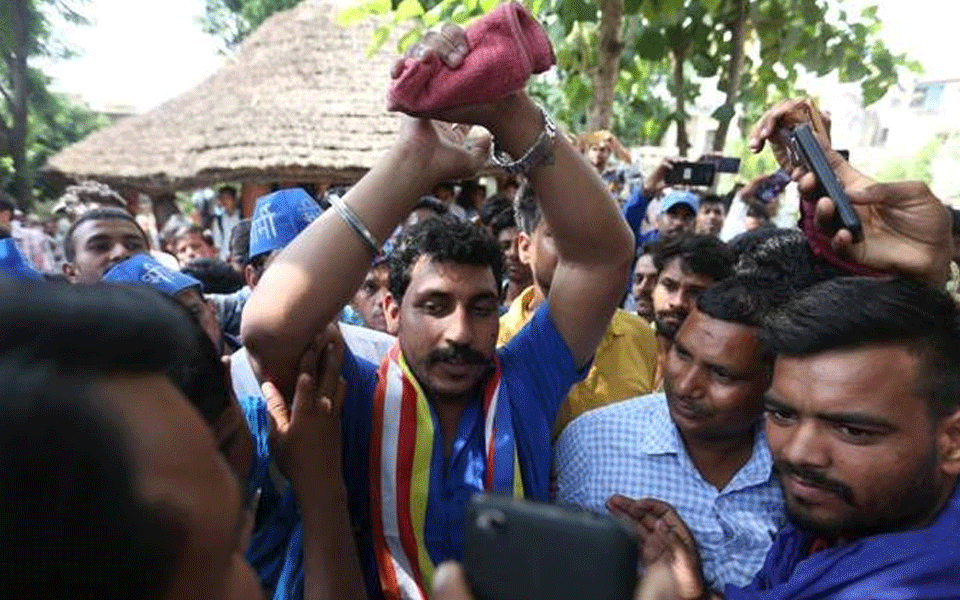
Around 1 pm Friday, Bhim Army founder Chandrashekhar, who was released from UP’s Saharanpur jail at 2.45 am after more than a year, stepped out of his home in Chhutmalpur to meet supporters and well-wishers. Within minutes, the mob crowded around him, and he fainted.
“First, we didn’t let him sleep through the night in our excitement. Now, since morning, people are not letting him take rest. He is not saying no, either. He hasn’t even eaten anything since last night,” says an associate, as Bhim Army workers help their leader back on his feet.
The popularity that Chandrashekhar enjoys here among the Dalits, particularly the young, is no less than that of a Bollywood star. Since morning, the small public space near his one-storey house in Saharanpur’s Chhutmalpur has been teeming with people arriving in batches from as far as Haridwar and Aurangabad. Most of them are in their 20s, sporting moustaches like their icon and seeking nothing more than a selfie.
Chandrashekhar obliges them, hugging and thanking everyone. Then, twirling his moustache, it’s time for politics. “Our sole aim is to defeat the BJP. We will support whoever that can do it. If we see the Mahagathbandhan is not coming through, we will create social pressure on the BSP to join hands with other parties. We will hold rallies across the state. Everyone must understand that it is important to defeat the BJP,” he says (interview, page 13).
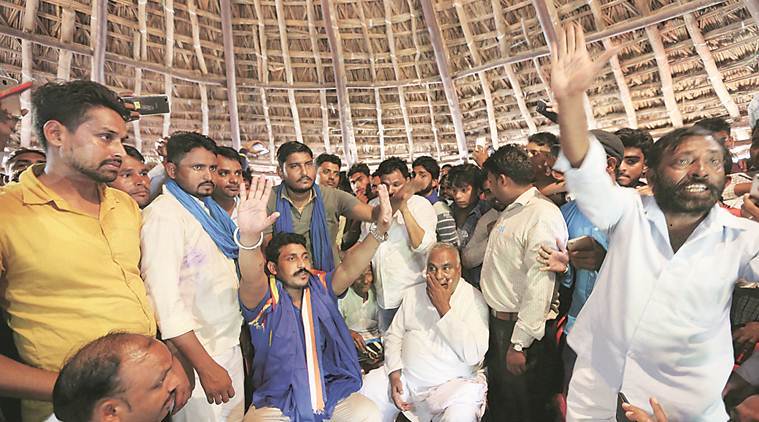
Bhim Army founder Chandrashekhar (centre) with supporters at Chhutmalpur village after his release from Saharanpur jail after more than a year. (Express photo/Gajendra Yadav)
So does that mean support for Mayawati, who once described Bhim Army as the BJP’s B-team? “She has struggled a lot along with Saheb (Kanshiram), and after was gone. It is now our turn to do something. To build the society, to boost the morale of our people, to empower them with education. She can continue doing her electoral politics. We both have the same blood. She may have some issues with me, I have none with her. It is not in my values to speak ill of my Bua (aunt). Our only aim is to defeat the BJP,” he says.
His supporters, meanwhile, watch in awe. “This is the kind of leader we want. Thok-ke bolta hai (He minces no words),” says Deepak, 21, a welder sporting a T-shirt with Chandrashekhar’s silhouette printed on it. Deepak and a friend, 22-year-old Amit who runs a food stall, decided not to work today to be with Chandrashekhar. “He stayed in jail for us for 14 months. What’s losing a day’s work for him?,” they say.
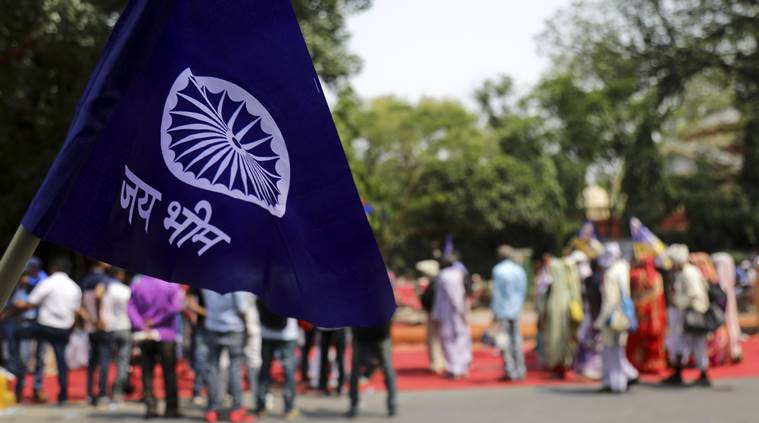
Protest against Violence and Persecution of Dalits & Adivasis by Bheem army at Parliament Street.
The anger is palpable and directed at the BJP government for Chandrashekhar’s prolonged incarceration. “Yeh toh Thakuron ki sarkar hai (This government is for Thakurs),” is the refrain directed at the Yogi Adityanath government.
Echoing the mood around him, Chandrashekhar says that despite the BJP’s efforts, Dalits will not vote for the ruling party. Asked if the BJP will gain political mileage from his release, he says, “Until I am free and alive, I will not let that happen. Main voton se BJP ki nasbandi kar dunga (I will sterilise BJP with my votes).”
On speculation that he was released as a part of the BJP’s strategy to divide Dalit votes, he claims he was released because the state government knew it was going to be reprimanded by the Supreme Court, where a petition was up for hearing Friday. “In any case, I am not going to fight elections. I want to keep away from electoral politics and engage at the social level. But I will support the right kind of people,” he says.
On Thursday, the UP government revoked the National Security Act (NSA) against Chandrashekhar, setting the stage for his release more than a year after he was jailed for his alleged role in clashes between Thakurs and Dalits in Saharanpur in May 2017.
Chandrashekhar was arrested along with two others — Shiv Kumar, pradhan of Shabbirpur village, and Sonu, a resident. The Bhim Army chief was granted bail by the Allahabad High Court in November 2017 before the government detained him under the NSA. On Friday, Kumar and Sonu were also released.
In the crowd surrounding Chandrashekhar, meanwhile, is a sizeable number of Muslims. The Bhim Army has been pushing for Dalit-Muslim unity, and had extended support to the Mahagathbandhan’s Muslim candidate in the Kairana bypolls.
“Chandrashekhar is doing what Kanshiram always dreamed of — Dalit-Muslim unity. Today, no political party wants to associate with Muslims. But he is openly embracing Muslims,” says a Muslim teacher, who does not want to be identified.
As for Bhim Army fans, the road ahead is clear: Chandrashekhar should fight the elections. “So what if Mayawati is not supporting him? He should fight as an Independent. He will win. Without political power, there is no power,” says Kuldeep Kumar, 26, a Dalit journalist from the area.
Courtesy: indianexpress.com
Let the Truth be known. If you read VB and like VB, please be a VB Supporter and Help us deliver the Truth to one and all.
CM Siddaramaiah alleges ‘criminal conspiracy’ in Sringeri recount, vows legal action
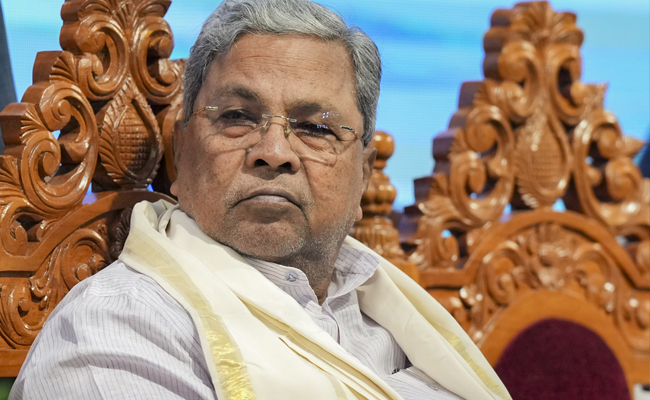
Bengaluru (PTI): Alleging a “criminal conspiracy” by BJP candidate D N Jeevaraj in the Sringeri Assembly poll recounting, Karnataka CM Siddaramaiah on Tuesday said the outcome was manipulated after valid postal ballot votes in favour of Congress leader T D Raje Gowda were tampered with during the recounting process.
Following a Karnataka High Court order on an election petition filed by Jeevaraj, challenging Raje Gowda’s election, the reverification and recounting were conducted on Saturday.
After the reverification and recount of postal ballots for the Sringeri Assembly constituency, votes polled in favour of Raje Gowda were reduced by 255, the returning officer said.
A report on the matter has been submitted to the Election Commission of India for further action, the officer added.
Congress leader Raje Gowda had won the 2023 Assembly polls from Sringeri by 201 votes, defeating his nearest rival Jeevaraj.
Addressing a press conference in Bengaluru, Siddaramaiah said the High Court had directed the recounting of postal ballots and that irregularities were noticed during the exercise conducted on May 2.
“This is a clear case of criminal conspiracy,” Siddaramaiah said, alleging that valid votes cast in favour of Raje Gowda were altered after being accepted by counting agents of all parties, including Congress, BJP, and JD(S).
He claimed that during the recounting of postal ballots, 255 votes were initially accepted as valid by all agents but were later tampered with by subordinate officials.
“There is a second mark on the votes polled in favour of Raje Gowda. They had accepted these as valid votes. Subsequently, another mark was made by officials. This is a clear case of criminal conspiracy,” he said.
When asked who was behind the alleged conspiracy, the CM replied, “It was hatched by Jeevaraj and others. It is planned.”
Siddaramaiah further alleged that the returning officer acted improperly by declaring the result despite the presence of an Election Commission observer during the recounting.
“Immediately after the counting, the returning officer announced the result. He should not have done so; this is against the law,” he said.
He pointed out that Raje Gowda had originally won by 201 votes, but after the recounting, the BJP candidate was declared the winner by 52 votes.
“The BJP has committed a criminal act of conspiracy. This is not vote chori but vote dacoity,” he alleged.
The CM said a police complaint had already been filed by Raje Gowda’s election agent, Sudhir Kumar, and emphasised the need for electoral integrity.
“We want transparency and free and fair elections. That is what our Constitution mandates,” he added.
Stating that the government would pursue legal remedies, Siddaramaiah said, “We are preparing an appeal challenging the returning officer’s announcement in a court of law.”
Responding to a separate query on elections in other states, the CM said there appeared to be an anti-incumbency factor in West Bengal, while results in Tamil Nadu were “surprising,” adding that Vijay’s party was emerging as the largest there.
Following the victory of party candidates in Bagalkote and Davanagere South, Siddaramaiah expressed confidence about future electoral prospects in Karnataka.
“Even in 2028, we will win the Assembly elections. We will come back,” the CM said.
Siddaramaiah added that he would order a forensic examination into the alleged tampering of postal ballots.