Will sign CCTV file on Monday: Kejriwal
New Delhi, July 29 : Delhi Chief Minister Arvind Kejriwal on Sunday said he will, on Monday, sign the CCTV file in which he will ensure that the cameras are installed at a location approved by the public without any licence required.
Kejriwal had called RWAs and market associations from across the city at the Indira Gandhi Indoor Stadium here to interact with them over the installation of CCTV cameras in the national capital.
He not only took suggestions from the public on the CCTV project but also raised certain questions before the audience.
Announcing that he will "sign the CCTV file on Monday as the public wants him to do so", Kejriwal received an enthusiastic response from the gathering when he said he "will sign the file by writing that people of Delhi want no licence for the CCTVs".
The public also welcomed his statement that women will decide, in a general body meeting of all the stakeholders, the points where CCTVs should be installed.
He suggested that the recording of the cameras should be with the police, RWAs and the Delhi government.
During the address, he said: "I am not saying everything will improve, but the situation will improve by 50 per cent if entire Delhi is under CCTV cameras."
Later, speaking to media, Kejriwal said: "In a democracy, the public is the head. There is no logic behind the licence rule for the camera installation. This will only increase the corruption. Once the people refuse, there will be no need for the licence."
"Ensuring women safety and reducing the crime level is Delhi is our priority. The public will decide if they want CCTV or not. Police, LG, or BJP will not decide."
Saying the public wanted him to do it, he also tore a report of a committee, formed by Lt Governor Anil Baijal, which suggested that the Delhi Police will be the custodian of all CCTV cameras in public spaces in the capital, including ones to be installed under AAP government's CCTV project.
The CCTV project proposed by the Delhi government will cover all RWAs and market associations of Delhi. Each RWA/market association shall have cameras to cover their respective areas.
The power supply to the cameras, with day/night vision, will be from any of the resident(s) nearest to the unit. The Delhi government will bear the monthly electricity charges.
There will be approximately 2,000 cameras per assembly constituency in all 70 constituencies
Let the Truth be known. If you read VB and like VB, please be a VB Supporter and Help us deliver the Truth to one and all.
Bengal awaits May 4 results; TMC looks to retain power, BJP aims historic win after record turnout
Kolkata (PTI): West Bengal heads into verdict day on Monday after over a month of frenzied campaigning, as it waits with bated breath to see whether the TMC manages to hold on to power or the BJP makes a historic breakthrough and claims the state for the first time.
As the EVMs open at 8 am, the CPI(M) and the Congress will be watching with equal keenness, hoping to reclaim a foothold in the state's electoral map after five years in the wilderness, following their wipeout in the 2021 polls.
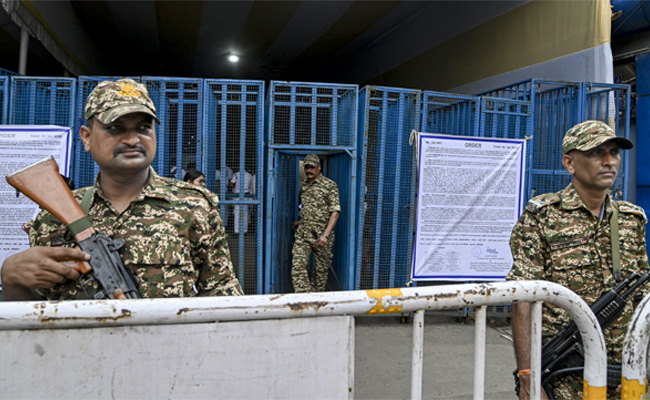
Counting of votes will take place across 77 centres in the state, with elaborate security arrangements and a charged political atmosphere setting the stage for the declaration of results in 293 of the 294-seat House.
The Election Commission countermanded polls in the entire Falta constituency in South 24 Parganas district, citing “severe electoral offences and subversion of democratic process during polling in a large number of polling stations”.
ALSO READ: SC to hear on May 4 PIL seeking stringent guidelines for issuing Aadhaar to adolescents, adults
The fresh poll in that seat and the counting will take place on May 21 and May 24, respectively.
The two-phase polls in the state ended on April 29, with what the election watchdog said was the state's highest-ever voter turnout of 92.47 per cent since Independence.
Repolling in 15 booths in South 24 Parganas concluded on Saturday, with around 87 per cent turnout recorded, officials said.
The state’s political climate bordered on the vicious, even after the conclusion of polls, leading to fervent anticipation ahead of the announcement of results, with both primary contenders TMC and BJP, claiming they were dead certain about their victory prospects.
Courtesy the tight security arrangements – with over 2.5 lakh central paramilitary personnel on the ground, besides the presence of a thoroughly reshuffled state police force – electoral violence remained at a minimum, and no deaths were reported for the first time in the state’s election history of recent decades.
This was also the first election held in the state in twenty years, conducted after an extensive, albeit controversial, SIR exercise that revised the electoral rolls, removing over 9 million voters.
The jury is out on the impact of the exercise on the electoral fortunes of all parties across the board, prompting pollsters to burn the midnight oil to make sense of the likely choice of voters and keeping the public greatly enthused about what verdict the result day would deliver.
The campaigns recorded the BJP unleashing its full might, with top leaders like Prime Minister Narendra Modi, Union Home Minister Amit Shah and Defence Minister Rajnath Singh launching all-out attacks on the TMC over corruption, law and order, infiltration, women’s safety and unemployment, while promising welfare measures.
The TMC’s retaliation, with the CM and party MP Abhishek Banerjee leading the charge, focused on SIR harassment, Bengali persecution and ‘outsider’ plank, accusing the BJP of failing to deliver on its national commitments and upholding TMC’s development report card.
Polling for the elections was held on April 23 and April 29, with a total electorate of over 3.21 crores.
The poll body has scaled down the number of counting centres this year to 77 from 87 announced earlier, and 108 in 2021, while putting in place a multi-layered security grid.
“Comprehensive security arrangements have been made to ensure that counting is conducted in a peaceful, transparent and orderly manner,” a senior EC official said.
The run-up to counting, however, has been marked by high political drama, with TMC leaders, helmed by CM Mamata Banerjee, rushing to strongrooms in Kolkata, apprehending counting malpractice and alleging attempts to tamper with the sealed EVMs.
The EC rejected those allegations, maintaining that all electronic voting machines are kept under strict surveillance with round-the-clock security and CCTV monitoring.
“Strongrooms are secured under a three-tier security system, and candidates or their representatives are allowed to keep watch as per protocol. There is no scope for any tampering,” another poll panel official said.
Closer to the counting date, security outside strongrooms has been further tightened, with the EC deploying 165 additional counting observers and 77 police observers to oversee the process and ensure adherence to norms.
In Kolkata, counting for 11 assembly constituencies will be conducted across five locations - Ballygunge Government High School, Baba Saheb Ambedkar Education University, Shakhawat Memorial School, Netaji Indoor Stadium and St Thomas Boys’ School.
Counting for the Bhabanipur seat, arguably carrying the highest symbolic weight where Mamata Banerjee is taking on senior BJP leader Suvendu Adhikari in a prestige fight on her home turf, will be held at the Sakhawat Memorial centre.
The EC has introduced stringent access control measures, mandating entry only through QR code-based photo identity cards issued via its ECINet system. Mobile phones have been barred inside counting halls, except for returning officers and observers.
The counting exercise will be conducted under a framework upheld by the Supreme Court, which on Saturday declined to pass further directions on a TMC plea challenging the deployment of central government personnel.
The elections saw the TMC contesting in 291 seats and its ally Bharatiya Gorkha Prajatantrik Morcha (BGPM), led by Anit Thapa, fielding candidates in three seats in the Darjeeling hills.
The BJP, Congress and the Left Front are gunning for all 294 segments, with parties like Humayun Kabir’s AJUP and Asaduddin Owasi’s AIMIM also trying their luck in some crucial pockets.
BJP leaders like Dilip Ghosh, Agnimitra Paul, Roopa Ganguly and Nishit Pramanik are in the fray, while prominent TMC candidates include Firhad Hakim, Kunal Ghosh, Madan Mitra and Udayan Guha.